Hi Tom
But Bill called out a 4 pole motor. Most of what I have seen are simple
single coil clocks.
Wondering how his comment changes the discussion.
But Bill actually didn't ask for a driver circuit just the divider ratio.
Regards
Paul
On Fri, Sep 11, 2020 at 6:43 PM Tom Van Baak <[email protected]> wrote:

> Paul,
>
> I'll open the Omega Quartz Chronometer and trace the circuit if you're
> curious. Many of these 70's stepper / analog clocks used Patek Philippe
> movements, the classic one you see in vintage Austron, Tracor, Sulzer,
> and, of course, hp time / frequency standards with the /001 clock option
> (e.g., 5061A, 5065A).
>
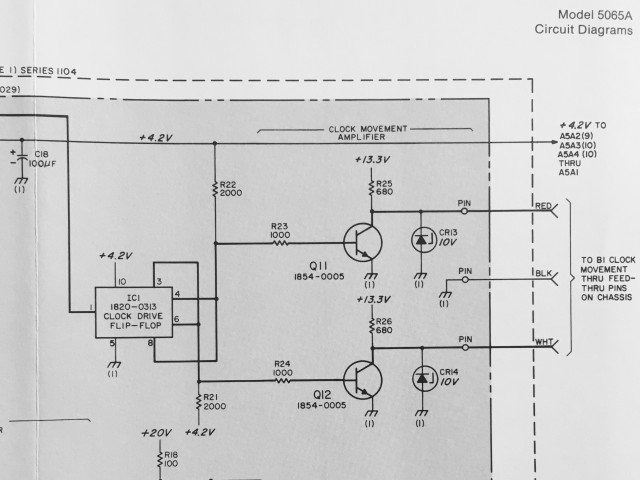
> Yes, the drive circuit for the hp 5065A analog clock has a final
> flip-flop on the A16 board:
>
> http://leapsecond.com/museum/patek/hp5065A-A16-Patek.jpg
>
> The 5065A manual says: "1 PPS drive pulses connect from A5 Digital
> Divider through J1 to IC1 of the clock movement amplifier.
>   IC1 provides flip-flop action and furnishes a push-pull output to
> clock amplifiers Q11 and Q12. The push-pull output of power amplifiers
> Q11 and [Q?] A12 connects to the front panel clock and is limited to 10
> V peak by zener diodes CR13 and CR14."
>
> More eye candy:
>
> http://leapsecond.com/museum/patek/
>
> /tvb
>
>
> On 9/11/2020 2:50 PM, paul swed wrote:
> > I went looking for the clock and found nothing. But like the rest
> > discovered the divider ratio to 1Hz. But does the conversation stop at
> that
> > point? Since Bill said the motor was 4 pole wouldn't there be 1 more
> > divider to .5 Hz with the Q and /Q essentially across the coil. Add
> > protection diodes and such.
> > It  looks like the Omega timepieces were quite nice.
> > regards
> > Paul
> > WB8TSL
> >
> > On Fri, Sep 11, 2020 at 3:59 PM Graham / KE9H <[email protected]>
> wrote:
> >
> >> 2^22 = 4,194,304
> >> So divide by two, 22 times in a row to get to 1 Hz.
> >> --- Graham
> >>
> >>
> >> On Fri, Sep 11, 2020 at 12:42 PM Bill S <[email protected]> wrote:
> >>
> >>> A friend has acquired a Chelsea Clock Company Chronoquartz which was
> >>> probably made in the 70's. He has measured the oscillator frequency at
> >>> approximately 4.194304 MHz. He wanted to know what arrangement of
> >>> dividers they used to run the 4 pole stepper motor to step seconds.
> >>> Anybody know?
> >>>
> >>> Thanks,
> >>>
> >>> Bill_S
> >>>
> >>> _______________________________________________
> >>> time-nuts mailing list -- [email protected]
> >>> To unsubscribe, go to
> >>> http://lists.febo.com/mailman/listinfo/time-nuts_lists.febo.com
> >>> and follow the instructions there.
> >>>
> >> _______________________________________________
> >> time-nuts mailing list -- [email protected]
> >> To unsubscribe, go to
> >> http://lists.febo.com/mailman/listinfo/time-nuts_lists.febo.com
> >> and follow the instructions there.
> >>
> > _______________________________________________
> > time-nuts mailing list -- [email protected]
> > To unsubscribe, go to
> http://lists.febo.com/mailman/listinfo/time-nuts_lists.febo.com
> > and follow the instructions there.
> >
>
>
> _______________________________________________
> time-nuts mailing list -- [email protected]
> To unsubscribe, go to
> http://lists.febo.com/mailman/listinfo/time-nuts_lists.febo.com
> and follow the instructions there.
>
_______________________________________________
time-nuts mailing list -- [email protected]
To unsubscribe, go to
http://lists.febo.com/mailman/listinfo/time-nuts_lists.febo.com
and follow the instructions there.