Andy G4JNT,
> And I wouldn't trust integration over such extended periods to derive
timing error.
Exactly right. Always measure phase and derive frequency, frequency at
your chosen tau.
----

There are several ways to monitor mains phase:
1) Use a ZCD, convert to digital, divide by 50, and then time the 1PPS
using existing time nuts methods; either period or time interval or
timestamp. A calibrated OCXO is sufficient; you don't need to resort to
Rb or Cs or GPS for this application, but a GPSDO is convenient. You get
one sample every *mains second*.
2) Use a dual channel ADC to capture mains and a 90 degree delayed
mains. Trigger the ADC with a GPS/1PPS. Post-process the data with atan2
to obtain mains phase and frequency. You get one sample every *UTC second*.
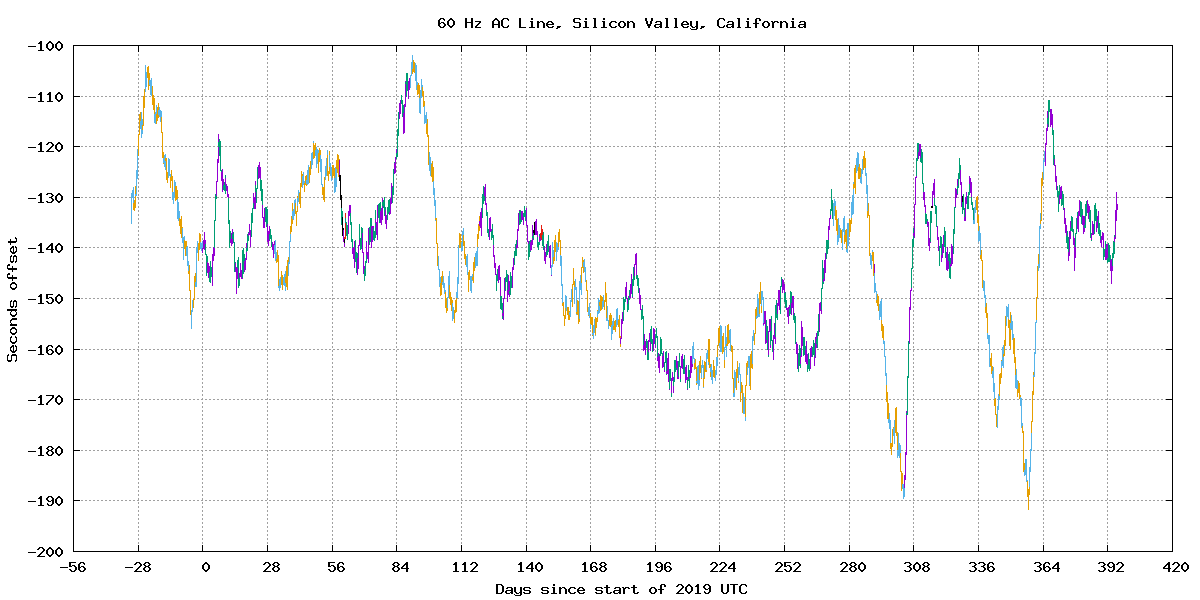
3) Use a ZCD, count cycles using a PC running NTP. Snapshot the cycle
counter and PC precise time every 10 seconds. You get one sample every
10 *UTC seconds*. In the US each sample typically covers 599, 600, or
601 cycles. Ask Hal Murray for details. Example:
https://users.megapathdsl.net/~hmurray/time-nuts/60Hz/60Hz-2019.png
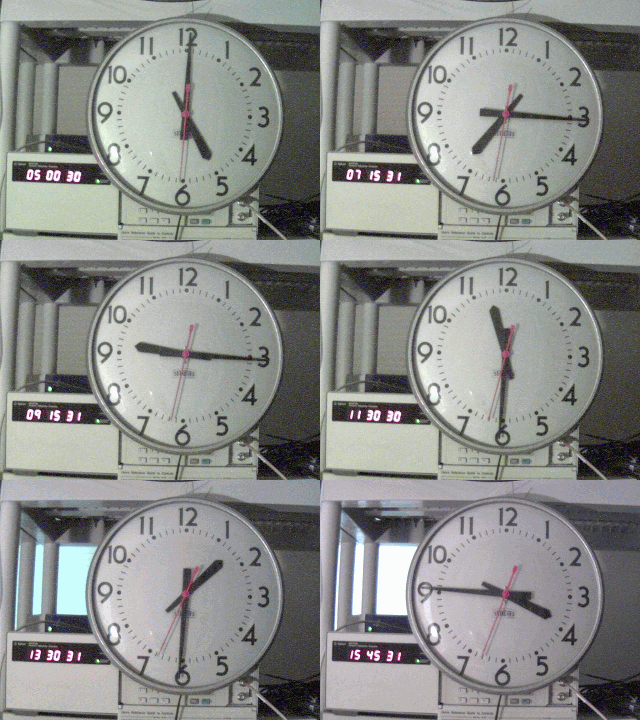
4) Synchronize a mains "kitchen" clock and let it run. Take a photo of
it exactly every 15 minutes or an hour. Example:
http://leapsecond.com/pages/tec/mains-clock-ani.gif
5) Use a transformer to step down mains to a few volts, skip the ZCD and
divider, and drive a 10 MHz picPET (or equivalent). You will get one
sample per cycle. That's a couple million per day. PC's are fast, it's
easy to reduce the data. Example:
http://leapsecond.com/pic/
http://leapsecond.com/pic/pp06.htm

----
All methods should give you identical plots. In fact, if this is your
first time with mains phase, I recommend you use two independent methods
(because it's easy to make errors when timing mains). Alternatively,
find someone in your grid who is also measuring phase and compare your
data to theirs. I've done that here in Washington against Hal in
California and Kevin in New Mexico. Though thousands of miles apart our
results agree to the microsecond because we are on the same US West
grid. For this data I used a picPET. See:
http://leapsecond.com/pages/mains-cv/

Finally, here are some older time nuts threads with additional info:

"[time-nuts] Building a mains frequency monitor"
https://www.febo.com/pipermail/time-nuts/2016-April/097091.html

"[time-nuts] Recommendations for Mains Power Monitor / Logger"
https://www.febo.com/pipermail/time-nuts/2018-March/109360.html

/tvb


On 2/21/2021 3:02 AM, Andy Talbot wrote:
Since building my real time mains monitor, I've noticed just how far the
mains timing drifts, for days at a time.   Friday evening last week (10
days ago)  timing was running at [plus] +50 seconds, and was slowly dragged
back over the weekend to about +7s on teh Monday.  Over the week it wobbled
around, but on a slow downward trend.  By Friday evening (2 days ago) it
was -17s  and I watched it drop further.  Now, Sunday morning, it is -56
seconds

So in the space of eleven days the mains timing has drifted a total of
nearly two minutes.

There doesn't seem to be, anywhere,   a long term record of mains timing
error.  You can download frequency from the Gridwatch site, but not
timing.   And I wouldn't trust integration over such extended periods to
derive timing error.
perhaps it's time to add a serial output to my monitor and couple up an old
obsolete laptop

Andy
www.g4jnt.com
_______________________________________________
time-nuts mailing list -- [email protected]
To unsubscribe, go to
http://lists.febo.com/mailman/listinfo/time-nuts_lists.febo.com
and follow the instructions there.
_______________________________________________
time-nuts mailing list -- [email protected]
To unsubscribe, go to
http://lists.febo.com/mailman/listinfo/time-nuts_lists.febo.com
and follow the instructions there.