Hi

Even back when they were new, most of these devices got swapped out rather
than repaired. The cost to the manufacturer to do a repair that finds everything
was simply to high.
Bob

> On Jun 17, 2021, at 11:32 AM, Jeremy Elson <[email protected]> wrote:
>
> After taking the cover off the bad LPRO I finally found the calibration pot
> and realized why I hadn't seen it before: the hole in the case that allows
> access to the pot was covered by a calibration sticker.
>
> However, turning it seemed to have no effect at all on the frequency. I
> wonder if the unit is just broken.
>
> Is there anywhere I can send the thing for repair?
>
>
> On Thu, Jun 17, 2021 at 4:20 AM Pluess, Tobias <[email protected]> wrote:
>
>> Hi Jeremy
>>
>> when buying LPROs from eBay, be careful! I did this twice and I bought it
>> from the same seller. However, one of the "LPROs" I got is actually not an
>> LPRO but an SLCR-101. I have not found much information about this, but it
>> appears to be a cheaper version of the LPRO.
>>
>> As far as I know, some of the LPROs have a small hole in the case where you
>> can insert a really small screwdriver and adjust some internal
>> potentiometers, but not all LPROs have this. Mine has this little hole.
>> The SLCR does not have an adjustment hole. You have to open the case to
>> adjust things.
>>
>> Best
>> Tobias
>> HB9FSX
>>
>> On Thu, Jun 17, 2021 at 1:11 AM Jeremy Elson <[email protected]> wrote:
>>
>>> Fellow nuts,
>>>
>>> This week, I've been working more on my "$5 timestamper" based on the
>>> STM32G4 chip. I've finally been able to use it to get some nice results
>>> comparing the frequency of a couple of LPRO-101 rubidium frequency
>>> standards I have to SI seconds via a GPS receiver.
>>>
>>> My original email to this list on my new timestamper, in February, had a
>>> version of this experiment. Unfortunately it was flawed because there
>> were
>>> still some bugs in the analog front-end of my timestamper that I had not
>>> yet discovered. As a result, there were discontinuities in the timestamps
>>> when the clock line going into the timestamping chip had noise
>> (generating
>>> extra pulses) or wouldn't quite be high enough voltage to go over the
>>> chip's threshold (causing missed pulses). These have been fixed, as I
>>> reported in my second email on the timestamper (in April).
>>>
>>> I moved recently, and now that I have GPS set up in my new lab I was
>>> finally able to redo my February experiment to measure the frequency of
>> two
>>> LPRO-101 rubidium standards I bought on eBay for about $200 each. The
>>> seller ("test_tool") claimed to have calibrated both before sale.
>> However,
>>> I discovered the performance of one of them was almost two orders of
>>> magnitude better than the other. The test setup was:
>>>
>>> 1) The device-under-test (LPRO-101) was used as the 10mhz reference clock
>>> for my timestamping board.
>>>
>>> 2) An early eval board of a ublox M10 GNSS (EVK-M101) with a decent sky
>>> view, was configured to listen to 3 constellations (GPS, Galileo,
>> GLONASS).
>>> I did not use location surveying so the accuracy is probably less than it
>>> could have been but the reported 3D position was quite stable.
>>>
>>> 3) The PPS output of the uBlox M10 was attached to one of the
>> timestamper's
>>> input channels.
>>>
>>> I did this with two LPRO-101 units. The resolution of the timestamper is
>>> currently ~6ns, i.e. the inverse of the 170mhz clock speed of the chip.
>> (On
>>> my todo list is to create another revision of my board with the
>> higher-end
>>> STM32G4 chip that will get the timestamper resolution down to 184ps.) I
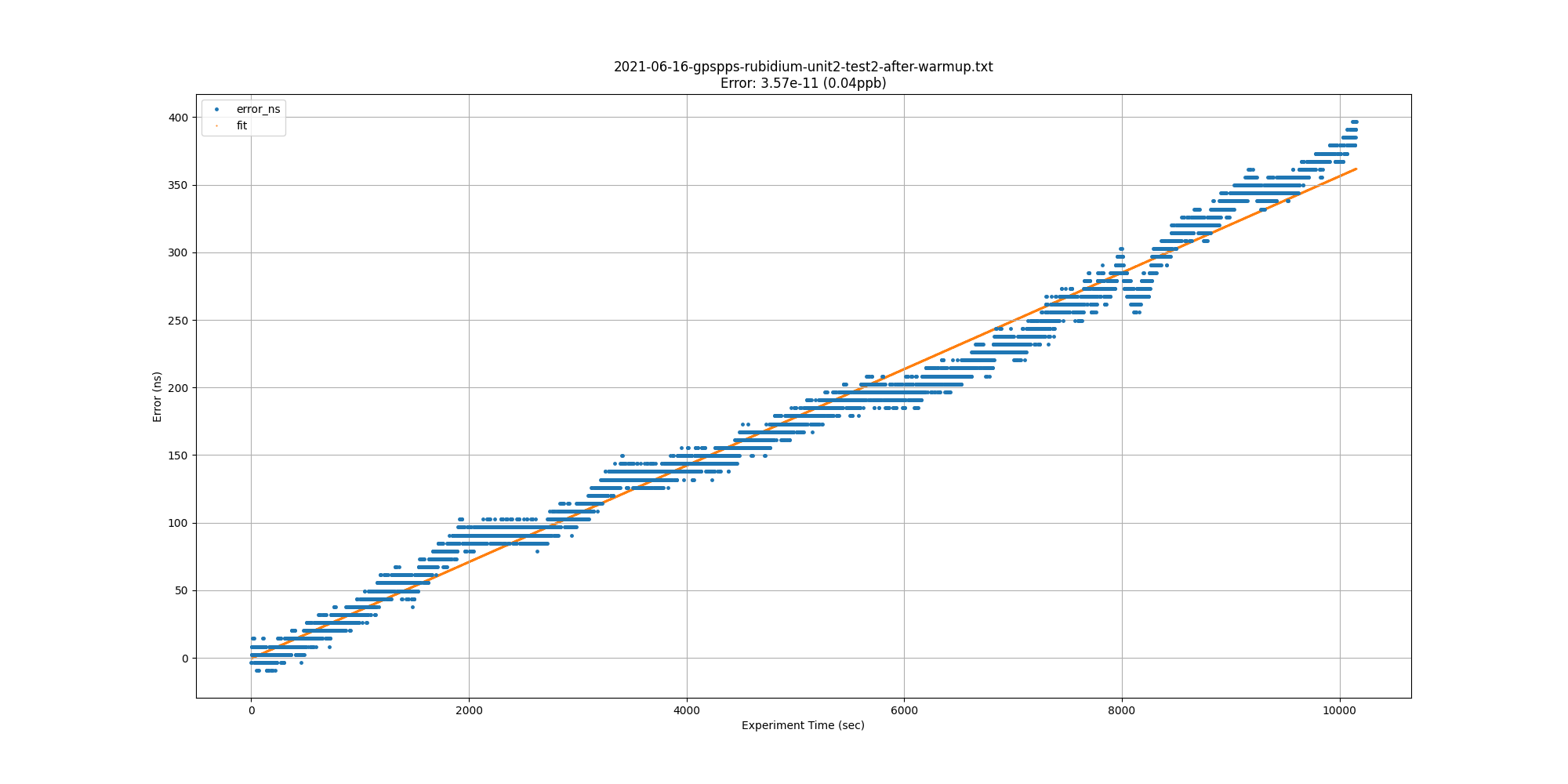
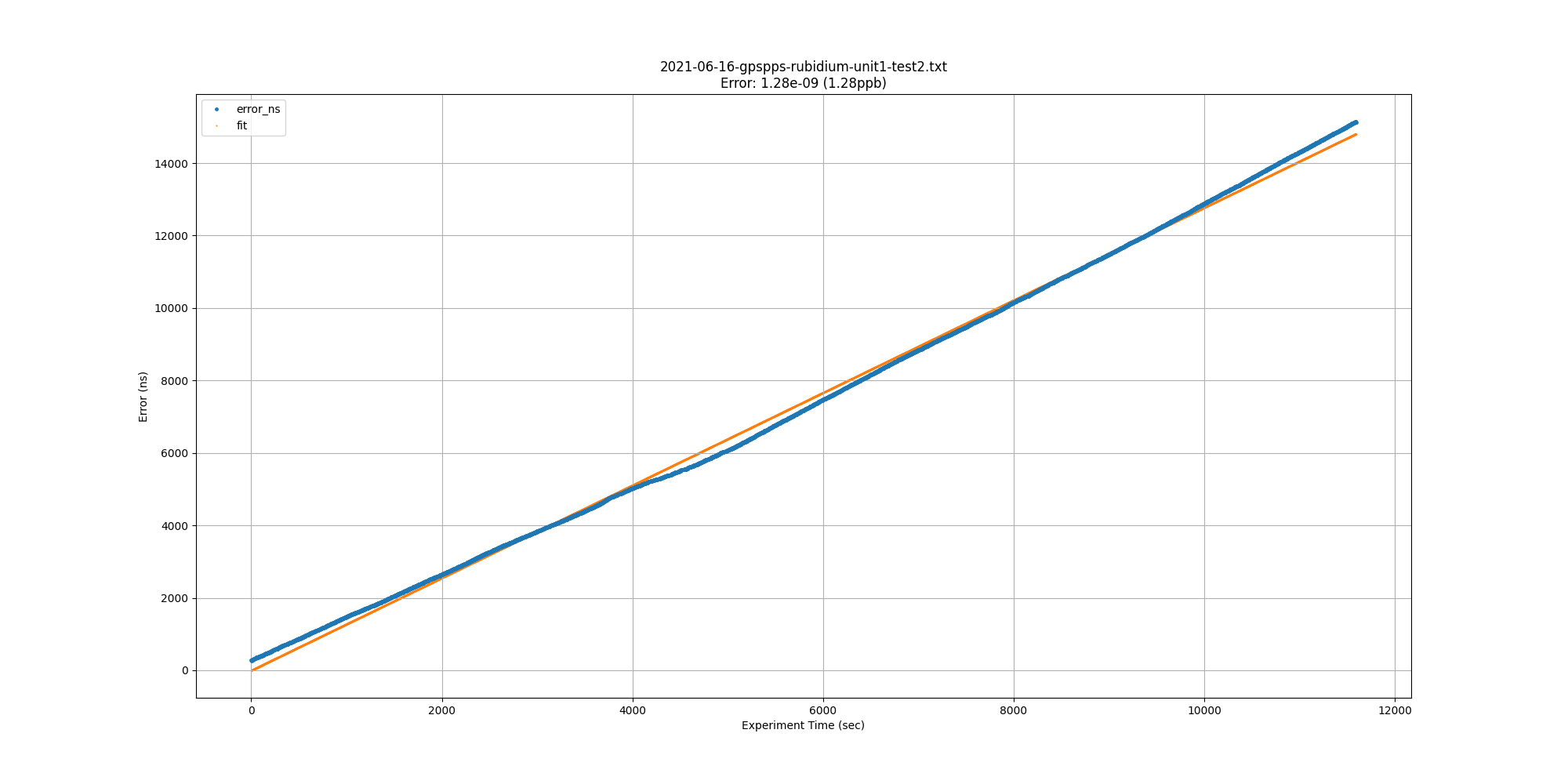
>>> plotted the error in the timestamps of the PPS signal with time, i.e. the
>>> x-axis is the time the experiment has been running in seconds; the y-axis
>>> is the difference between the actual timestamp and what the timestamp
>>> "should have been" if the timestamps were actually received exactly 1
>>> second apart. Ideally it would be a flat line indicating no frequency
>>> difference.
>>>
>>> The better of the two units showed a frequency error (t=10000s) of about
>>> 4e-11, which (as I understand it) is typical performance for an RbXO:
>>>
>>>
>>>
>> https://www.circlemud.org/jelson/time-graphs/2021-06-16-gpspps-rubidium-unit2-test2-after-warmup.txt.time.plot.png
>>>
>>> The other unit was about 20x worse, about 1e-9:
>>>
>>>
>>>
>> https://www.circlemud.org/jelson/time-graphs/2021-06-16-gpspps-rubidium-unit1-test2.txt.time.plot.png
>>>
>>> I'm very pleased with the performance of my timestamper, which seems to
>> be
>>> working perfectly, and I look forward to getting it "cooked" enough to be
>>> able to share with all of you.
>>>
>>> I'm less pleased with the performance of one of the frequency standards,
>>> which leads me to my question: has anyone calibrated one of these things
>>> before? The manual I found online says I should be able to turn a
>>> calibration screw on the cover, but the units I have don't seem to have
>> any
>>> exposed screws!
>>>
>>> Regards,
>>> -Jeremy
>>>
>>> PS: If needed, the raw data behind the two graphs below is here:
>>>
>>>
>>>
>> https://www.circlemud.org/jelson/time-graphs/2021-06-16-gpspps-rubidium-unit1-test2.txt
>>>
>>>
>>>
>> https://www.circlemud.org/jelson/time-graphs/2021-06-16-gpspps-rubidium-unit2-test2-after-warmup.txt
>>> _______________________________________________
>>> time-nuts mailing list -- [email protected] -- To unsubscribe
>> send
>>> an email to [email protected]
>>> To unsubscribe, go to and follow the instructions there.
>>>
>> _______________________________________________
>> time-nuts mailing list -- [email protected] -- To unsubscribe send
>> an email to [email protected]
>> To unsubscribe, go to and follow the instructions there.
>>
> _______________________________________________
> time-nuts mailing list -- [email protected] -- To unsubscribe send an
> email to [email protected]
> To unsubscribe, go to and follow the instructions there.
_______________________________________________
time-nuts mailing list -- [email protected] -- To unsubscribe send an
email to [email protected]
To unsubscribe, go to and follow the instructions there.