On Sat, 25 Dec 2021 15:27:51 -0800
Hal Murray <[email protected]> wrote:
> How good are cell phones?  I remember comments about them being way off.  But
> that was a long time ago.

Cellphone network time distribution is something rather new
and didn't exist until EDGE (or was it HSDPA?) came along.
But once it was available, it was "good enough", i.e. the
time offset was low enough to be not perceivable (~100ms).
At least in Europe.

I know from other countries, that back in 2005, network time
was off by a few minutes. This has probably improved now, because
UMTS requires the cells to be synchronized to UTC to within
a few 10s of µs. (I don't remember the details, Magnus can
provide a more accurate picture) And by already having accurate
time in the network, providing that to the cellphones is easy
and the obvious way to go about.


> If I was doing it now, I would probably setup one of the battery powered
> clocks that listens to WWVB.  When were they first widely available?

Hmm... Let me give you a quick history of how time aquisition
evolved through the eyes of a fledgling time-nut :-)

Disclaimer: This is how I experienced things as I grew up in
Switzerland. It was probably quite similar throughout western
Europe, but I didn't travel enough until early/mid 90s to say
anything beyond the countries I visited regularly. Not to
mention that a toddler who can't read a watch wasn't much
interested in how to get accurate time in the first place...
That said, Swiss were and still are quite a bit more obsessed
with time than the rest of Europe. So my view might be a bit
skewed.

In the 80s virtually all watches and clocks were quartz movements.
I.e. they kept time accurately enough for most things. There were
still some mechanical watches around, but they were mostly a
thing of the past and kind of a fashion statement... Or a watch
gifted by a relative decades ago. Most people set their watches
at least every 6 months, when dailight saving switched. I had
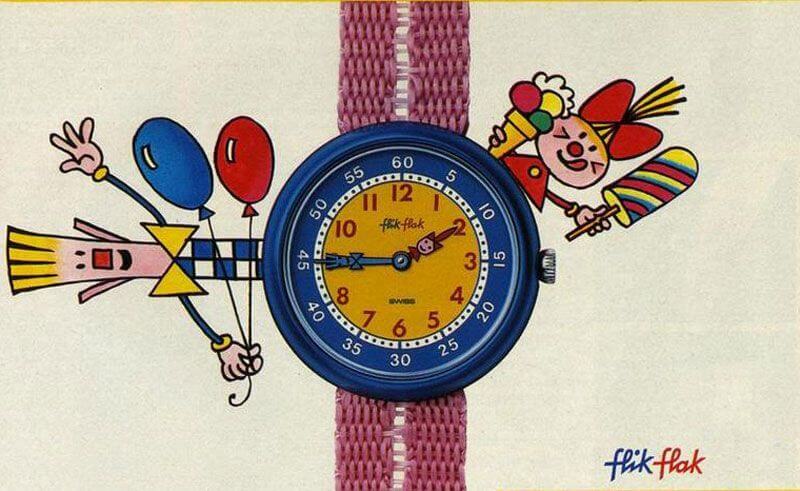
(and lost) a Swatch Flick Flak (
https://www.newlyswissed.com/wp-content/uploads/2015/08/Flik-Flak.jpg ),
two Pop Swatch ( https://www.uhrenkosmos.com/30-jahre-pop-swatch/ )
and two Tissot Two-timer (pretty much this model
https://watchcharts.com/listing/1084976/tissot-twotimer-timer-analog-digital-watch
 ).
as my watches as a kid during kindergarten and elementary school.
The Tissot I used until I broke its wristband holder a week before
I graduated from high-school, which had a pretty deep gouge in the
glass through the whole watch face when I fell on some gravel path
in 4th grade.

None of these watches were special for a child in Switzerland.
Even the Tissot Two-timer, which was IIRC CHF 80-100 back in
the late 80s (probably around 200 USD in today's money), was a
relatively common watch to have as an elementary/middle school
student. And even a first grade student was expected to have
some form of a watch, either on his wrist or in his pocket.
And that, even though there was a clock somewhere in sight virtually
everywhere in Switzerland  as there were plenty of watch/clock shops
and a lot of stores had a clock somewhere around the entrance.

The way to get time was usually TV and radio broadcast or church
bell towers. One popular way was to adjust to the beep at the
start of the news, which was always scheduled at fixed time
(usually the start of the hour).

But using Teletext ( https://en.wikipedia.org/wiki/Teletext )
was more common, whenever a TV was available, as it offered to
have time without waiting for a special program and could be
read with sub-seconds accuracy. What was a bit weird, now that
I think back, is that different TV stations had slightly
different times. Usually just a few seconds, but enough to
be noticable. I usually set my watch whenever I noticed that
it was off more than 30-60 seconds (usually because I would
start missing the bus). Which was, if I remember correctly,
every 3-4 months with the Tissot.

The clocks of churches and schools were, in the 80s, already
synched up to HBG or DCF77, though I did not know that back then.
I just saw the big blinkenlights that would control the clocks
and would wonder why they were so big. :-)

In the late 80s, DCF77 alarm clocks became cheap and very common.
And we started using them as a quick reference instead of the TV.
They also had the advantage of always showing the time, which made
checking the accuracy of one's watch kind of an automatic and
regularly performed movement. Their range was quite impressive too.
I once took one to Turkey and it would still sync up during the
night. (I completely forgot that I left it there with a relative
until it turned up a few years ago, still working).

In the late 90s, early 2000s, the internet became more ubiquitous
and people started to use NTP to sync their computers and then
set their watches according to their computers. At least those
of us who were using Unix/Linux. It would take another couple
of years, until Windows would offer something similar out of
the box, though it would take IIRC until Windows Vista for it
to be accurate for better than 10 seconds (which lead to interesting
effects when using concurent document editing through Active
Directory). Also around the same time, everyone and their dog started
to have a cell phone. While at first one had to manualy set the
time (the same way as a watch), at some point in the first half
of the 2000s, the cellphone network started to provide time.

Today, for most people, their cellphone is the thing that provides
them with accurate time to which they set ther watches and clocks.

For me, my main clock source is NTP, for the most part. At least
for everything that is networked. I do have a GPSDO that provides
me with an accurate PPS for my time-nutty needs, but that is only
used within my home network and for measurement. I set my watches
twice a year, when I have to adjust them for daylight savings,
by which time they are usually off by less than 10s. (Modern
quartz watches are amazing!)

                        Attila Kinali

--
The driving force behind research is the question: "Why?"
There are things we don't understand and things we always
wonder about. And that's why we do research.
                -- Kobayashi Makoto
_______________________________________________
time-nuts mailing list -- [email protected] -- To unsubscribe send an
email to [email protected]
To unsubscribe, go to and follow the instructions there.