Bob,
Many thanks for the guidance you provide and the phase noise measurement
document.
Can you provide feedback on this reasoning: A counter is like an ADC but
in the frequency domain. So if you measure with 0.01 s tau you basically
average over 0.01 s so you can only observe "phase noise" (e.g. energy
that is not at the exact requested frequency) up to maximum 50 Hz from
the carrier. But as you measure the true frequency changes the
sensitivity of this measurement is extremely high. Translating the
amount of time spend at a certain frequency away from the carrier
(ADEV?) into a phase noise number in dBc is something I do not yet
understand.
With a (very good) spectrum analyzer you may be able to come close to
the carrier but as there is so much energy in the carrier it will be
difficult to observe phase noise energy closer than say 1 or 10 kHz (at
least not with the equipment I can afford) so any phase noise plot
created using a spectrum analyzer can not be better than the combined
phase noise of all LO's in the spectrum analyzer and will start at say 1
or 10 kHz.
For the frequencies between 50 Hz and 20 kHz the simplest option is to
use a second LO and a mixer and a slow (loop BW below 10 Hz)PLL to keep
the mixer in quadrature and feed the output of the mixer, after low pass
filtering, into a PC soundcard for FFT processing.
Erik.
On 19-6-2022 22:45, Bob kb8tq via time-nuts wrote:
Hi

As HP found out back around 1973 or so, translating ADEV to phase noise
is not possible. This is true, even if you have the ADEV numbers for a variety
of Tau values as opposed to some sort of “average” kind of number.

There are a number of things ( like spurs ) that can strongly influence a
counter
based ADEV reading, and have very little impact on a phase noise ( or signal to
noise reading.  There also are ways the shape of the phase noise curve can
impact ADEV and have very little signal to noise impact for a specific signal.

By far the best way to do this is to properly measure phase noise at various
offsets from carrier. You can then look at the dbc/Hz numbers at each offset.
This lets you see what your devices are doing to the signal. You can then track
down the offending bit or piece and fix the problem.

The easiest way I know of to do phase noise is to quadrature lock two identical
sources into a double balanced mixer. You then put in a simple amplifier stage
to drive the mix down output into a sound card or spectrum analyzer. Total cost
if you already have a sound card should be < $50 ( US dollars …) for a DIY
version.
That assumes you have the usual junk box parts and do a point to point wire
version.

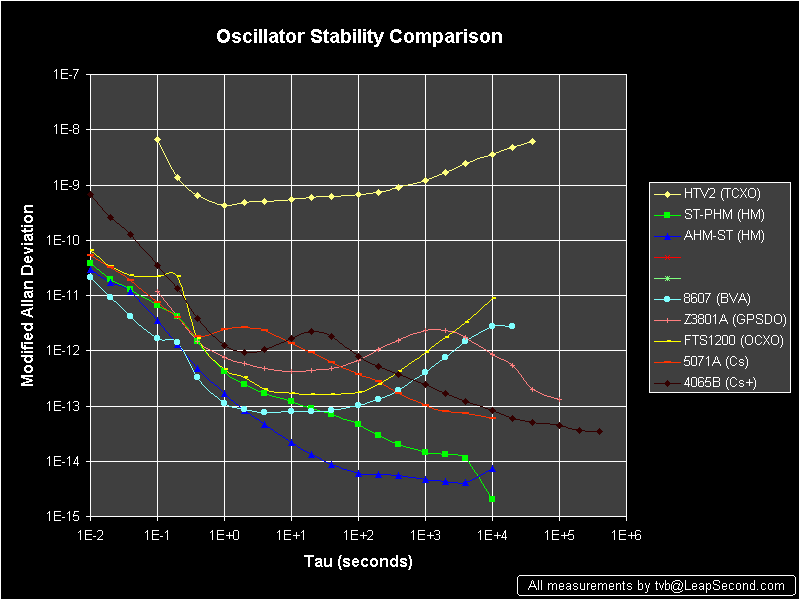
Some example ADEV plots:

http://leapsecond.com/museum/manyadev.gif
<http://leapsecond.com/museum/manyadev.gif>

http://leapsecond.com/museum/manyadev.gif
<http://leapsecond.com/museum/manyadev.gif>

Some plots of a number of measurements:

http://www.leapsecond.com/pages/fe405/ <http://www.leapsecond.com/pages/fe405/>

Quick primer on phase noise measurement

https://www.npl.co.uk/special-pages/guides/gpg68_noise
<https://www.npl.co.uk/special-pages/guides/gpg68_noise>

( The easy approach starts on page 21 :) )

Bob
On Jun 19, 2022, at 11:40 AM, Karen Tadevosyan via time-nuts
<[email protected]> wrote:

Hi


Thank you for the clarification and rf-tools link.


Agree with your calculation. That’s why I raised this question regarding a
fixing PN degradation by Pendulum CNT-91.


Could you please explain where is the error in my reasoning of the experiment :


*       There is one 10 MHz OCXO with ADEV = 5 mHz
*       There are two boards (DUT1 and DUT2) which multiply 10 MHz OCXO signal
by 2.5 using the PLL method
*       DUT1 has 25 MHz output signal with high PN  (checking by air and by
measurement of S/N)
*       DUT2 has 25 MHz  output signal with low PN  (checking by air and by
measurement of S/N)
Experiment’s steps:
*       Step 1: DUT1 ADEV measuring gives me a value of 60 - 70 mHz instead of
the expected 12.5 mHz  (5 mHz x 2.5)
*       Step 2: DUT2 ADEV measuring gives me a value of 10 - 12 mHz which
matches the expected 12.5 mHz  (5 mHz x 2.5)
*       Step 3: based on ADEV values which in the first case (DUT1) are much
greater than expected and in the second case (DUT2) coincide with the expected
I conclude that PN of the output signal from DUT2 will be lower than from DUT1.
I can see this PN degradation using Pendulum CNT-91 only as R&S FSQ8 does not
fixate any PN degradation between DUT1 and DUT2

Karen, ra3apw

_______________________________________________
time-nuts mailing list -- [email protected]
To unsubscribe send an email to [email protected]
_______________________________________________
time-nuts mailing list -- [email protected]
To unsubscribe send an email to [email protected]
_______________________________________________
time-nuts mailing list -- [email protected]
To unsubscribe send an email to [email protected]