I forgot to add:

It *is* magic.  :)
Retinal neuroanatomy is hard enough; retinal neurophysiology is insane.
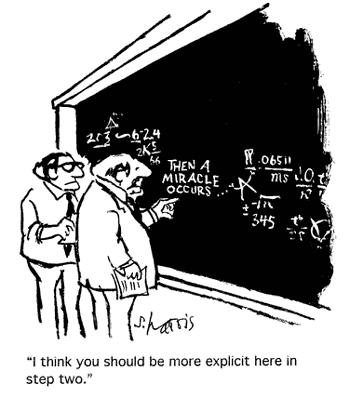
I am often reminded of this
<http://www.sciencecartoonsplus.com/gallery/math/math07.gif> cartoon.

Good luck!

m


------
"There is no power for change greater than a community discovering what
it cares about."
--
Margaret Wheatley

-----Original Message-----
From: DeVolder Carol L [mailto:[EMAIL PROTECTED]
Sent: Wednesday, October 10, 2007 11:39 AM
To: Teaching in the Psychological Sciences (TIPS)
Subject: RE: [tips] Sensation and Perception people--help please

Thanks, Marc. The site is very helpful and I'm feeling less frustrated.
Carol


Carol DeVolder, Ph.D.
Professor of Psychology
Chair, Department of Psychology
St. Ambrose University
Davenport, Iowa  52803

phone: 563-333-6482
e-mail: [EMAIL PROTECTED]


-----Original Message-----
From: Marc Carter [mailto:[EMAIL PROTECTED]
Sent: Tuesday, October 09, 2007 4:00 PM
To: Teaching in the Psychological Sciences (TIPS)
Subject: RE: [tips] Sensation and Perception people--help please


I'm rushing and have to leave, and I cannot say off the top of my head
what are the conditions under which each does what it does, but my
recollection is that they are two distinct types of bipolars.  I think
the bipolars representing on-center connections are depolarizing
(invaginating) bipolars and off-center connections are made with
hyperpolarizing (basal junction) bipolars.  Whether glutamate causes the
cell to hyper- or depolarize is a function of the kind of cell.

Try here <http://webvision.med.utah.edu/OPL2.html#horizontal> for an
explanation.  It's at the bottom of the page, and seems pretty sound, to
me.

m


------
"There is no power for change greater than a community discovering what
it cares about."
--
Margaret Wheatley


---

---