Oops, I was wrong. The article is in Perspectives on Psychological Science,
along with a response from Lieberman and others. It's a fascinating debate, and
I think that the dead salmon study makes the correlations in fMRI studies look
even fishier.
________________________________________
From: Bourgeois, Dr. Martin
Sent: Thursday, September 17, 2009 7:58 PM
To: Teaching in the Psychological Sciences (TIPS)
Subject: RE: [tips] Dead salmon detects human emotion

This is awesome, and it reminds me of a debate at the upcoming Society for
Experimental Social Psychology:

Puzzlingly High Correlations in Cognitive/Affective Neuroscience
 Matthew Lieberman, University of California at Los Angeles vs. Piotr
Winkielman, University of California, San Diego, with David Kenny as
moderator

The debate is organized around a paper that just came out in Current Directions
in Psychological Science (Piotr Winkielman is one of the authors), which argues
that the methods of a great many fMRI studies lead to spurious correlations
(the original title of the paper was Voodoo Correlations in Cognitive/Affective
Neuroscience) because researchers selectively define the brain regions of
interest after looking at the data.

________________________________________
From: [email protected] [[email protected]]
Sent: Thursday, September 17, 2009 6:08 PM
To: Teaching in the Psychological Sciences (TIPS)
Subject: [tips] Dead salmon detects human emotion

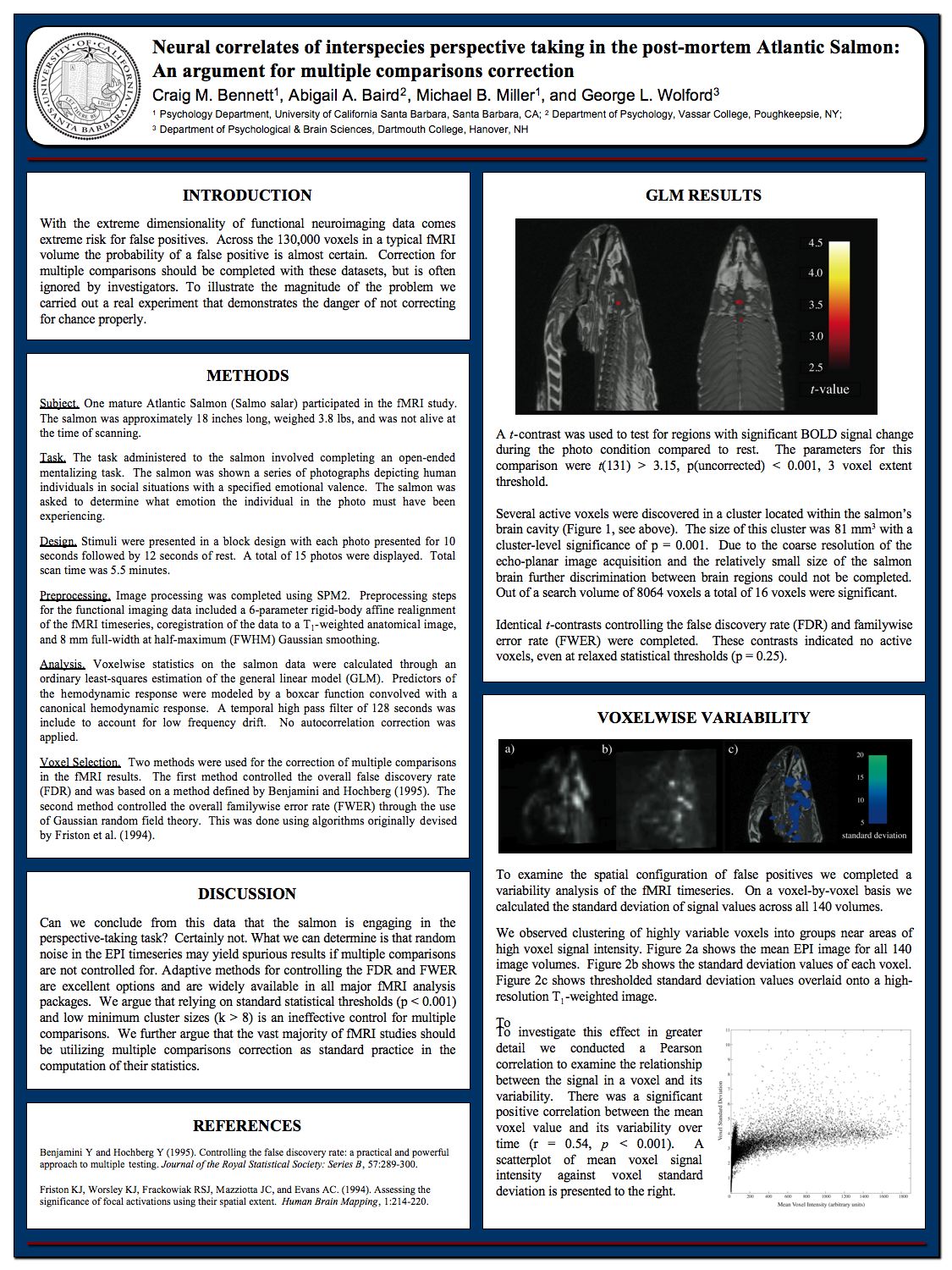
Remarkable new experiment, a fMRI study by Bennett et al
reported at the 15th annual meeting of the Organization for
Brain Mapping in June this year in San Francisco.

Meeting announcement at
http://www.meetingassistant3.com/OHBM2009/index.php

>From the Methods section of the abstract:

Subject: One mature Atlantic Salmon (Salmo salar) participated
in the fMR study. The salmon was...not alive at the time of
scanning.

Task: The task administered to the salmon involved completing
an open-ended mentalizing task. The salmon was shown a
series of photographs depicting human individuals in social
situations with a specified emotional valence. The salmon was
asked to determine what emotion the individual in the photo
must have been experiencing.

http://prefrontal.org/files/posters/Bennett-Salmon-2009.jpg
for the abstract of the poster presentation (the poster itself,
actually)

And if that doesn't make itself clear, try this:
http://tinyurl.com/mww9tj


Stephen

-----------------------------------------------------------------
Stephen L. Black, Ph.D.
Professor of Psychology, Emeritus
Bishop's University
 e-mail:  [email protected]
2600 College St.
Sherbrooke QC  J1M 1Z7
Canada
-----------------------------------------------------------------------

---
To make changes to your subscription contact:

Bill Southerly ([email protected])
---
To make changes to your subscription contact:

Bill Southerly ([email protected])
---
To make changes to your subscription contact:

Bill Southerly ([email protected])