Hi

By "earlier generations" I was not thinking of the time periods that Chris
mentioned, but rather about the last 50 years or so.  But even going back
further, as Chris did, I still suspect that opportunities for adult
interactions with kids are probably much greater today than in the past.  My
major point was that the impact of whether personal electronic devices are on
or off (the purpose of the study cited) needs to be considered in light of
major improvements in opportunities for adult-child interactions.
The following link, for example, shows that the length of the manufacturing
work week declined from 70 hours per week to 40 hours from 1840 to 1940 or so,
after which it stayed relatively flat.  There has therefore been, I assume, a
corresponding (in part at least) increase in opportunities for father-child
interactions.

http://www.preservenet.com/endgrowth/013-USWorkHours.gif

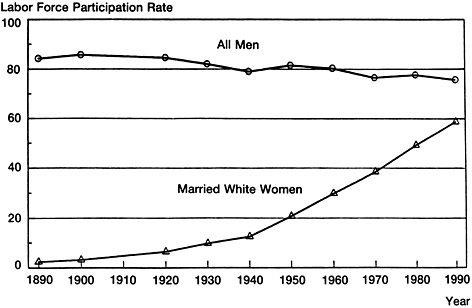
The story for mothers would be more complicated because some factors
(employment) would decrease opportunities for interaction and others (family
size) would increase opportunities.  There has been a marked increase in mother
employment of course ... see:

http://www.econlib.org/library/Enc1/art/fig05.jpg

At the same time, fertility rates and family size have declined dramatically.
Go to following site and click on play to see stats for many countries over
time.  I have set USA to show trail of change (if everything works properly ...
gapminder.org is a phenomenal site for graphs, some of which relate nicely to
psychology).

www.bit.ly/9c5wN1

I mention family size because the smaller the family the greater the
opportunity for parents to have single-child interactions.

Finally, I started above with adult-child interactions because many of today's
kids are in fact spending considerable time with non-parental caregivers,
either other relatives or professionals.  One would hope the professionals are
not on their cell phones while caring for the kids!

Subjectively, I also have the perhaps faulty impression that parent-child
interactions have changed for the better ... I've had 3 experiences, once as a
child in the 50s (single mom with 4 kids, so perhaps idiosyncratic), once as a
parent in the 60/70s, and currently as a parent.  My main memory of my own
childhood is playing with friends outside or at the YMCA, and being told to
come home when it gets dark.  More parent time and interactions with my first
son than I remember during my childhood, and even more parent time and
interactions with the current son.  Such anecdotes are pretty feeble evidence,
but I was unable to find anything stronger that provides historical evidence.
Perhaps others know of something that would quantify experiences like Beth
referred to (e.g., helping parents).

Partly I responded this way because one hears so much today about parents being
over-involved in their kids lives (helicopter parents) and then along comes
this concern about lack of interaction because of personal electronics (there
are similar concerns expressed about effects of television being off and on,
which also impacts parent-child interaction).   We need to keep in mind I think
the massive societal changes to which humans have adapted (we hope
effectively?) in thinking about effects like those reported here.

Finally ... I do not text and hardly ever even use my cell phone (for
"emergency" purposes primarily) and I certainly do not advocate that parents
should ignore their kids until bitten, as in one example given in the article.

Take care
Jim

James M. Clark
Professor of Psychology
204-786-9757
204-774-4134 Fax
[email protected]

>>> "Christopher D. Green" <[email protected]> 10-Jun-10 9:42:24 AM >>>
Jim Clark wrote:
> Hi
>
> It is amazing that earlier generations of children survived with daddy at
> work from morning to night and mommy slaving away in the kitchen and rest of
> the house to keep the home fires burning!  Is it not probably the case that
> children today generally have far more contact with their parents than was
> historically true?

I agree that we often make too much of technology, but I think your
"historical" remark is way off base. Until the 1940s, most mothers
stayed at home with their children, and those mothers who worked out of
the home often took their children to work with them (necessitating
child labor laws). In addition, there was no universal public education
for most until the mid-late 19th century (depending on where one lived),
and farm kids from a young age did chores around the farm with their
parents. As late as 1900, only 40% of the US population (and far less of
the world population) lived a rural life.

http://www.google.ca/search?hl=en&client=firefox-a&hs=NC4&rls=org.mozilla%3Aen-US%3Aofficial&tbs=tl%3A1&q=history+urban+population+US&aq=f&aqi=&aql=&oq=&gs_rfai=


Chris
--

Christopher D. Green
Department of Psychology
York University
Toronto, ON M3J 1P3
Canada


416-736-2100 ex. 66164
[email protected]
http://www.yorku.ca/christo/

==========================


---
You are currently subscribed to tips as: [email protected].
To unsubscribe click here:
http://fsulist.frostburg.edu/u?id=13251.645f86b5cec4da0a56ffea7a891720c9&n=T&l=tips&o=3010

or send a blank email to
leave-3010-13251.645f86b5cec4da0a56ffea7a89172...@fsulist.frostburg.edu

---
You are currently subscribed to tips as: [email protected].
To unsubscribe click here:
http://fsulist.frostburg.edu/u?id=13090.68da6e6e5325aa33287ff385b70df5d5&n=T&l=tips&o=3014
or send a blank email to
leave-3014-13090.68da6e6e5325aa33287ff385b70df...@fsulist.frostburg.edu