Here is a follow-up on Chris's response. It may be more than your students
want to know, though.
http://www.scientificamerican.com/article/seeing-forbidden-colors/
Carol

On Mon, Nov 3, 2014 at 8:07 AM, Christopher Green <[email protected]> wrote:

>
>
>
>
>
>
> What is the question, exactly? Yes, negative after images go to their
> opposites — each primary becomes a secondary, and vice versa. When the
> student says “the red-green opposite we were taught,” does s/he mean taught
> in your class or just “taught” by her past. Lots of people say that red and
> green are opposites, but it is important to remember that there is a lot of
> “slippage” in color-naming. In particular, “magenta” and “cyan” are not
> words commonly used in colloquial language and so nearby primary names are
> often substituted.
>
> In addition, when kids are taught colour mixing, it is often with pigments
> rather than light, and so it is subtractive mixing they are taught rather
> than additive mixing (which is why “everyone” comes to perception class
> thinking that mixing “blue” and “yellow” results in  “green” — which they
> do, subtractively). The additive primaries are identical to the subtractive
> secondaries, and vice versa. BUT, no one ever calls the subtractive
> primaries “cyan," “magenta," and “yellow." They are always called “blue,"
> “red," and “yellow." There is lots more to this topic, but I don’t want to
> bore everyone here. Write me off line if you would like to not more about
> the relation between additive and subtractive mixing.
>
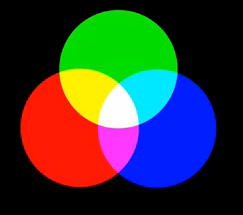
> Images like the one above are rarely rendered exactly accurately. True
> additive primary red is a little more orange than people expect it to be
> (what North Americans think of a “pure” red actually has a bit of blue in
> it, a cultural convention that caused Japanese car makers all kinds of
> consternation when they first tried to sell red cars in the US). Also the
> additive primary blue appears to North American to be closer to violet
> (indeed, Helmholtz called it violet in his classic textbook on the topic).
>
> I hope this helps.
>
> Best,
> Chris
> …..
> Christopher D Green
> Department of Psychology
> York University
> Toronto, ON M3J 1P3
> Canada
>
> [email protected]
> http://www.yorku.ca/christo
> ………………………………...
>
> On Nov 2, 2014, at 1:09 PM, Carla Grayson <[email protected]> wrote:
>
>
>
>
> A student sent me this email and I don't have a response. Can somebody
> help me?
>
> When you did the negative color afterimage demonstration in class on
> Tuesday, I looked at the cross in the middle of the four eagles. The blue
> and yellow swapped like I thought they would, but red became cyan and green
> became magenta. They went to their color opposite instead of the "red
> green" opposite we were taught.
>
> I also did a negative afterimage with this image
> http://2.bp.blogspot.com/-bQvF9kxioDc/T-m6569bd6I/AAAAAAAADP4/9yl0NLP1G5Q/s400/red-green-blue-light-make-white.png
>
> Red, green, and blue turned into cyan, magenta, and yellow respectively
> (on a white piece of paper) but the green was much stronger than the red,
> which was stronger than blue. Is there a reason why some of these
> afterimages show up more strongly?
>
> Lastly, by focusing on the boundaries of the images I can imagine that
> there are only three circles, each with its own filter. When I do this, I
> can no longer see the cyan, magenta, yellow, or white parts of the image
> and this is easier to do when my eye is unfocused. Do you know the
> cognitive explanation for this?
>
> Thanks,
> Carla Grayson
> ([email protected])
> University of Michigan
>
> ---
>
> You are currently subscribed to tips as: [email protected].
>
> To unsubscribe click here:
> http://fsulist.frostburg.edu/u?id=430248.781165b5ef80a3cd2b14721caf62bd92&n=T&l=tips&o=39798
>
> (It may be necessary to cut and paste the above URL if the line is broken)
>
> or send a blank email to
> leave-39798-430248.781165b5ef80a3cd2b14721caf62b...@fsulist.frostburg.edu
>
>
>
>
>
> ---
>
> You are currently subscribed to tips as: [email protected].
>
> To unsubscribe click here:
> http://fsulist.frostburg.edu/u?id=177920.a45340211ac7929163a0216244443341&n=T&l=tips&o=39816
>
> (It may be necessary to cut and paste the above URL if the line is broken)
>
> or send a blank email to
> leave-39816-177920.a45340211ac7929163a0216244443...@fsulist.frostburg.edu
>
>
>
>
>


--
Carol DeVolder, Ph.D.
Professor of Psychology
St. Ambrose University
518 West Locust Street
Davenport, Iowa  52803
563-333-6482

---
You are currently subscribed to tips as: [email protected].
To unsubscribe click here:
http://fsulist.frostburg.edu/u?id=13090.68da6e6e5325aa33287ff385b70df5d5&n=T&l=tips&o=39817
or send a blank email to
leave-39817-13090.68da6e6e5325aa33287ff385b70df...@fsulist.frostburg.edu