Much closer to the heart of it now...   Interspersed.

On Mon, Nov 14, 2011 at 8:03 AM, Richard Fry <[email protected]> wrote:
> Guy - some selected comments to your recent post on this topic...
>
> >And here we are many years later trying to use their study, which
> SERIOUSLY
> >duns 15 and 30 radials, to legitimize a ham putting down 2, 4 or 8 buried
> >radials.
>
> If 15 and 30 radials were/are dunned by BL&E, how would that legitimize the
> use of even fewer of them by hams?
>

That's my question, and my answer that it does NOT.  But many hams by
references to these studies are incorrectly assured that a few on ground or
buried radials, even with miscellaneous lengths and orientation, will work
well.  This myth persists, and when the myth is called out, they quote the
old studies as justification.

But in any case, the BL&E report has to be taken as presented, without
> impugning motive.  It doesn't dun or promote anything -- it just shows the
> performance of each configuration they measured.
>

Here I would disagree.  Perhaps one can quibble with the word "dun" and
substitute an engineering-speak term.  There has long been in each
profession, by the time we reach serious academic study, a version of the
language understood by the "in" crowd.  Its problem has always been that
the "secrets" avoid the common man.  "Taken as given" means different
things to different people.  One meaning is that "it's right, that's all
there is to it, and you can't differ with that, learn to live with it."
 That would be the most common understanding of that term in my experience.
 A VERY different understanding of "taken as given" is that it's a
collection of measurements in the circumstances described, with no specific
proposal or proof of proposal intended.  If the latter I fully agree with
you.  For a long time in my middle life, I used the first meaning, and that
was the end of it.

The study duns or promotes by virtue of assigning arithmetic values which
in turn imply performance, whether by the express intent of the authors or
not.

>Why the 113 instead of 120?  This is how I know that they started with two
> >and worked outward. My 95% gut lurch understanding: The 120 was
> never staked to start. By the time they got to 60 they had irregularity in
> the end spacing, and rather than cram radials, they skipped a few around
> the
> circle to keep the last count as uniform about the compass as possible.
>
> Here's the truth.  Quoting from George H. Brown's autobiography "and part
> of
> which I was, Recollections of a Research Engineer" about the measurement
> process for the 1937 IRE paper on ground systems:
>
>  \\ Our plan called for plowing 120 wires of a certain length into the
> ground, making the desired measurements, and then pulling out half the
> wires. ... By this process we were to secure data for 120, 60, 30 and 15
> wires of a given length.  Then we were to start all over again with another
> length. ... When we plowed in wires of the longest length we ran out of
> wire
> when we had placed 113 wires in the ground, so we had to settle for data
> with 113, 60, 30 and 15 wires. //
>
> Even the experts don't plan for everything, apparently  :<)
>

This is quite wonderful actually.  It's good to know that the ancients were
as burdened by the aggravating physical realities as we are.  I figured
they got the stakes wrong a little at 15 and 30 which got them in trouble
at 120.

And knowing this story, you still insist that the measurement at 2 radials
was thoroughly explored and vetted for use in general with some warranty of
usefulness? Of such usefulness that he doesn't even mention two radials in
his own autobiographical reference?  If I could find their graves, I would
jump up and down on them and cuss at them for even including any of the
data at two radials.  Do you not think they would be horrified at the use
made of it in current ham practice?

>Do we really want to defend the idea that two buried radials is only down
> >3.6 dB from 60 radials to that station in Minnesota that could barely work
> >anyone?  When did minus 3.6 dB ever do that kind of TX signal strength
> >damage to anyone?
>
> It is unlikely that the BL&E measured field data is seriously incorrect for
> the various configurations of monopole heights and buried radial systems in
> their experiments.  If your anecdotal case of a Minnesota station
> experiencing a 10 or 20 dB improvement in field when changing from two
> radials on the ground to two elevated radials is correct, then factors
> other
> than the change in r-f ground resistance must have contributed to the
> result.
>

I sincerely appreciate the terms "unlikely" and "seriously incorrect", as
they are without numerical scalars implying statistical modifiers, and are
clearly terms of opinion.  The Minnesota ham is hardly the only one with
abysmal results.  One could also ask what aspect of the BL&E measurement
procedure at only two radials could place the measurement in such error for
general use, that would naturally be avoided at densities of 30 and up.  I
am stating that the RBN measurements indicate serious issues with
extrapolation of ground measurements to sky wave at sparse and .  The RBN
measurements indicate correlation of sky wave and ground measurements
EXISTS at 60, but decouples rapidly as dense goes to sparse or irregular
with frequent abysmal skywave results in the single digit "radial" range .


> > My question then immediately is that if the H plane field readings at a
> > mile are NOT constant, then how can one use those readings to tie down
> sky
> wave, other than MEASURING sky wave?
>
> Relative field (E/Emax) in the vertical plane radiated by a 1/4-wave,
> unloaded, base-driven, series-fed monopole varies as the cosine of the
> elevation angle.  The resistance of its connection to r-f ground as related
> to the number/length of buried radial wires it uses does not change its
> relative field, just its maximum field.
>

Your statement is the Achilles heel of the proposition.  I differ, and
challenge the "does not change".  I propose that has not been proven.  For
that to be so, resistance of the dirt would have to be the ONLY factor in
play. The BL&E authors state that the measured field at one mile is not
constant for a constant field at the antenna across frequencies. That is
the particular reason  Resistance is surely an INESCAPABLE issue, and
energy once lost cannot be recovered, but if the BL&E authors indicate a
variation in loss

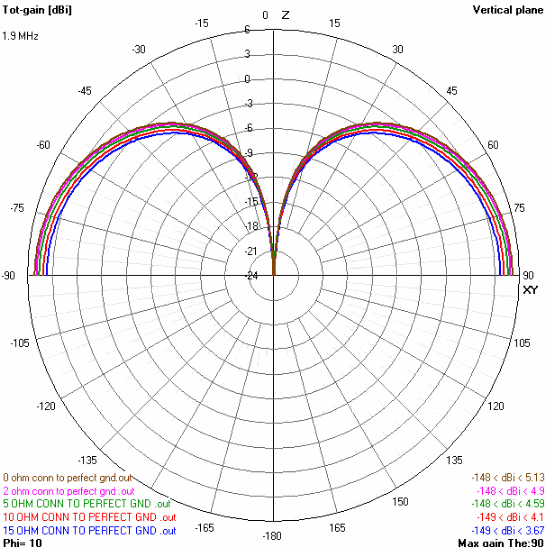
The chart linked next below illustrates this reality, going from a
> near-perfect 1/4-wave monopole using a zero loss connection to r-f ground
> to
> one with a loss of 15 ohms (fewer/sparser buried wires in the radial
> system).  The plot for 2 ohms is typical for 120 x 1/4-wave buried radial
> wires, regardless of of the conductivity of the earth in which the wires
> are
> buried.
>
>
> http://i62.photobucket.com/albums/h85/rfry-100/Qtr_Wave_Monopole_Gain_Compare.gif
>

This chart is a simple series insertion of a resistor between the feed and
what is a near perfect radial system.  The performance of such a remarkable
dense and extensive radial field has NEVER been in question by me.  This
chart simply does not apply to whatever depriving transmission mode
mechanism is in effect with a SPARSE and NONUNIFORM radial field.

I state again: RBN MEASUREMENTS ***SUPPORT*** THE EFFECTIVENESS OF DENSE
BURIED/ON GROUND RADIAL FIELDS AT SKY WAVE, with MOST known stations with
60 quarter wave buried/on ground radials doing very well, and consistently
turning up the highest RBN readings for the evening and general locale. I
know a few stations with dense radials that have issues with other
conductors in the near field, those having the effect of inserting
resistors.

Richard, find me a study in your amazing index that produces those results
over two, four, or eight buried radials.  I have no interest in, and have
not been talking at all about antennas over commercial quality radial
fields. I simply have no issues with the cardinal intent of those 30's and
40's studies, which very clearly was very efficient antenna systems for
commercial BC stations.  My advice to anyone has always been, if you can do
a commercial grade radial field, then by all means do it.  Absent issues
with other conductors in the near field, you will be very happy with it,
and will get maximum results for whatever wire you use over it.

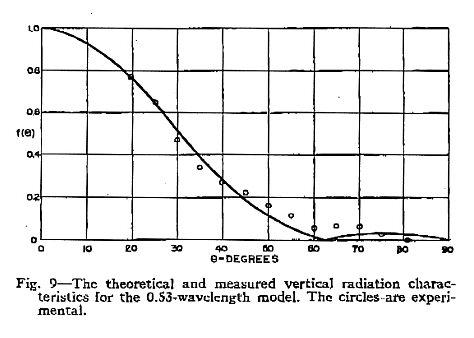
Measuring the elevation pattern of a monopole was done by Charles Jeffers in
> his experimental studies leading to the Franklin type (sectionalized)
> antenna used later by WOAI in San Antonio.  Jeffers' paper "An Antenna for
> Controlling the Nonfading Range of Broadcasting Stations" was published in
> the November, 1948 issue of the Proceedings of the I.R.E., and includes the
> measured elevation pattern of a 0.53-wave monopole when driven against a
> nearly perfect ground plane (linked below).
>

You state yourself "driven against a nearly perfect ground plane".  Again,
the RBN measurements SUPPORT these conclusions above a DENSE radial field,
and DIFFER above SPARSE.  I should note that the RBN mechanism has no way
to know if the transmitting antenna was a well-executed commercial design,
or a window screen.  It just hears a CW call sign at a certain signal to
noise.  It's the ultimate dispassionate observer.

It is clear to see from this chart that the skywave radiation from a
> monopole is a function of the groundwave field it produces, and the
> distribution of r-f current along the height of the monopole.
>

> http://i62.photobucket.com/albums/h85/rfry-100/Measured_Elev_Pattern.gif
>
> Readers might be interested in referring to the FCC equations and
> techniques
> for determining the skywave performance of AM broadcast monopole antenna
> systems found at
> http://edocket.access.gpo.gov/cfr_2009/octqtr/pdf/47cfr73.190.pdf . The
> same
> general principles apply to the monopoles used by hams.
>

Without getting into remarkable FCC gaffes over the years, these are part
of the FCC's published body of rules and procedures, not the science.
 Mother Nature determines what applies, not the FCC.  Nor have I seen any
work by the FCC regarding broadcasting, attempting to characterize results
at 2,4,8 radials.  Have you?  Again, I have no questions regarding what
happens with DENSE radial fields, about what happens with the FCC specified
120 0.4 wavelength radial field.  I know that works very well.  There ARE
aspects of the BL&E study for short radiators over 0.4 wavelength radials
that I feel apply positively to ham use, if there were space for the long
radials.  This is not brought up in typical ham specifications either,
which tends to discount 120 radials as overkill.

The assumption seems to be, however long held, and by however many held,
that sky wave and ground wave are hard-linked, and there exists NO
mechanism which defines why they are not hard-linked, that would depend on
density of buried radials. I remind you that the BL&E authors themselves
clearly referenced one such varying mechanism which forced them to take on
the difficulty of constructing different sized radiators at a SINGLE study
frequency, rather than conveniently varying the frequency to vary the
wavelength size of a SINGLE set of constructed items.

The CORE of the hard-link assumption is that the ground level measurement
is ONLY constrained by resistive losses, and has no means of enhancement
that applies to the region of ground which would make 2 radial measurements
at the ground better than at sky wave. We CHARACTERIZE THAT LOSS as
immediate loss to heat, but do we KNOW? Until it is ruled out or in by
careful work about 2,4,8 radials which has this issue as its central line
of inquiry, we need to keep the open mind. Could it not be that some degree
of the extra resistance of two radials is actually coupling a ground
transmission mode that enhances ground based measurements at mile distances
over roughly uniform ground conditions?  There is some undiscovered country
here, which has zero application to commercial stations. After all our Mr.
Beverage had a 500 kHz buried TX antenna.  How did that work if the only
ground "loss" was pure resistor and no in-ground transmission?  Shouldn't
burial of the antenna have simply shielded the antenna?

The RBN numbers just continue to accumulate, and those who use them
continue to improve their stations, particularly difficult 160 meter
antennas, and improve their signals, contacts and contest scores.  Already
antennas based on conclusions from those numbers have been built, are being
built and compared.  It would be nice if the mechanism of departure from
commercial grade systems is identified.  This will not happen if the BL&E
3.6 dB is considered gospel from on high, must be defended at all costs,
and therefore RBN is considered junk.

We are testing N3ND's new 160 antenna tonight (Monday local time) 1818 @
0005Z.  This is another antenna based on RBN validated untraditional
design.

73, Guy.

RF
>
_______________________________________________
UR RST IS ... ... ..9 QSB QSB - hw? BK