Keep in mind this Sole purpose of a BC station is to get coverage of about 60
miles running 5KW day time and 1 KW night time with no fad and quality signal
not to work DX.
I read in some posts or on some web site that it does not matter if the ends
are tied to a ground rod or not.  Note then ends not at the base of the
vertical.

My backyard is only 35 by 36 feet.  You guys only think you have a small back
yard.  Compare it with this one.

The City water pipe system sure works as the good ground I guess so does the
neighbors plumbing cause their house in only 8 feet from mine :-)

Jim K9TF Stay on course, fight a good fight, and keep the faith.  Jim
K9TF/WA9YSD


________________________________
 From: "[email protected]" <[email protected]>
To: [email protected]
Sent: Saturday, May 5, 2012 7:07 AM
Subject: Topband Digest, Vol 113, Issue 6

Send Topband mailing list submissions to
    [email protected]

To subscribe or unsubscribe via the World Wide Web, visit
    http://lists.contesting.com/mailman/listinfo/topband
or, via email, send a message with subject or body 'help' to
    [email protected]

You can reach the person managing the list at
    [email protected]

When replying, please edit your Subject line so it is more specific
than "Re: Contents of Topband digest..."


Today's Topics:

   1. Re: Fwd: radals fer 160m vertcal (Richard Fry)
   2. Re: Fwd: radals fer 160m vertcal (James Rodenkirch)
   3. Re: Fwd: radals fer 160m vertcal (Jim Brown)
   4. Re: Fwd: radals fer 160m vertcal (BP Veal)
   5. Re: Fwd: radals fer 160m vertcal (Merv Schweigert)
   6. Re: Fwd: radals fer 160m vertcal (W2RU - Bud Hippisley)
   7. Re: Fwd: radals fer 160m vertcal (Joe Subich, W4TV)
   8. Re: Fwd: radals fer 160m vertcal (Richard Fry)


----------------------------------------------------------------------

Message: 1
Date: Fri, 4 May 2012 19:10:56 -0500
From: "Richard Fry" <[email protected]>
Subject: Re: Topband: Fwd: radals fer 160m vertcal
To: <[email protected]>
Cc: [email protected]
Message-ID: <CBE6FE690AFC41169BDC2A6EAB2A6EA2@RFryNew530>
Content-Type: text/plain; format=flowed; charset="Windows-1252";
    reply-type=original

Bud, W2RU wrote:

> 3.  Using radials that are longer than a vertical (of reasonable
> electrical length) is tall simply wastes a lot of money (and real estate).

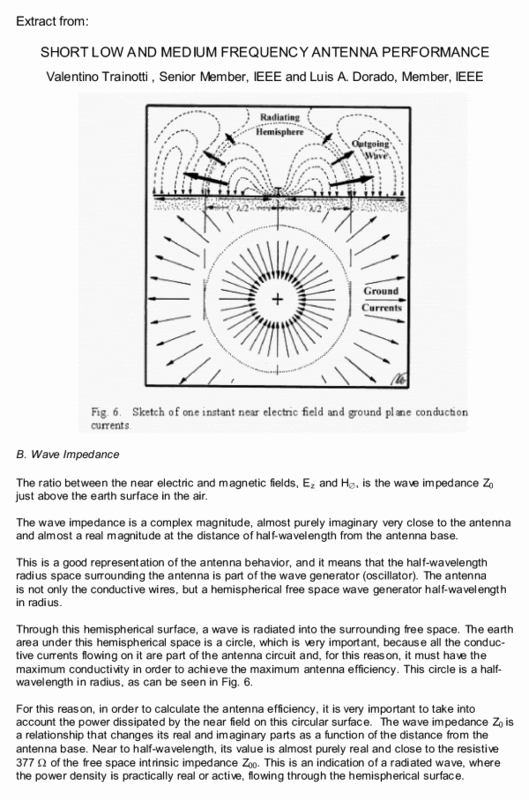
Those tending toward such beliefs should be interested in the clip at the
link below, as well as the BL&E study linked earlier in this thread.

Note the logical conclusions therefrom that the radiation efficiency of
every vertical monopole system of every electrical height depends on the
loss of the r-f ground reference against which it is driven.

These data show that for monopole heights no matter how short in electrical
wavelength, system radiation efficiency using buried radials is dependent on
the r-f loss in the circular surface area at/just below the surface of the
earth within ~1/2-wavelength radius of such monopoles.

In fact, the shorter the electrical heights of such monopoles, the more
important such r-f loss becomes toward defining the radiation efficiency of
those electrically short monopole systems.

http://i62.photobucket.com/albums/h85/rfry-100/GroundCurrentNearMonopole.gif


------------------------------

Message: 2
Date: Fri, 4 May 2012 18:52:38 -0600
From: James Rodenkirch <[email protected]>
Subject: Re: Topband: Fwd: radals fer 160m vertcal
To: <[email protected]>, <[email protected]>
Message-ID: <[email protected]>
Content-Type: text/plain; charset="iso-8859-1"


What about radials above the ground?  Like what I'm planning to install ---
base of the vertical at around 5' to 6' above ground and slope all of the
radials from that 5' or 6' point down to the ground?  Jim R. K9JWV


> From: [email protected]
> To: [email protected]
> Date: Fri, 4 May 2012 19:10:56 -0500
> CC: [email protected]
> Subject: Re: Topband: Fwd: radals fer 160m vertcal
>
> Bud, W2RU wrote:
>
> > 3.  Using radials that are longer than a vertical (of reasonable
> > electrical length) is tall simply wastes a lot of money (and real estate).
>
> Those tending toward such beliefs should be interested in the clip at the
> link below, as well as the BL&E study linked earlier in this thread.
>
> Note the logical conclusions therefrom that the radiation efficiency of
> every vertical monopole system of every electrical height depends on the
> loss of the r-f ground reference against which it is driven.
>
> These data show that for monopole heights no matter how short in electrical
> wavelength, system radiation efficiency using buried radials is dependent on
> the r-f loss in the circular surface area at/just below the surface of the
> earth within ~1/2-wavelength radius of such monopoles.
>
> In fact, the shorter the electrical heights of such monopoles, the more
> important such r-f loss becomes toward defining the radiation efficiency of
> those electrically short monopole systems.
>
> http://i62.photobucket.com/albums/h85/rfry-100/GroundCurrentNearMonopole.gif
>
> _______________________________________________
> UR RST IS ... ... ..9 QSB QSB - hw? BK


------------------------------

Message: 3
Date: Fri, 04 May 2012 18:34:31 -0700
From: Jim Brown <[email protected]>
Subject: Re: Topband: Fwd: radals fer 160m vertcal
To: [email protected]
Message-ID: <[email protected]>
Content-Type: text/plain; charset=ISO-8859-1; format=flowed

On 5/4/2012 5:52 PM, James Rodenkirch wrote:
> What about radials above the ground?  Like what I'm planning to install ---
> base of the vertical at around 5' to 6' above ground and slope all of the
> radials from that 5' or 6' point down to the ground?

N6LF has published extensive work that he did on 40M showing that
radials elevated only a feet or so were quite effective, and that a foot
higher was better, but close to many radials on the ground.  I tried
scaling this to 160M, placing radials at about 5 ft.  They were NOT
particularly effective, and I had the chance to discuss the issue with
N6BT, who has studied elevated radial systems extensively on 160M.
Paraphrasing Tom, the earth at 160M is a rather different animal than it
is at 40M.  Tom suggested that 16 ft was a better height for a few
elevated radials on160M, and I hope to move the ones on my experimental
antenna to that height in the next month or so, perhaps even before
leaving for Dayton.

73, Jim K9YC


------------------------------

Message: 4
Date: Fri, 4 May 2012 19:56:24 -0600
From: BP Veal <[email protected]>
Subject: Re: Topband: Fwd: radals fer 160m vertcal
To: <[email protected]>, "[email protected]"
    <[email protected]>
Message-ID: <[email protected]>
Content-Type: text/plain; charset="iso-8859-1"


Gull Winged raised radials cut to resonance seem to be excellent above ground
radials-  But I am in a small yard, and have my MA160V hooked up to radials
going all over the yard, buried, of various lengths, 10-80 feet, about 60 of
them- it only goes out in about a 100 degree pattern as the antenna is in the
corner of the yard-they work as the resonance point and SWR bell curve really
are effected when they are hooked up-  15KHz of usable bandwidth at a 4:1 SWR
(matched with an UnUn to 1.5:1) vs 60KHz bandwidth without the radials at a
1:1.2 SWR, reflective of the hidden ground loss and impendence mismatch- -  so
even in a puny yard, with limited space, measured effect of buried radials can
be significant.......too many dogs and kids for raised radials.......

Bryon "Paul" Veal  MAED
FCC Amateur Radio License-N0AH
[email protected]
Home Page at http://groups.yahoo.com/group/HamRadioPropagation/


> Date: Fri, 4 May 2012 18:34:31 -0700
> From: [email protected]
> To: [email protected]
> Subject: Re: Topband: Fwd: radals fer 160m vertcal
>
> On 5/4/2012 5:52 PM, James Rodenkirch wrote:
> > What about radials above the ground? Like what I'm planning to install ---
> > base of the vertical at around 5' to 6' above ground and slope all of the
> > radials from that 5' or 6' point down to the ground?
>
> N6LF has published extensive work that he did on 40M showing that
> radials elevated only a feet or so were quite effective, and that a foot
> higher was better, but close to many radials on the ground. I tried
> scaling this to 160M, placing radials at about 5 ft. They were NOT
> particularly effective, and I had the chance to discuss the issue with
> N6BT, who has studied elevated radial systems extensively on 160M.
> Paraphrasing Tom, the earth at 160M is a rather different animal than it
> is at 40M. Tom suggested that 16 ft was a better height for a few
> elevated radials on160M, and I hope to move the ones on my experimental
> antenna to that height in the next month or so, perhaps even before
> leaving for Dayton.
>
> 73, Jim K9YC
> _______________________________________________
> UR RST IS ... ... ..9 QSB QSB - hw? BK


------------------------------

Message: 5
Date: Fri, 04 May 2012 16:01:34 -1000
From: Merv Schweigert <[email protected]>
Subject: Re: Topband: Fwd: radals fer 160m vertcal
To: [email protected]
Message-ID: <[email protected]>
Content-Type: text/plain; charset=ISO-8859-1; format=flowed

At my old QTH in ILL,  I used a fed tower with 4 elevated radials,  they
were about
12 foot off the ground,  it worked fairly well,  but I started adding
radials on the ground,
as I added radials the feed point impedance changed,  I hit diminishing
returns at about
60 radials,   the difference between 4 elevated and adding the 60 on the
ground was
more than the equivalent of doubling my power.   so at least 3DB for
me.  YMMV..
The raised radials were very "hot"  I could draw a 2 to 3 inch spark off
the ends
easily so make sure they are insulated and out of reach of humans.
Almost set my garage on fire as one radial arced over to the roof
flashing close to where
it was tied off.

I find a big difference in 160 compared to a 4 radial GP type system on
40 meters,
maybe if the radials were much higher and less coupling to the ground
they would work
better.
73 Merv K9FD/KH6   KH7C

> On 5/4/2012 5:52 PM, James Rodenkirch wrote:
>
>> What about radials above the ground?  Like what I'm planning to install ---
>> base of the vertical at around 5' to 6' above ground and slope all of the
>> radials from that 5' or 6' point down to the ground?
>>
> N6LF has published extensive work that he did on 40M showing that
> radials elevated only a feet or so were quite effective, and that a foot
> higher was better, but close to many radials on the ground.  I tried
> scaling this to 160M, placing radials at about 5 ft.  They were NOT
> particularly effective, and I had the chance to discuss the issue with
> N6BT, who has studied elevated radial systems extensively on 160M.
> Paraphrasing Tom, the earth at 160M is a rather different animal than it
> is at 40M.  Tom suggested that 16 ft was a better height for a few
> elevated radials on160M, and I hope to move the ones on my experimental
> antenna to that height in the next month or so, perhaps even before
> leaving for Dayton.
>
> 73, Jim K9YC
> _______________________________________________
> UR RST IS ... ... ..9 QSB QSB - hw? BK
>
>


------------------------------

Message: 6
Date: Fri, 4 May 2012 23:28:57 -0400
From: W2RU - Bud Hippisley <[email protected]>
Subject: Re: Topband: Fwd: radals fer 160m vertcal
To: Richard Fry <[email protected]>
Cc: [email protected]
Message-ID: <[email protected]>
Content-Type: text/plain; charset=windows-1252

On May 4, 2012, at 8:10 PM, Richard Fry wrote:

> Bud, W2RU wrote:
>
>> 3.  Using radials that are longer than a vertical (of reasonable
>> electrical length) is tall simply wastes a lot of money (and real estate).
>
> Those tending toward such beliefs should be interested in the clip at the
> link below, as well as the BL&E study linked earlier in this thread.

I think you missed the parenthetical portion of my sentence:  "of REASONABLE
electrical length".

> Note the logical conclusions therefrom that the radiation efficiency of
> every vertical monopole system of every electrical height depends on the
> loss of the r-f ground reference against which it is driven.

No argument there.  The ground losses and the radiation resistance of the
vertical monopole form a voltage divider.  The higher the radiation resistance
of the monopole itself, the greater the percentage of transmitter power that is
radiated, rather than being dissipated in heating up the ground near the
monopole.  The "logical conclusion" (to borrow a phrase) to take from this is
that you can spend a whole lot more of your time getting on the air and
actually working far away stations and a lot less time fussing with your radial
field, transmission line connections, etc., if you first put your effort into
making your vertical monopole as close to a quarter-wave in height as you
possibly can.

> These data show that for monopole heights no matter how short in electrical
> wavelength, system radiation efficiency using buried radials is dependent on
> the r-f loss in the circular surface area at/just below the surface of the
> earth within ~1/2-wavelength radius of such monopoles.

Agreed.  But as I attempted to explain in my previous posting by using the
examples I took from the two curves you pointed us to, for a REASONABLE
electrical height (say, 75 degrees), the difference between quarter-wave and
half-wave radials is hardly earth-shattering (pardon the pun).

The thrust of the paper you were referencing was that the AM broadcast
industry, which had been fixated on half-wavelength vertical radiators since
its inception, could attain comparable field strengths with vertical radiators
as short as an eighth-wavelength (45 degrees' electrical height) if reasonable
attention was given to the radial fields beneath them.
What was absent from the paper, however, was any concern for losses in the
matching network between the transmitter and the base of the antenna.  All the
curves, and all the comparisons in that paper are based on constant power to
the base of the antenna ? NOT constant power at the output of the transmitter!
Only at the very end of the paper is it noted that the added cost of low-loss
inductors for the matching network can be paid for out of funds saved by
constructing a shorter tower....:-)  AM broadcast stations are governed by a
different set of regulations than amateurs.  I'll try your approach provided
I'm free to run as much transmitter power as I need in order to deliver a solid
1500 watts to the base of a very short vertical.

Furthermore, you neglected to mention the curve in that same article that shows
how a 25-degree tall tower, for example, has more than 20 times the peak
voltage across the base insulator than a 75-degree tower does.  The difference
in insulator specifications required by those two towers represents a potential
cost increase (or, at the very least, an increase in the mechanical complexity
of the vertical at its base) that is totally unnecessary if appropriate
techniques are used to maximize the electrical length of the vertical portion
of the antenna.

> In fact, the shorter the electrical heights of such monopoles, the more
> important such r-f loss becomes toward defining the radiation efficiency of
> those electrically short monopole systems.

Gosh, that was my point, I thought.

One of the core things you learn in any course on antennas is that there's only
a fraction of a dB difference in the theoretical gain of a half-wave dipole or
quarter-wave monopole versus an infinitesimally short one FOR EQUAL FEEDPOINT
DRIVE, but I'll always choose to put my effort into erecting the full half-wave
dipole or the full quarter-wave monopole.  Why?  Because I know the difficulty
and the losses I'll encounter trying to match the 50-ohm output of my
transmitter to the extremely low resistive and extremely high reactive input
impedance of an infinitesimally short wire ? especially if I'm limited to
AFFORDABLE matching network components.  I have a good friend struggling with
that exact issue right now; he has an (expensive) antenna coupler that claims
to be capable of handling 1500 watts.  It also claims to be able to handle SWRs
up to such-and-such.  What the specs don't say, however, is that it can't do
both simultaneously.  Components
 melt if my friend tries.  Antenna m
atching units that can deliver 1500 watts of RF to high SWR feedpoints are
neither simple nor inexpensive.  By and large, they are far beyond what most
amateurs are willing or able to spend.

Losses in the ground are only one part of the resistance divider equation.  Six
ohms' ground loss (as measured by at least one person on here) is far less
important to a vertical that has an input impedance (over perfect ground) of 37
ohms than it is to a very short vertical with an input impedance of 1 ohm.
What the Brown article neglects is that similar or higher losses in the
matching network are equally destructive to the performance of very short
verticals.  You can have a very short vertical attached to a perfect ground
extending for miles in all directions, and still get lousy performance because
you can get only a fraction of the transmitter output power into the radiation
resistance of the vertical.  The beauty of striving for the maximum electrical
height possible at your specific installation is that you are reducing the
effect of BOTH kinds of losses!

My comments were directed at those of us who are interested in vertical
monopoles as a means to an end ? working far away stations.  I tend to work
more stations by sitting in front of my rig than I do if I'm spending hours
carting instrumentation (that I can't afford) around the back yard or burying
50-100% more wire for questionable benefit.   Is my 160-meter shunt-fed
vertical with 16 radials of various lengths perfect?  No.  Do I have highly
conductive ground around it?  Heck, no!  Is it a full 90 degrees' electrical
wavelength?  Thanks to the top-loading of my HF Yagis, it's pretty close.  Does
it get out well?  You better believe it!  Could it get out better?  Sure...for
that 0.01% of the time I can't get through to the DX.

To repeat:  In my opinion, for amateurs to lose a lot of sleep over whether to
have quarter-wavelength or half-wavelength radials beneath a vertical monopole
of REASONABLE electrical length is foolish.

I stand by my earlier comments.

Bud, W2RU

------------------------------

Message: 7
Date: Sat, 05 May 2012 01:38:08 -0400
From: "Joe Subich, W4TV" <[email protected]>
Subject: Re: Topband: Fwd: radals fer 160m vertcal
To: [email protected]
Message-ID: <[email protected]>
Content-Type: text/plain; charset=ISO-8859-1; format=flowed


On 5/4/2012 10:01 PM, Merv Schweigert wrote:
> I find a big difference in 160 compared to a 4 radial GP type system
> on 40 meters, maybe if the radials were much higher and less coupling
> to the ground they would work better.

Purely on a logical basis there are two factors working against the
(sparse) elevated radials on 160 meters vs. 40 meters.  First the
160 meter radial system is 1/4 as high in terms of wavelength than
the 40 meter system  ... that means fields in the (lossy) dielectric
are 16 times greater.  Secondly, the skin depth is much greater on
160 than on 40 meters meaning there is greater volume of dielectric
to generate losses.

I don't have the tools to really calculate the difference but I would
postulate that the dielectric (ground) losses increase at some rather
high exponential (perhaps as the square squared) rate as frequency
decreases.  When this is coupled with "short" radial systems - even
those that are "dense" close to the antenna or dense in only one sector,
the losses can really get out of hand.

73,

    ... Joe, W4TV


------------------------------

Message: 8
Date: Sat, 5 May 2012 07:07:11 -0500
From: "Richard Fry" <[email protected]>
Subject: Re: Topband: Fwd: radals fer 160m vertcal
To: <[email protected]>
Message-ID: <5D3B3E458E9241ED8CB11A80C7407857@ToshLaptop>
Content-Type: text/plain; format=flowed; charset="Windows-1252";
    reply-type=original

James Rodenkirch wrote:
>What about radials above the ground?

This link http://www.commtechrf.com/documents/nab1995.pdf leads to a paper
by Clarence Beverage with some real-world results for monopoles with
elevated wires used as a counterpoise.   Here is a quote from it:


\ \The antenna system consisted of a lightweight, 15 inch face tower, 120
feet in height, with a base insulator at the 15 foot elevation and six
elevated radials, a quarter wave in length, spaced evenly around the tower
and elevated 15 feet above the ground. The radials were fully insulated from
ground and supported at the ends by wooden tripods.

Power was fed to the system through a 200 foot length of coaxial cable with
the cable shield connected to the shunt element of the T network and to the
elevated radials. A balun or RF choke on the feedline was not employed and
the feedline was isolated from the lower section of the tower. The system
operated on 1580 kHz at a power of 750 watts.

The efficiency of the antenna was determined by radial field intensity
measurements along 12 radials extending out to a distance of up to 85
kilometers. The measured RMS efficiency was 287 mV/m for 1 kW, at one
kilometer, which is the same measured value as would be expected for a 0.17
wave tower above 120 buried radials. / /


So while such "elevated" installations are rare for AM broadcast stations,
their performance has been measured to be about the same as when using an
r-f ground consisting of 120 buried wires, each 1/4-wave long (free space
length).

These elevated systems are readily modeled using NEC-2.  However the
radiation patterns shown by a typical NEC far-field analysis do not
accurately show the fields actually "launched" by them, or by any vertical
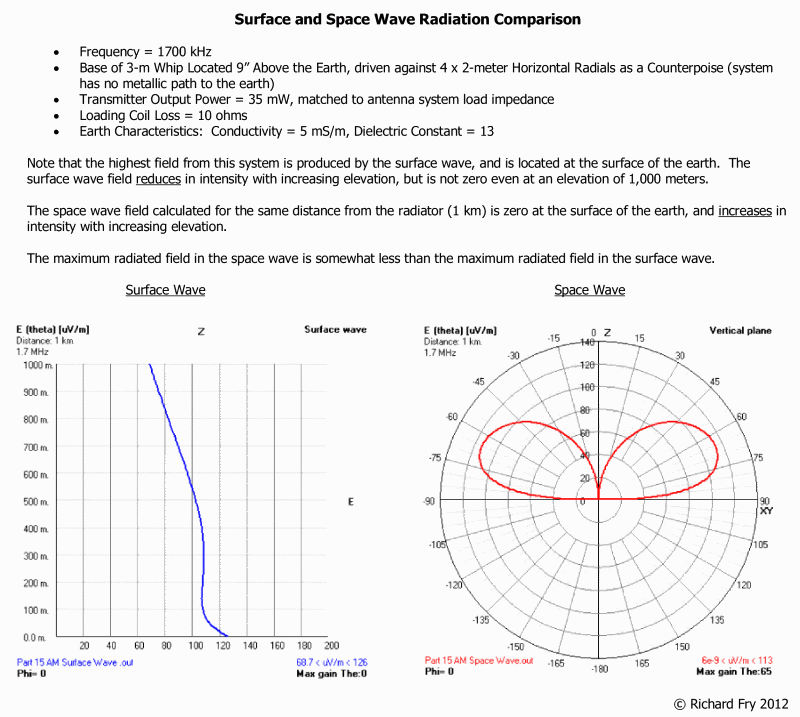
radiator with its base near the earth, because they do not include the
surface wave.

The fields radiated in and near the horizontal plane by any vertical
monopole of 5/8 wavelength height and less are the greatest fields it
radiates in the entire elevation plane, regardless of earth conductivity.
Those fields from very low elevation angles (say, less then 5 degrees) can
reach the ionosphere, and under the right conditions return to the earth as
a useful skywave.

The link below illustrates this concept.

http://i62.photobucket.com/albums/h85/rfry-100/Space_Surface_Wave_Compare.gif


------------------------------

_______________________________________________
Topband mailing list
[email protected]
http://lists.contesting.com/mailman/listinfo/topband


End of Topband Digest, Vol 113, Issue 6
***************************************
_______________________________________________
UR RST IS ... ... ..9 QSB QSB - hw? BK