A common belief seen on the web is that if buried radials are not installed
over some azimuth sector around a monopole, then the azimuth radiation
pattern of that monopole will become distinctly directional.
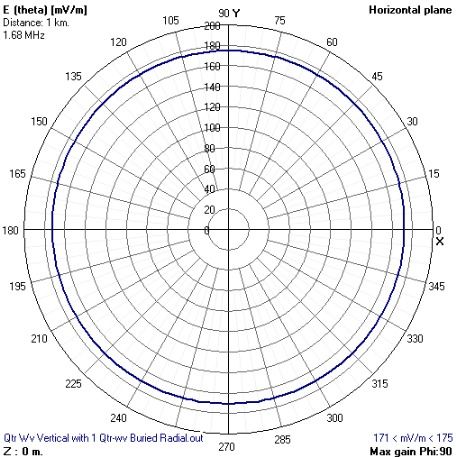
But as an extreme illustration of this situation, below is a link to a NEC-4
model of a 1/4-wave monopole using just one 1/4-wave buried radial, directed
on the +Y axis.  Earth conductivity was set to 6 mS/m, dc 13, and the
applied power was 1 kW on 1680 kHz.

The H-plane (groundwave) field intensity is plotted at a distance of 1 km.
The field essentially is omnidirectional, even with only one radial in use.
The maximum field at 1 km is 175 mV/m in the +Y direction, and never drops
below 171 mV/m on other bearings.

This is reasonable, as all of the useful radiation from this system has to
originate from the monopole, and there is no physical reason for it to favor
one azimuth sector over another.  The slight field improvement toward +Y
would be the result of the lower groundwave path loss in that direction, due
to the buried radial running in that direction.

So while this isn't a very efficient antenna system compared to one using
120 x 1/4-wave buried radials spaced every 3 degrees around the monopole, it
does not show much directionality in the azimuth plane -- as might be
anticipated for the lopsided ground system it uses

http://i62.photobucket.com/albums/h85/rfry-100/Qtr-wv_Monopole_w_One_Qtr-4wv_Buried_Radial.jpg

R. Fry

_______________________________________________
UR RST IS ... ... ..9 QSB QSB - hw? BK