Solar precursors correlating solar physical phenomena with the level
of future solar activity are much better indicators of the progress of
a broad phase of the solar cycle -- solar minimum -- than forecasting
a specific event such as the bottom of a broad solar minimum by
observing the statistics of numeric values such as solar flux.


Here's an example of how one solar precursor -- spotless day s --
can be used to assess our progress towards solar minimum.


We entered the Cycle 24 solar cycle minimum with the onset of
eight spotless days in June 2016. We had only 32 spotless days in
2016.


We had 15 spotless days in a row in March 2017, followed by relatively
infrequent spotless days for the next seven months. The frequency
of occurrence of s potless days accelerated in early November 2017
when we had 13 spotless days in a row followed by many more
frequent spotless days over the next five months. We had 104
spotless days during 2017.


The frequency of spotless accelerated again last month when we
had 25 spotless days. W e've already had 54 spotless days during the
first 25% of 2018.


So where are we in our progress to solar minimum?


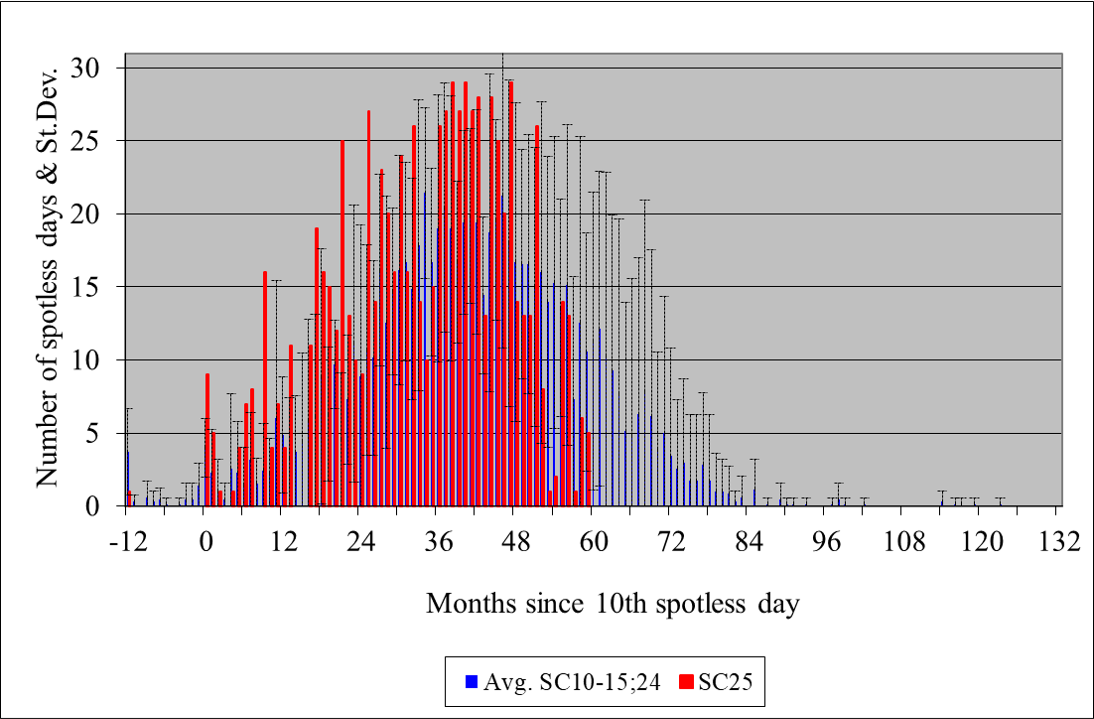
This chart shows the number of spotless days -- in red -- since the
tenth spotless day of the onset of solar minimum in July 2016.
Shown in blue are the average numbers of spotless days during
sunspot minimums following sunspot cycles similar to cycle 24.
This data suggests that we have just begun a period of very frequent
spotless days for at least the next two years.


http://www.sidc.be/silso/IMAGES/GRAPHICS/spotlessJJ/SC25_month1015.png


The next s olar precursor is frequent long periods of spot-free days.
We had a 14 day period of spotless days in 2016, 15 in a row
in March 2017, 13 in a row in November 2017, and 14 in a row
early last month. Long periods of spotless days will become even
more frequent a s we go deeper into solar minimum.


We'll see another important solar precursor as long periods of spotless
days become more frequent. N ew high latitude, opposite polarity
Cycle 25 sunspots will begin to appear more frequently , perhaps by
late next year. More frequent Cycle 25 sunspots will signal that
we're approaching the bottom of the solar minimum phase of the
s olar cycle.


So what about the intensity of the next solar cycle?


An ongoing solar precursor of the intensity of Cycle 25 is the intensity
of the solar magnetic fields prior to our current solar minimum.
The good news is that the solar magnetic field strength is already
slightly stronger than it was prior to the last solar minimum which
suggests that Cycle 25 will be somewhat stronger that Cycle 24.


73
Frank
W3LPL


----- Original Message -----

From: "Jim Miller" <[email protected]>
To: "brian" <[email protected]>
Cc: "PVRC" <[email protected]>
Sent: Wednesday, April 4, 2018 2:53:26 PM
Subject: Re: [PVRC] SFI theoretical minimum?


At 68 today and for the past few, we're pretty near the bottom.


Thanks all


Jim ab3cv


On Wed, Apr 4, 2018 at 10:47 AM, brian < [email protected] > wrote:


https://wattsupwiththat.com/2008/07/16/sun-in-deep-slumber-107-solar-flux-hits-record-low-value/


Indicates that the theoretical minimum is 67. However, values lower that this
have been measured (e.g. lowest ever 64.4 in 1954). The observed values lower
than 67 are attributable to the elliptical orbit of the Earth. When the earth
is further from the sun, lower measured values than 67 are possible. The
article points out that if corrections are made for this orbital distance
effect, values lower than 67 don't occur.

73 de Brian/K3KO

On 4/4/2018 14:08 PM, Alfred Laun wrote:

<blockquote>
Jim:

Actually SFI=66 is a rule of thumb which I have used for years as being
the theoretical minimum possible SFI. I don't know where I originally
got that info and indeed, now that you mention it, I may very well be
wrong. Indeed during the most recent solar minimum the SFI did plunge
to SFI=64 point something on one occasion. And, to quote G3YWX: "The
figure for the solar flux can vary from as low as 50 or so to as high as
300."
See https://www.arrl.org/files/file/Technology/tis/info/pdf/0209038.pdf

I'm sure Frank, W3LPL knows a lot more about this than I do.

73, Fred, K3ZO


On Wed, Apr 4, 2018 at 8:56 AM, Jim Miller < [email protected]
<mailto: [email protected] >> wrote:

Hi Fred

You mentioned in one of your recent contest posts that the SFI was
near its theoretical minimum of 66. How is that minimum known?

Thanks

Jim ab3cv

ps. always learn something new from your posts!
pps. feel free to reply on the reflector if you like


<
http://www.avg.com/email-signature?utm_medium=email&utm_source=link&utm_campaign=sig-email&utm_content=emailclient
 >
Virus-free. www.avg.com
<
http://www.avg.com/email-signature?utm_medium=email&utm_source=link&utm_campaign=sig-email&utm_content=emailclient
 >


<#DAB4FAD8-2DD7-40BB-A1B8-4E2AA1F9FDF2>


______________________________________________________________
PVRC mailing list
Home: http://mailman.qth.net/mailman/listinfo/pvrc
Help: http://mailman.qth.net/mmfaq.htm
Post: mailto: [email protected]
Message delivered to [email protected]

This list hosted by: http://www.qsl.net
Please help support this email list: http://www.qsl.net/donate.html


______________________________________________________________
PVRC mailing list
Home: http://mailman.qth.net/mailman/listinfo/pvrc
Help: http://mailman.qth.net/mmfaq.htm
Post: mailto: [email protected]
Message delivered to [email protected]

This list hosted by: http://www.qsl.net
Please help support this email list: http://www.qsl.net/donate.html

</blockquote>


______________________________________________________________
PVRC mailing list
Home: http://mailman.qth.net/mailman/listinfo/pvrc
Help: http://mailman.qth.net/mmfaq.htm
Post: mailto:[email protected]
Message delivered to [email protected]

This list hosted by: http://www.qsl.net
Please help support this email list: http://www.qsl.net/donate.html

_________________
Topband Reflector Archives - http://www.contesting.com/_topband