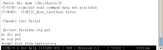
"env set -e" selects a default vendor GUID when no -guid option is
given, using a hand rolled name check in do_env_set_efi(). That check
has drifted from the canonical name_type[] table in
lib/efi_loader/efi_var_common.c: it knows db, dbx and dbt but not dbr,
so "env set -e dbr" silently operates on a variable under
EFI_GLOBAL_VARIABLE_GUID instead of the image security database GUID,
creating a variable that no consumer will ever look up. The command
also unmapped the -i value buffer twice, which triggers a spurious
"Address not mapped" warning on sandbox for addresses that get a
tagged mapping.
Patch 1 replaces the hand rolled check with a call to
efi_auth_var_get_guid() so that the shell command and the variable
service share a single table, and consolidates the value and name
cleanup on the common exit path. Behaviour is unchanged for db, dbx,
dbt and for non-authenticated variable names.

Patch 2 adds a test case to the sandbox secure boot suite that enrolls
each of db, dbx, dbt and dbr in setup mode without an explicit -guid
option and checks that every variable is created under the image
security database GUID and not under the global variable GUID. This is
the first coverage of dbt and dbr under test/. The enrollment happens
in setup mode because once secure boot is enabled,
efi_variable_authenticate() only accepts writes to PK, KEK, db and
dbx. The new test fails at the dbr step without patch 1.

Aristo Chen (2):
  cmd: nvedit_efi: use efi_auth_var_get_guid() for the default GUID
  test: check default GUID selection of signature database variables

 cmd/nvedit_efi.c                              | 22 +++++---------
 test/py/tests/test_efi_secboot/conftest.py    |  8 +++++
 .../py/tests/test_efi_secboot/test_authvar.py | 30 +++++++++++++++++++
 3 files changed, 46 insertions(+), 14 deletions(-)

--
2.43.0