South Sudan Should Be Placed Under UN Trusteeship to Aid Development of
Viable Self-Government
Description:
http://s3.amazonaws.com/bbemail/PROD/ulib/zvw22/img/SudSoudan.jpg


opinion

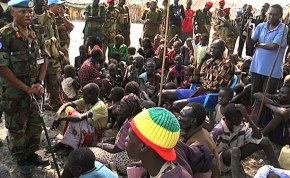
United Nations commander Moses Obi talking to displaced people in Jonglei
state (file photo).

It is time to divest ourselves of all our romantic delusions about South
Sudan. We were all so focused on helping the South escape the repressive
colonial clutches of Khartoum that we forgot about the need to prepare the
South Sudanese people for self-government. Of all the African countries that
came to independence since 1950, South Sudan has had the least amount of
preparation.

Even the former Belgian Congo that came to independence in 1960 had
significant infrastructure, a fairly good educational system operated by the
Christian missionaries, and major industrial and commercial agricultural
development. Unfortunately, the Belgians thought they could continue
colonial rule into the 1980s, and therefore had done nothing to prepare the
human capital necessary for self-government that came about on very short
notice in 1960. As a result, the newly independent Democratic Republic of
the Congo fell into a state of near anarchy shortly after independence,
requiring a six-year UN peacekeeping operation that included substantial
civilian governmental tutelage as well as Blue Helmets. It is the civilian
side of the UN operation in the Congo that is far less known than the
military aspect, but was arguably more important.

Compared to the Belgian Congo, South Sudan began with a big bunch of zeros:
infrastructure, education, private investment, institutions. And we all saw,
of course, violent competition for power within the SPLA even years before
the negotiations leading to independence even began. Riek Machar began his
fight for power back in 1991 under Khartoum's subsidies. So, why would
anyone think that an insurgent military movement had the ability to rule a
newly independent country that had so many handicaps?

In the Belgian Congo, the UN Security Council imposed its tutelage on the
newly independent nation within a few months of independence, and the small
number of educated Congolese intellectuals accepted it without complaint.

Another historical analogy that might be instructive for South Sudan is the
transition to full independence of Namibia between December 1988 and March
1990. The situation there was legally different because Namibia had been
under nominal UN trusteeship after the territory was transferred from
Germany to South Africa in 1918. Unfortunately, South Africa did not
implement its mandate to bring the territory to independence, and instead
ruled it as part of the apartheid system. In 1987, South Africa accepted the
US invitation to begin comprehensive negotiations to bring peace to
southwest Africa, along with Angola and Cuba. A two-year marathon
negotiation led by the then US Assistant Secretary Chester Crocker led to
the New York agreement of December 1988 that provided, inter alia, for
Namibian independence.

The negotiators of the December 1988 agreement made the wise decision to
restore UN tutelage to Namibia for a 15-month transition period, during
which UN Blue Helmets and civil servants took up temporary residence to
prepare the country for full independence in March 1990. During this
transition as well, the leading nationalist political party and insurgent
force, the South West African Peoples Organization (SWAPO) had the time to
prepare to govern the country. Like the Belgian Congo in 1960, Namibia
thirty years later had the benefit of extensive infrastructure, private
investments, education and some civil society.

It would be a shame if current cease-fire talks among the South Sudanese
warlords resulted in another crude arrangement to share the oil wealth among
the corrupt former fighters, with the general population seeing zero
benefits. The cease-fire should be followed by a major debate in the UN
Security Council establishing a UN mandate over South Sudan similar to the
one established for the Congo in 1960.

Herman J. 'Hank' Cohen is Former Assistant Secretary of State for Africa


           Thé Mulindwas Communication Group
"With Yoweri Museveni and Dr. Kiiza Besigye Uganda is in anarchy"
           Kuungana Mulindwa Mawasiliano Kikundi
"Pamoja na Yoweri Museveni na Dk. Kiiza Besigye Uganda ni katika machafuko"
<<image001.jpg>>
_______________________________________________
Ugandanet mailing list
[email protected]
http://kym.net/mailman/listinfo/ugandanet

UGANDANET is generously hosted by INFOCOM http://www.infocom.co.ug/

All Archives can be found at http://www.mail-archive.com/[email protected]/

The above comments and data are owned by whoever posted them (including
attachments if any). The List's Host is not responsible for them in any way.
---------------------------------------