Edward Pojim
Western countries are doing exactly what Yoweri Museveni did in Great Lakes.
Why are you not barking yet as you did on Museveni? Oh I forgot this is done by
whites thus fair and when it was done by Museveni he was a war criminal. I said
at a time that Luos need to be very careful for after they throw  Kenyatta to
Hague for he is a Kikuyu, with time that court is going to target a Luo then
what? Guess what it has started by targeting Israel and Western counties are
running exactly from the very same court system they themselves not only
created but fund. And this qualifies to be the  very official “I told you so”
of 08/21/2014.


Man we live in very strange days indeed.


EM

On the 49th Parallel


                    Thé Mulindwas Communication Group
"With Yoweri Museveni, Ssabassajja and Dr. Kiiza Besigye, Uganda is in anarchy"
                    Kuungana Mulindwa Mawasiliano Kikundi
"Pamoja na Yoweri Museveni, Ssabassajja na Dk. Kiiza Besigye, Uganda ni katika
machafuko"


From: [email protected]
[mailto:[email protected]] On Behalf Of Hannah Ogwapiti
Sent: Thursday, August 21, 2014 5:59 AM
To: [email protected]
Subject: {UAH} Hague court under western pressure not to open Gaza war crimes
inquiry


Hague court under western pressure not to open Gaza war crimes inquiry


Potential ICC investigation into actions of both the IDF and Hamas in Gaza has
become a fraught political battlefield

*
<https://www.facebook.com/sharer/sharer.php?u=http://www.theguardian.com/law/2014/aug/18/hague-court-western-pressure-gaza-inquiry>


*
*       The Guardian <http://www.guardian.co.uk/theguardian> , Monday 18 August
2014

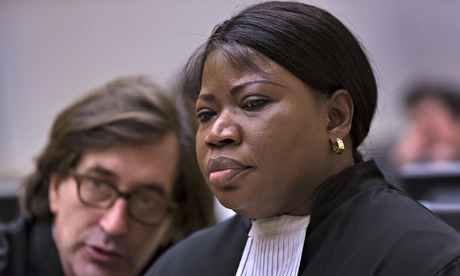
 Fatou Bensouda
<http://static.guim.co.uk/sys-images/Guardian/Pix/pictures/2014/8/17/1408290178177/Fatou-Bensouda-011.jpg>


Fatou Bensouda, the international criminal court prosecutor. Photograph:
Michael Kooren/AFP/Getty Images

The international criminal court
<http://www.theguardian.com/law/international-criminal-court>  has persistently
avoided opening an investigation into alleged war crimes
<http://www.theguardian.com/law/war-crimes>  in Gaza
<http://www.theguardian.com/world/gaza>  as a result of US and other western
pressure, former court officials and lawyers claim.

In recent days, a potential ICC investigation into the actions of both the
Israel <http://www.theguardian.com/world/israel>  Defence Forces and Hamas
<http://www.theguardian.com/world/hamas>  in Gaza has become a fraught
political battlefield and a key negotiating issue at ceasefire talks in Cairo.
But the question of whether the ICC could or should mount an investigation has
also divided the Hague-based court itself.

An ICC investigation could have a far-reaching impact. It would not just
examine alleged war crimes by the Israeli military, Hamas and other Islamist
militants in the course of recent fighting in Gaza that left about 2,000 people
dead, including women and children. It could also address the issue of Israeli
settlements in the Palestinian territories
<http://www.theguardian.com/world/palestinian-territories> , for which the
Israeli leadership would be responsible.

The ICC's founding charter, the 1998 Rome statute (pdf)
<http://www.theguardian.com/law/2014/aug/18/www.icc-cpi.int/nr/rdonlyres/ea9aeff7.../0/rome_statute_english.pdf>
 , describes as a war crime "the transfer, directly or indirectly, by the
occupying power of parts of its own civilian population into the territory it
occupies".

Also at stake is the future of the ICC itself, an experiment in international
justice that occupies a fragile position with no superpower backing. Russia,
China and India have refused to sign up to it. The US and Israel signed the
accord in 2000 but later withdrew.

Some international lawyers argue that by trying to duck an investigation, the
ICC is not living up to the ideals expressed in the Rome statute that "the most
serious crimes of concern to the international community as a whole must not go
unpunished".

John Dugard, a professor of international law at the University of Leiden, in
the Netherlands, and a longstanding critic of Israel's human rights record,
said: "I think the prosecutor could easily exercise jurisdiction. Law is a
choice. There are competing legal arguments, but she should look at the
preamble to the ICC statute which says the purpose of the court is to prevent
impunity."

In an exchange of letters in the last few days, lawyers for the Palestinians
have insisted that the ICC prosecutor, Fatou Bensouda, has all the legal
authority she needs to launch an investigation, based on a Palestinian request
in 2009. However, Bensouda is insisting on a new Palestinian declaration, which
would require achieving elusive consensus among political factions such as
Hamas, who would face scrutiny themselves alongside the Israeli government.
There is strong US and Israeli pressure on the Palestinian leader, Mahmoud
Abbas, not to pursue an ICC investigation.

Western pressure on the ICC to stay away from the issue has caused deep rifts
within the prosecutor's office. Some former officials say the Palestinians were
misled in 2009 into thinking their request for a war crimes investigation – in
the wake of an earlier Israeli offensive on Gaza, named Cast Lead – would
remain open pending confirmation of statehood. That confirmation came in
November 2012 when the UN general assembly (UNGA) voted to award Palestine the
status of non-member observer state, but no investigation was launched.

Bensouda initially appeared open
<http://jurist.org/paperchase/2012/11/icc-to-consider-legal-meaning-of-palestine-statehood.php>
  to reviewing the standing Palestinian request, but the following year issued
a controversial statement (pdf)
<http://www.icc-cpi.int/en_menus/icc/press%20and%20media/press%20releases/Documents/OTP%20Preliminary%20Examinations/OTP%20-%20Report%20%20Preliminary%20Examination%20Activities%202013.PDF>
  saying the UNGA vote made no difference to the "legal invalidity" of the 2009
request.

Luis Moreno Ocampo, who was prosecutor at the time of the Palestinian 2009
declaration, backed Bensouda, saying in an email to the Guardian: "If Palestine
wants to accept jurisdiction, it has to submit a new declaration."

But another former official from the ICC prosecutor's office who dealt with the
Palestinian declaration strongly disagreed. "They are trying to hiding behind
legal jargon to disguise what is a political decision, to rule out competence
and not get involved," the official said.

Dugard said Bensouda was under heavy pressure from the US and its European
allies. "For her it's a hard choice and she's not prepared to make it," he
argued. "But this affects the credibility of the ICC. Africans complain that
she doesn't hesitate to open an investigation on their continent."

Moreno Ocampo took three years to make a decision on the status of the 2009
Palestinian request for an investigation, during which time he was lobbied by
the US and Israel to keep away. According to a book on the ICC published this
year, American officials warned the prosecutor that the future of the court was
in the balance.

According to the book, Rough Justice: the International Criminal Court in a
World of Power Politics, by David Bosco, the Americans suggested that a
Palestine investigation "might be too much political weight for the institution
to bear. They made clear that proceeding with the case would be a major blow to
the institution."

Although the US does not provide funding for the ICC, "Washington's enormous
diplomatic, economic and military power can be a huge boon for the court when
it periodically deployed in support of the court's work," writes Bosco, an
assistant professor of international politics at American University.

In his book, Bosco reports that Israeli officials held several unpublicised
meetings with Moreno Ocampo in The Hague, including a dinner at the Israeli
ambassador's residence, to lobby against an investigation.

A former ICC official who was involved in the Palestinian dossier said: "It was
clear from the beginning that Moreno Ocampo did not want to get involved. He
said that the Palestinians were not really willing to launch the investigation,
but it was clear they were serious. They sent a delegation with two ministers
and supporting lawyers in August 2010 who stayed for two days to discuss their
request. But Moreno Ocampo was aware that any involvement would spoil his
efforts to get closer to the US."

Moreno Ocampo denied that he had been influenced by US pressure. "I was very
firm on treating this issue impartially, but at the same time respecting the
legal limits," he said in an email on Sunday. "I heard all the arguments. I
received different Oxford professors who were explaining the different and many
times opposing arguments, and I concluded that the process should … go first to
the UN. They should decide what entity should be considered a state."

He added: "Palestine was using the threat to accept jurisdiction to negotiate
with Israel. Someone said that if you have nine enemies surrounding you and one
bullet, you don't shoot, you try to use your bullet to create leverage."

A spokeswoman for his successor, Fatou Bensouda, rejected allegations of bias
in the prosecutor's choice of investigations. "The ICC is guided by the Rome
statute and nothing else," she said. "Strict rules about jurisdiction, about
where and when ICC can intervene should be not be deliberately misrepresented …
Geographical and political consideration will thus never form part of any
decision making by the office."

The French lawyer representing the Palestinians, Gilles Devers, argued that it
was for the court's preliminary chamber, not the ICC's prosecutor, to decide on
the court's jurisdiction in the Palestinian territories. Devers said
negotiations were continuing among the Palestinian parties on whether to file a
new request for an investigation, even though he believed it to be unnecessary
in legal terms. Ultimately, he said, the outcome would be determinedly
politically.

"There is enormous pressure not to proceed with an investigation. This pressure
has been exerted on Fatah and Hamas, but also on the office of the prosecutor,"
Devers said. "In both cases, it takes the form of threats to the financial
subsidies, to Palestine and to the international criminal court."

Among the biggest contributors to the ICC budget are the UK and France, which
have both sought to persuade the Palestinians to forego a war crimes
investigation.

http://www.theguardian.com/law/2014/aug/18/hague-court-western-pressure-gaza-inquiry?CMP=twt_gu


--
H.OGWAPITI
-----------------------------------------------------
"To announce that there must be no criticism of the president, or that  we are
to stand by the president right or wrong, is not only unpatriotic  and servile,
but is morally treasonable to the American public."
---Theodore Roosevelt

--
UAH forum is devoted to matters of interest to Ugandans. Individuals are
responsible for whatever they post on this forum.To unsubscribe from this
group, send email to: [email protected] or Abbey
Semuwemba at: [email protected].

  _____

No virus found in this message.
Checked by AVG - www.avg.com
Version: 2012.0.2247 / Virus Database: 3955/7567 - Release Date: 08/20/14
_______________________________________________
Ugandanet mailing list
[email protected]
http://kym.net/mailman/listinfo/ugandanet

UGANDANET is generously hosted by INFOCOM http://www.infocom.co.ug/

All Archives can be found at http://www.mail-archive.com/[email protected]/

The above comments and data are owned by whoever posted them (including
attachments if any). The List's Host is not responsible for them in any way.
---------------------------------------