I feel pretty confident in proposing the Uranian Planet symbols, but I am now
wondering how far I can go.
Astrological symbols are mostly used in charts. Rarely, you will also see a
tabular listing of aspects, positions, or midpoints accompanying the chart, and
these will have symbols. Even more rarely, astrologers will discuss or mention
aspects using symbols instead of words. However, many astrology programs used
to produce charts nowadays can also produce tables (in image format because of
the symbols) automatically, so any symbol appearing in charts can potentially
appear in tables (text). These tables can rarely be found in PDFs (
http://www.tonybonin.de/IQ-Jauch.PDF has a good example on page 9 and 10 ), but
you can also find somewhat similar tables embedded inside images on the
internet (easy to find using Google image search)

There are plenty of extra symbols I've seen in charts, but for which I
otherwise lack text examples (except for one or two)‘in use’, as opposed to
merely showing what they are.

Transpluto : An ‘Astrological Planet’ invented in 1972, also called ‘Isis’,
‘Bacchus’, and so on. Has a well defined symbol. I do have one example from a
table, but the other examples are just for showing the symbol or from charts.

Vulcan : This hypothetical intra-mercurian planet may have been disproved by
General Relativity, but that has not stopped some astrologers from using it to
this day. The symbol is simple enough, but I haven't foundanything to unify it
with.

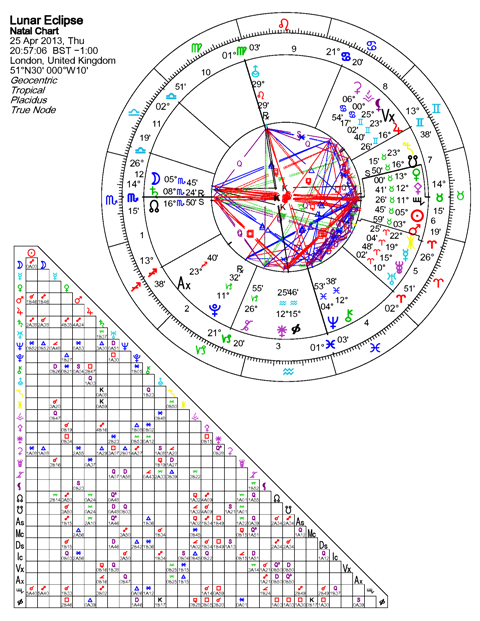
Sedna: The only trans-Neptunian object other than Pluto and Eris that has a
symbol that astrologers commonly use. People have devised symbols for the other
Dwarf Plants and some of the smaller TNO's, but I have not seen them in charts
(even when I looked). The following images :
https://wegoastrology.files.wordpress.com/2014/10/sfpage.jpg
http://www.the-dreamweaver.net/portal/images/Lunar%20eclipse%202013%20apr%2025.png
have some info outside the chart proper that include the Sedna symbol.

Extra Asteroids: Astrologers have devised symbols for asteroids other than
Ceres, Pallas, Juna, and Vesta, but the only ones I've seen in charts are
Hygeia, Astraea, Lillith, and Sappho. The Sappho symbol is usually identical to
U+26A2 DOUBLED FEMALE SIGN (unless you replace the circles with hearts, which
is probably just a stylistic variation), but the others are not in Unicode.

‘Waldemath’s Moon’ aka ‘Dark Moon Lilith’: Not to be confused with Black Moon
Lilith. This is an ‘Astrological Moon’ of Earth. There is no need for a
separate symbol, since it looks like U+2205 EMPTY SET or U+2300 DIAMETER SIGN.

Centaurs : Small Planetoids that orbit between the orbits of Jupiter and
Neptune. Chiron (⚷ U+26B7) is one of them, so when other such objects began to
be discovered in the 90's, some astrologers started using them. The only ones I
have actually come across in charts are symbols for Pholus and Nessus.

Finally, there is some confusion caused by the orbit of the Moon. Astrology
uses virtual points calculated from this orbit ( ☊ ☋ ⚸ ). Thanks to the sun and
the barycentre, the orbit of the moon is rather wobbly, and before the 90's,
astrologers typically (but not always) used an approximation. With the advent
of astrology software and downloadable NASA/JPL information, accurate virtual
points became easy. Versions of ☊ and ☋ with ‘T’ inside them can be used to
indicate the ‘true’ nodes. Also, there is ⚸, a reversed glyph is sometimes used
to indicate the ‘True’ Black Moon Lilith. I have seen charts with both the
regular (mean) and reversed (true) Liliths.

David