Bear in mind as well how often you will be updating certain information:
each update creates a document revision, so a large document where a couple
of fields (or even just one) are frequently updated can lead to increased
storage requirements and will also impact replication: there will be
frequent replication of a large document where only a small part is
actually changing. In a scenario like that, it may well be better to have
the frequently updating field(s) in separate documents.
Regards,

Andrew

On 9 April 2012 17:26, Mohammad Prabowo <[email protected]> wrote:

> Thanks! I had read somewhere that there is a tradeoff between embedding the
> data (example 1) or more normalized document (example 2). It's more of a
> choice between data locality, disk space, and querying flexibilities. I
> guess since every query must go trough views, the speed benefits of data
> locality is therefore reduced
>
> On Mon, Apr 9, 2012 at 9:01 PM, Keith Gable <[email protected]
> >wrote:
>
> > I'd go the first route, but salaries and titles should be arrays of
> hashes:
> >
> > "titles": [
> > { "name": "xxx", "from": "xxx", "to": "xxx" }
> > ]
> >
> > If you want to decouple the data, like if you wanted a list of all
> titles,
> > you'd use CouchDB views.
> > On Apr 9, 2012 6:07 AM, "Mohammad Prabowo" <[email protected]> wrote:
> >
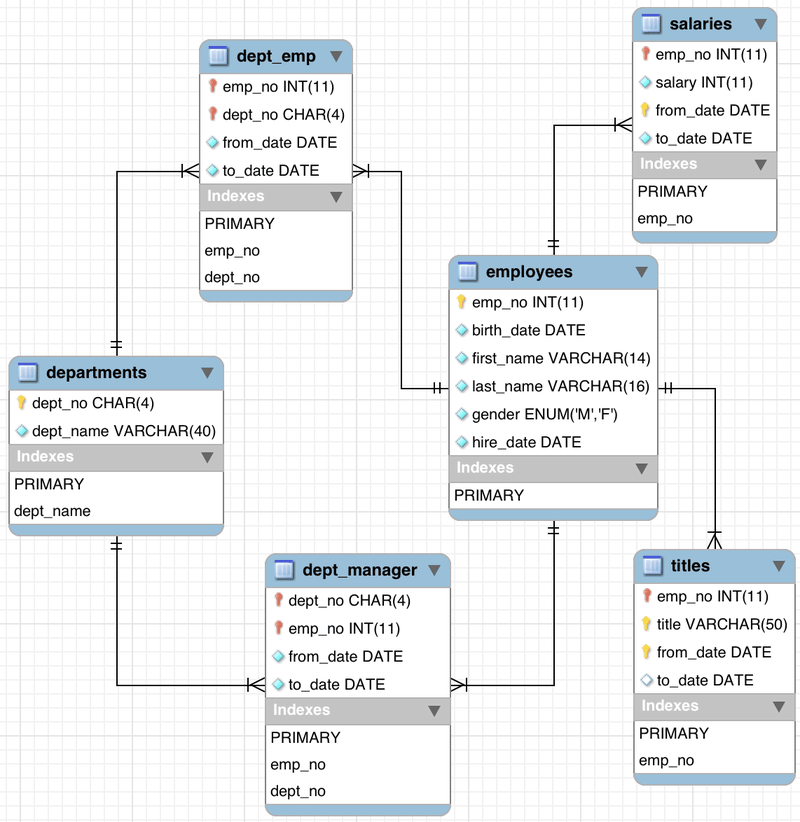
> > > Hi, suppose i have relational db with schema like this
> > >
> > > employees-schema<
> > > http://dev.mysql.com/doc/employee/en/images/employees-schema.png>
> > >
> > > I want to try converting it into document. I have two question:
> > >
> > >   1. The main strength of Document is that it is 'self contained'.
> > Meaning
> > >   we don't need to do JOIN stuff, and all data that is needed are
> > contained
> > >   within documents. So, should i choose to use nested documents like
> > this :
> > >
> > >   {
> > >       "emp_no": "...",
> > >       "birth_date": "...",
> > >       "first_name": "..",
> > >       "last_name": "..",
> > >       "gender": "..",
> > >       "hire_date": "..",
> > >       "titles": {
> > >           "title": "...",
> > >           "from_date": "...",
> > >           "to_date": "..."
> > >       },
> > >       "salaries": {
> > >           "salary": "...",
> > >           "from_date": "...",
> > >           "to_date": "..."
> > >       }
> > >   }
> > >
> > >
> > >   or using different documents like this :
> > >
> > >   [
> > >       {
> > >           "doc_name": "employees",
> > >           "emp_no": "...",
> > >           "birth_date": "...",
> > >           "first_name": "..",
> > >           "last_name": "..",
> > >           "gender": "..",
> > >           "hire_date": ".."
> > >       },
> > >       {
> > >           "doc_name": "titles",
> > >           "from_date": "...",
> > >           "to_date": "..."
> > >       },
> > >       {
> > >           "doc_name": "salaries",
> > >           "salary": "...",
> > >           "from_date": "...",
> > >           "to_date": "..."
> > >       }
> > >   ]
> > >
> > >
> > >   2. I want to benchmark MySQL and CouchDB with
> > > YCSB<https://github.com/brianfrankcooper/YCSB/wiki>.
> > >   Is there are db layer that has been built for CouchDB ?
> > >
> > > Thanks in advance
> > >
> >
>