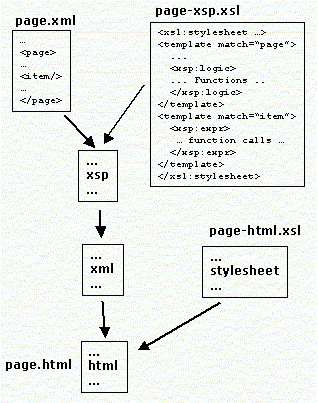
Included logicsheet
This is a much more preferable way to be working, whereby parts of the
original XML document that are matched by the stylesheet are replaced
with sections of logic code. In this scenario, an XSP page is generated from the original XML page, rather than the original XML page BEING an XSP page.
This is an example of a "logicsheet". The original XML file's elements are
replaced with pieces of logic (or plain ole XML, as needed). The
transformation is done by an XSL stylesheet, the results of which are
pieces of XSP logic or expressions.
In the diagram we see that the <item/> element will be substituted with the contents of the <template match="item></template> element. In this case, it's an <xsp:expr></xsp:expr>
element which will presumably contain some kind of Java code, which,
when executed will insert a text node into the XML result tree.
More importantly than the specific contents of the page, once again it is
important that the root element of the resulting XSP page is an <xsp:page> element.
By this stage, the result of this transformation (produced by the
logicsheet) is a canonical XSP page. This will then be "executed" and
the result will be an XML page, with all the variable bits replaced
with actual values. Once again, the XSL stylesheet transforms the final
outcome into a HTML page.
The diagram he refers to is _almost_ identical to the diagram given at the Included Logicsheet section of