Hi :)
Ok, in the case of fruit, say apples and oranges.  There are clear
differences between them.  They might be available (or better) in different
seasons.  One is usually orange and the other usually green or red.  One
might be juicier than the other.  One more acidic than the other.
Different tastes and textures.  Most of us are very clear about the
differences and can easily make an informed decision about which is
preferred at a given moment.
So again the question has apparently gone back to "What is the advantage of
the "Still" branch.  Why would people choose it or what circumstances would
suit "Still" better than "Fresh"?"

Regards from
Tom :)


On 6 August 2014 11:38, Nino Novak <[email protected]> wrote:

> Am 06.08.2014 11:38, schrieb Tom Davies:
>
> > This seems to contradict what both Charles and what Florian Reisinger
> were
> > saying.
>
> No. See below:
>
>
> [...]
>
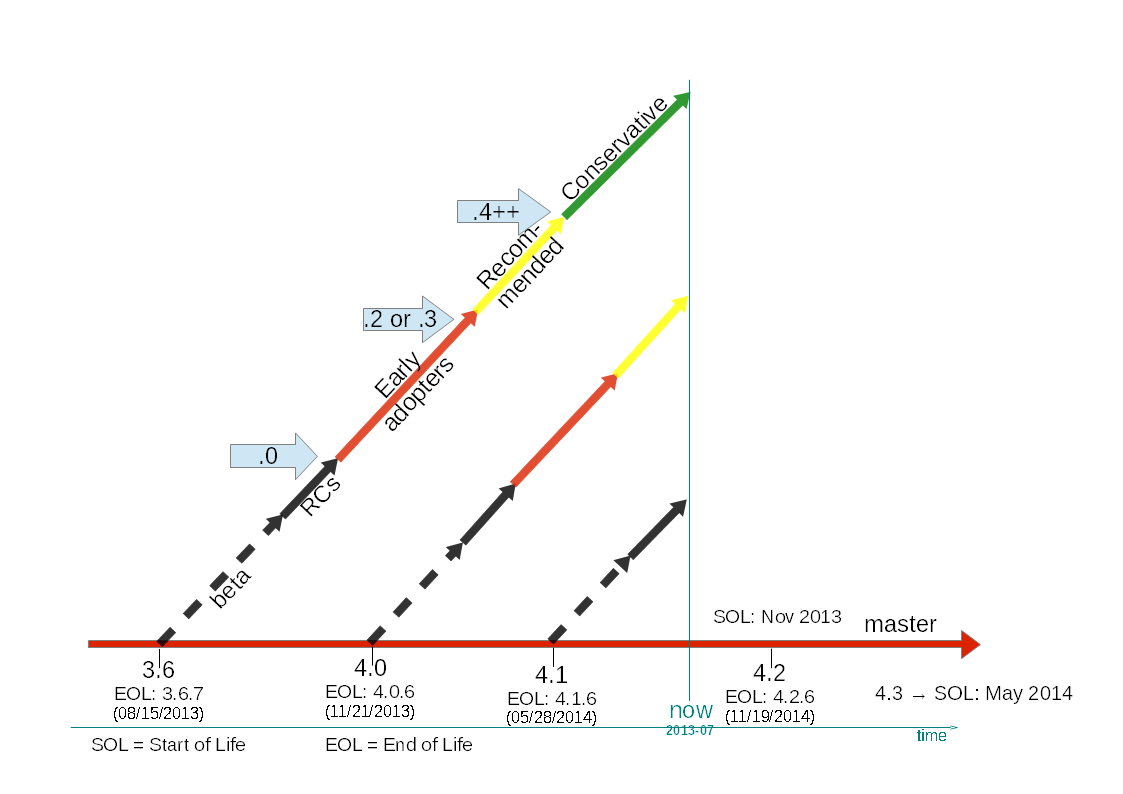
> > It also kinda explains the graphic on the;
> > https://wiki.documentfoundation.org/ReleasePlan
> > page, although that graphic doesn't make a lot of sense to me.  Do other
> > people understand it?  There used to be a neat little graph which kinda
> > boggled the eyes at first but began to make sense after staring at it
> for a
> > while.
>
> By clicking on the graphics you come to its upload page with all former
> versions: just chose the one you want to see, e.g. this:
> <
> https://wiki.documentfoundation.org/images/archive/2/2c/20130819233457!LibOReleaseLifecycle.png
> >
>
>
> > So Nino's answer suggests that some people might prefer the branch that
> has
> > matured because by that time it is more stable.  So releases with a
> higher
> > 3rd digit are more mature, more stable and less likely to have problems.
> > The only downside is that you get less features.
>
> exactly.
>
>
> > However this seems to contradict what Charles was saying about both
> > branches being fully stable.  So which is wrong?
>
> Maybe it's about the usage of the word "stable".
>
> Charles uses it in kind of a "strict sense" in software development: a
> software may be called stable if no crasher bugs are reported/open. (I
> don't
> know the exact actual definition in LibreOffice as I did not find it
> explicitly written somewhere). Florian simply assumes that the state
> "stable" is reached after the 6th bugfix release. So their definitions
> seemingly differ and it might be considered helpful to work on a common
> definition. But there is no doubt that both try to use it "according to
> definition" (or presumable definition).
>
> You seem to use it in an undefined way, kind of a "common sense". Which is
> also right, but - as is the nature of undefined terms - does not reflect
> the
> product's state but rather your (or someone else's) expectations.
>
> So, strictly spoken, Charles/Florian are right. But commonly spoken, you
> are
> right.
>
> There is additionally the problem of comparing two differend kinds of
> fruit:
> it's difficult to compare the maturity of oranges and apples. Strictly
> spoken, you cannot say, this orange is more mature than this apple. In this
> analogy, every minor branch *is* a different fruit as it has different
> features from other minor branches :-)
> Therefore one simply shouldn't compare them regarding "stableness". It will
> always stay an opinion showing that the person uttering it does not really
> understand what she is talking about ;-)
>
>
> Regards,
> Nino
> omg, what a long posting ,-)
>
> --
> To unsubscribe e-mail to: [email protected]
> Problems?
> http://www.libreoffice.org/get-help/mailing-lists/how-to-unsubscribe/
> Posting guidelines + more: http://wiki.documentfoundation.org/Netiquette
> List archive: http://listarchives.libreoffice.org/global/users/
> All messages sent to this list will be publicly archived and cannot be
> deleted
>

--
To unsubscribe e-mail to: [email protected]
Problems? http://www.libreoffice.org/get-help/mailing-lists/how-to-unsubscribe/
Posting guidelines + more: http://wiki.documentfoundation.org/Netiquette
List archive: http://listarchives.libreoffice.org/global/users/
All messages sent to this list will be publicly archived and cannot be deleted