Not to be tedious, but let me raise this question again.  First of all,
k-point.f90 is a routine I've been writing for my own education, and in the
bleariness of a late evening posting, I subliminally substituted it for
kpoints.f.  I did have a quick look at the latter code beforehand, but when
I saw the phrase "special points," I took it to refer to the
Bouckaert-Smolukowski-Wigner notation for high symmetry BZ "special points"
I learned in my younger years (this is the sort of stuff you can find on the
Bilbao website these days).  I do see now the usage of the term in kpoints.f
indeed means the calculation of an MP mesh.  Thanks, Paolo.
What I was most concerned about was the generation of k-point meshes or nets
for use as input to pw.x (nscf) for subsequent post-processing calculations,
such as the computation of Fermi surfaces or optical properties. For
example, the routine kvecs_FS.x appears to fill the reciprocal lattice of
its input structure with uniformly spaced, equally weighted, point
coordinates, whereas the method used to calculate the mesh used for the
aluminum example of epsilon.x is unclear (at least to me).  There is a
warning in the documentation for epsilon.x that "reduction of the k-points
grid into the irreducible BZ" is not supported.  I also note that the
conventional unit cell (ibrav = 1), not the Bravais or primitive fcc (ibrav
= 2) coordinates are used in the example.  Does this mean one can compute
the mesh for epsilon.x using kvecs_FS.x and the "conventional" reciprocal
cell coordinates?

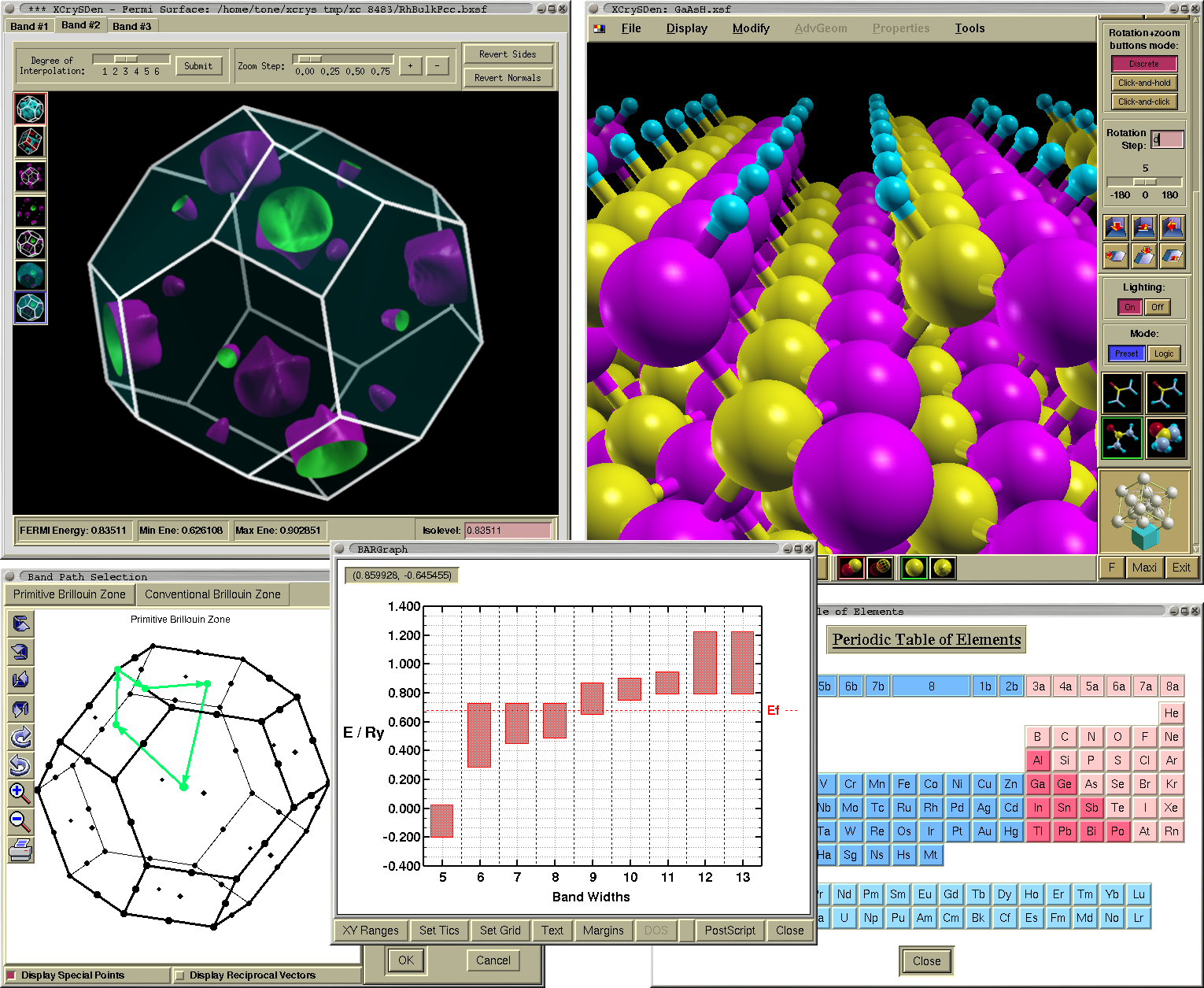
Finally, on the point of mesh visualization.  I use XCrySDen a lot,
especially for BZ and charge-potential visualizations.  But I don't know how
to configure or generate a .xsf file for a 3D mesh of discrete points.

Paul M. Grant, PhD
Principal, W2AGZ Technologies
Visiting Scholar, Applied Physics, Stanford (2005-2008)
EPRI Science Fellow (Retired)
IBM Research Staff Member Emeritus
w2agz at pacbell.net
http://www.w2agz.com
?
?

-----Original Message-----
From: pw_forum-bounces at pwscf.org [mailto:[email protected]] On
Behalf Of Paolo Giannozzi
Sent: Monday, September 15, 2008 1:33 AM
To: PWSCF Forum
Subject: Re: [Pw_forum] k-point grids...and all that

On Sep 15, 2008, at 5:30 , Paul M. Grant wrote:
> The ability to compute weighted 1st BZ grids according to the
> Monkhorst-Pack scheme is included somewhere within espresso-4.0,
> but exactly where is unclear (k-points.f90?  No).
>
of course no, since it is non-existent:
$ ls -l */k-points.f90
ls: */k-points.f90: No such file or directory
There is however an auxiliary code, pwtools/kpoints.f, that produces
Monkhorst-Pack
grids with weights (executable: kpoints.x).

Inside q-e, there are several routines for the generation of
automatic k-point grids.
See PW/setup.f90, under
   !
   ! ... Automatic generation of k-points (if required)
   !
Routines kpoint_grid_efield and kp_strings are specific for
macroscopic field
and Berry phase calculations; kpoint_grid and setupkpoint (undocumented)
take care of the typical scf case. The difference between the two is
just
aesthetic.
> Finally, is there a visualization tool to display the k-point
> distribution within the  1st BZ?  XcrysDen?
>
for sure: see http://www.xcrysden.org/img/xcrysden-in-action.png,
first picture

Paolo
---
Paolo Giannozzi, Dept of Physics, University of Udine
via delle Scienze 208, 33100 Udine, Italy
Phone +39-0432-558216, fax +39-0432-558222


_______________________________________________
Pw_forum mailing list
Pw_forum at pwscf.org
http://www.democritos.it/mailman/listinfo/pw_forum