Send users mailing list submissions to
        [email protected]

To subscribe or unsubscribe via the World Wide Web, visit
        https://lists.quantum-espresso.org/mailman/listinfo/users
or, via email, send a message with subject or body 'help' to
        [email protected]

You can reach the person managing the list at
        [email protected]

When replying, please edit your Subject line so it is more specific
than "Re: Contents of users digest..."


Today's Topics:

    1. oscillations in G(V) diagrams (Jakob Kraus)
    2. Re: oscillations in G(V) diagrams (Lorenzo Bastonero)
    3. Re: oscillations in G(V) diagrams (Lorenzo Paulatto)


----------------------------------------------------------------------

Message: 1
Date: Fri, 4 Nov 2022 09:20:27 +0100
From: Jakob Kraus <[email protected]>
To: [email protected]
Subject: [QE-users] oscillations in G(V) diagrams
Message-ID:
        <[email protected]>
Content-Type: text/plain; charset="utf-8"; Format="flowed"

Dear QE users,


I am trying to calculate heat capacities, and to this end, I have
calculated the Gibbs energy as a function of volume

at several temperatures in a range of 0-700 K.

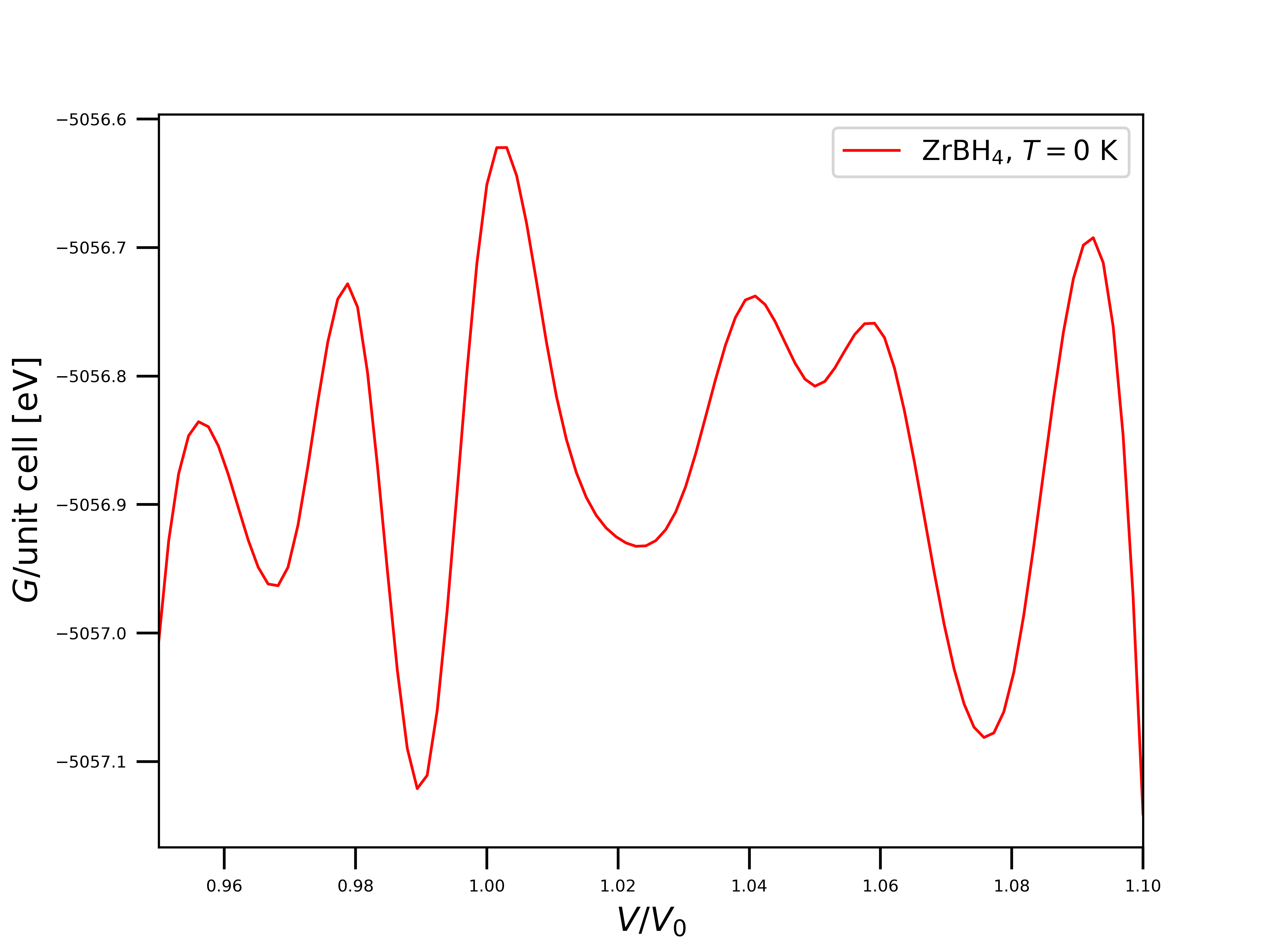
However, the functions that result from this do not show a single
minimum, but rather a whole lot of oscillations, which

seem to originate from the phonons, since the E(V) diagram at 0 K shows
a single minimum as expected.

I am thankful for any help you can offer with getting rid of these
oscillations.

I have attached input files and some plots to showcase the problem.


Best regards,


Jakob Kraus, TU Freiberg
-------------- next part --------------
A non-text attachment was scrubbed...
Name: G_Zr_BH4_0.0.png
Type: image/png
Size: 266484 bytes
Desc: not available
URL:
<http://lists.quantum-espresso.org/pipermail/users/attachments/20221104/ffcac2da/attachment-0002.png>
-------------- next part --------------
A non-text attachment was scrubbed...
Name: E_Zr_BH4.png
Type: image/png
Size: 198727 bytes
Desc: not available
URL:
<http://lists.quantum-espresso.org/pipermail/users/attachments/20221104/ffcac2da/attachment-0003.png>
-------------- next part --------------
&input
fildyn  =   'matdyn'
zasr    =   'crystal'
flfrc   =   'force.fc'
/
-------------- next part --------------
&CONTROL
    calculation      = 'scf'
    title            = 'Zr_BH4_4_v95'
    verbosity        = 'high'
    restart_mode     = 'from_scratch'
    tstress          = .true.
    tprnfor          = .true.
    outdir           = './'
    prefix           = 'espresso'
    pseudo_dir       = '/home/kraus/pslibrary_pp/PBE_PAW'
/
&SYSTEM
    ibrav            = 1
    ecutwfc          = 120
    ecutrho          = 960
    occupations      = 'fixed'
    nspin            = 1
    ntyp             = 3
    nat              = 21
    celldm(1)        = 11.718963054402725
/
&ELECTRONS
    electron_maxstep = 300
    conv_thr         = 1e-10
    mixing_beta      = 0.7
/

ATOMIC_SPECIES
Zr 91.224 Zr.pbe-spn-kjpaw_psl.1.0.0.UPF
B 10.81 B.pbe-n-kjpaw_psl.1.0.0.UPF
H 1.008 H.pbe-kjpaw_psl.1.0.0.UPF

K_POINTS automatic
2 2 2  0 0 0

ATOMIC_POSITIONS angstrom
Zr 3.1007040770 3.1007040770 3.1007040770
B 4.4131080846 1.7883000693 1.7883000693
B 1.7883000693 4.4131080846 1.7883000693
B 1.7883000693 1.7883000693 4.4131080846
B 4.4131080846 4.4131080846 4.4131080846
H 3.2091046915 1.6105056976 1.6105056976
H 2.9923034624 4.5909024564 1.6105056976
H 2.9923034624 1.6105056976 4.5909024564
H 3.2091046915 4.5909024564 4.5909024564
H 1.6105056976 3.2091046915 1.6105056976
H 1.6105056976 2.9923034624 4.5909024564
H 4.5909024564 2.9923034624 1.6105056976
H 4.5909024564 3.2091046915 4.5909024564
H 1.6105056976 1.6105056976 3.2091046915
H 4.5909024564 1.6105056976 2.9923034624
H 1.6105056976 4.5909024564 2.9923034624
H 4.5909024564 4.5909024564 3.2091046915
H 5.0910460240 1.1103621300 1.1103621300
H 1.1103621300 5.0910460240 1.1103621300
H 1.1103621300 1.1103621300 5.0910460240
H 5.0910460240 5.0910460240 5.0910460240

-------------- next part --------------
phdos Zr_BH4_4
&INPUTPH
     tr2_ph      =   1.D-14
     prefix      =   'espresso'
     outdir      =   './'
     fildyn      =   'matdyn'
     ldisp       =   .true.
     nq1         =   3
     nq2         =   3
     nq3         =   3
/
-------------- next part --------------
&input
     asr     =   'crystal'
     flfrc   =   'force.fc'
     dos     =   .true.
     fldos   =   'matdyn.dos'
     deltaE  =   1
     nk1     =   20
     nk2     =   20
     nk3     =   20
/

------------------------------

Message: 2
Date: Sat, 5 Nov 2022 16:55:49 +0100
From: Lorenzo Bastonero <[email protected]>
To: Quantum ESPRESSO users Forum <[email protected]>
Subject: Re: [QE-users] oscillations in G(V) diagrams
Message-ID: <[email protected]>
Content-Type: text/plain; charset="us-ascii"

Dear Jakob,

Do you mean the Helmoltz free energy (F)?

As by definition, the Gibbs free energy (G) does not depend upon volume, but on
pressure and temperature.
At p=0, then they are the same, but notice always that:

G(p,T) = min_{V}[F(V, T)+pV]

Thus, at p=0, you still need to take the minimum of F at the fixed temperature.

Moreover, I guess you are using the quasi-harmonic approximation. There exist
several flavours. Unless your system is isotropic, scaling the volume
isotropically can be a source of error (due to a physical assumption, not due
to the numerics).

Best,
Lorenzo Bastonero

********************************
Lorenzo Bastonero

PhD Student
U Bremen Excellence Chair,
Bremen Center for Computational Materials Science,
and MAPEX Center for Materials and Processes

University of Bremen
Faculty of Production Engineering
TAB-Building, Room 3.32
Am Fallturm 1
28359 Bremen, DE

http://www.hmi.uni-bremen.de/
Il giorno 4 nov 2022, alle ore 09:20, Jakob Kraus
<[email protected]> ha scritto:

Dear QE users,


I am trying to calculate heat capacities, and to this end, I have calculated
the Gibbs energy as a function of volume

at several temperatures in a range of 0-700 K.

However, the functions that result from this do not show a single minimum, but
rather a whole lot of oscillations, which

seem to originate from the phonons, since the E(V) diagram at 0 K shows a
single minimum as expected.

I am thankful for any help you can offer with getting rid of these oscillations.

I have attached input files and some plots to showcase the problem.


Best regards,


Jakob Kraus, TU Freiberg
<G_Zr_BH4_0.0.png><E_Zr_BH4.png><espresso.qi><espresso.pwi><espresso.phi><espresso.mdi>_______________________________________________
The Quantum ESPRESSO community stands by the Ukrainian
people and expresses its concerns about the devastating
effects that the Russian military offensive has on their
country and on the free and peaceful scientific, cultural,
and economic cooperation amongst peoples
_______________________________________________
Quantum ESPRESSO is supported by MaX (www.max-centre.eu)
users mailing list [email protected]
https://lists.quantum-espresso.org/mailman/listinfo/users
-------------- next part --------------
An HTML attachment was scrubbed...
URL:
<http://lists.quantum-espresso.org/pipermail/users/attachments/20221105/b9bcdfe7/attachment-0001.html>

------------------------------

Message: 3
Date: Sat, 5 Nov 2022 22:09:31 +0100
From: Lorenzo Paulatto <[email protected]>
To: <[email protected]>
Subject: Re: [QE-users] oscillations in G(V) diagrams
Message-ID: <[email protected]>
Content-Type: text/plain; charset="utf-8"; Format="flowed"

Hello Jakob,

you do not give much detail about what you are doing. As said, QHA is
effective when dealing with one degree of freedom (i.e. cubic
semiconductor) but harder to use in any other case. Are you doing a
constant-volume variable-cell relax (aka cell_dofree='shape') for a
series of volumes? And then computing for each volume the Helmholtz free
energy (from the phonons directly or from the dos)? Are you doing this
your self by hand or using one of the available QHA software packages?

The oscillations could be an honest bug, or a difficult integration of
the DOS.

cheers


On 04/11/2022 09:20, Jakob Kraus wrote:
Dear QE users,


I am trying to calculate heat capacities, and to this end, I have
calculated the Gibbs energy as a function of volume

at several temperatures in a range of 0-700 K.

However, the functions that result from this do not show a single
minimum, but rather a whole lot of oscillations, which

seem to originate from the phonons, since the E(V) diagram at 0 K
shows a single minimum as expected.

I am thankful for any help you can offer with getting rid of these
oscillations.

I have attached input files and some plots to showcase the problem.


Best regards,


Jakob Kraus, TU Freiberg

_______________________________________________
The Quantum ESPRESSO community stands by the Ukrainian
people and expresses its concerns about the devastating
effects that the Russian military offensive has on their
country and on the free and peaceful scientific, cultural,
and economic cooperation amongst peoples
_______________________________________________
Quantum ESPRESSO is supported by MaX (www.max-centre.eu)
users mailing [email protected]
https://lists.quantum-espresso.org/mailman/listinfo/users