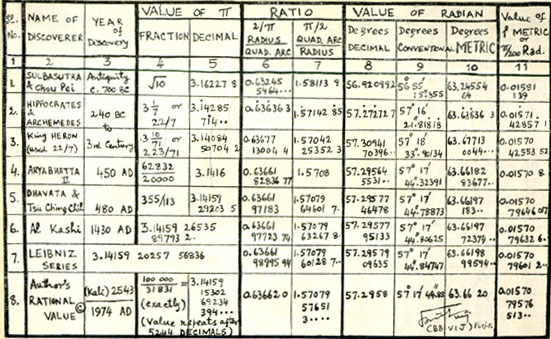
You are right 355/113 (from 113355 - just write the first 3-digits in denominator) is the approximation from China, which is fairly accurate. Yet, it does not FIX the value for arc-angle 'Radian', which is (57�.2958 or 57�17'44".88).This is fixed using Pi=100000/31831 (3.
14159 15302 69234 39414 40733 87578 14708 .....etc.)
√10 or Pi squared is also 10.
Regards,
Brij B. Vij TIME: to think Metric!<[EMAIL PROTECTED]> <And Calendar too>
From: Pat Naughtin <[EMAIL PROTECTED]>
Reply-To: [EMAIL PROTECTED]
To: "U.S. Metric Association" <[EMAIL PROTECTED]>
Subject: [USMA:24478] Re: Value of Pi As A Fraction
Date: Fri, 17 Jan 2003 19:03:21 +1100
Dear Brij, Joe, and All,
I have always liked the approximation of � (pi) that is 355/113
(3.141�592�9). I heard that this approximation is ancient and comes from
China, but I have never been able to confirm that. I like it because it only
uses the first three odd digits and it is more accurate than 22/7.
Cheers,
Pat Naughtin LCAMS
Geelong, Australia
on 2003-01-17 02.14, Joseph B. Reid at [EMAIL PROTECTED] wrote:
> Brij Bhushan Vij wrote in USMA 24467:
>
>> Madan, Bill and friends:
>> I have had the oppertunity of examining most values for Pi used by
>> man since (I could trace) and believe that *without defining Pi or
>> 'radian'* the sign of equation for circle (=2 Pi radians) is
>> incomplete. The data, I worked is placed at:
>> http://the-light.com/cal/bbv_pi-radian.jpg
>> It may be observed that NO VALUE for Pi fits the above criteria,
>> since all suffer from its *truncation limit* during its evaluation.
>> My suggestion to use Pi=100000/31831 (exactly) had a run in computer
>> (1973) and in 'decimal notation' repeat all by itself after 5244th
>> decimal, over and over again. This fixes the value for Pi, and also
>> fixes the value for 'Radian = 57.2958 degree'; to make the
>> definition meaningful.
>> Regards,
>> Brij B. Vij TIME: to think Metric!<[EMAIL PROTECTED]>
>> <And Calendar too>
>>
>
>> I was suspicious of this posting since I had always regarded pi as
>> irrational. A favorite exercise for underused super-computers is
>> adding a few hundred more digits to the value of pi. I have just
>> referred to Hardy's "Pure Mathematics" where I found the following:
> "It has been shown (though the proof is long and difficult) that this
> number pi is not the root of any algebraic equation with integral
> coefficients,"
> On page 382 of Hardy we find:
> pi/4 = 1 - 1/3 + 1/5 - ....
> I believe that there are more-rapidly convergent series for pi, but I
> can't put my hands on them.
_________________________________________________________________
Add photos to your e-mail with MSN 8. Get 2 months FREE*. http://join.msn.com/?page=features/featuredemail