Pierre Abbat & list:
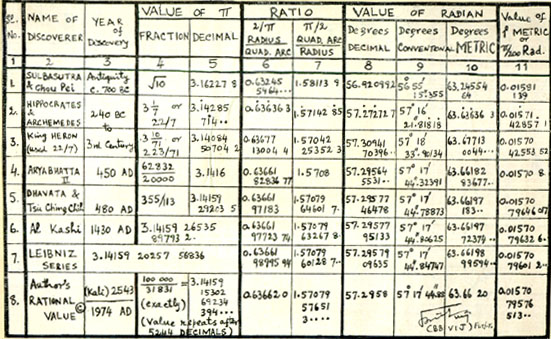
The Pi question has been discussed several times over. If Pi is the ratio
between circumference to the diametre of a circle, the BEST and only
fractional value for Pi in the form *a/b ratio* happen to be simple:
100000/31831, which also defines the angle radian at 57.2958 degree. Also,
visit: http://www.the-light.com/cal/bbv_pi-radian.jpg
Brij Bhushan Vij <[EMAIL PROTECTED]>
(Kali5106-W26-02)/D-284+1 (Wednesday)2005 Oct.12H1266(decimal) IST
Aa Nau Bhadra Kritvo Yantu Vishwatah -Rg Veda
Jan:31; Feb:29; Mar:31; Apr:30; May:31; Jun:30
Jul:30; Aug:31; Sep:30; Oct:31; Nov:30; Dec:30
(365th day of Year is World Day)
******As per Kali V-GRhymeCalendar******
Telephone: +91-11-25590335
From: Pierre Abbat <[EMAIL PROTECTED]>
Reply-To: [EMAIL PROTECTED]
To: "U.S. Metric Association" <[email protected]>
Subject: [USMA:34812] Re: common fractions fail for some numbers
Date: Tue, 11 Oct 2005 17:11:00 -0400

On Tuesday 11 October 2005 14:59, Bill Hooper wrote:
> A question recently raised here is how to show the results on non-even
> division (like 20 divided by 3) without using common fractions. It's
> interesting to note that there are other numbers that can't be
> described using common fractions.
>
> How would one use common fractions to cope with numbers like the square
> root of 2 or the square root of 3 etc., or the value of pi, or e (the
> base of the natural logs). Common fractions give one additional
> (superfluous?) way to describe one kind of number (results of non-even
> division) but they fail completely in describing other kinds of numbers
> (like the irrational numbers mentioned above).
>
> The best that can be done is to give approximations like
>   pi = 22/7
>
> or
>   square root of 2 = (1 and 2/5)
>     or (1 and 3/7)
>     or (1 and 13/32)
>
> All of these are approximations, but approximation are no better or
> worse here than are approximations like
>   20 / 3 = 6.67
> which can be used for expressing the result of dividing 20 by 3.
Transcendental numbers can be approximated much better by rationals that
are
not constrained to power-of-ten denominators (see Liouville's theorem), and
even algebraic numbers usually have better approximations. A particularly
good approximation to pi is 355/113, and 99/70, which I'm sure you'll
recognize better as 297/210, is a better approximation to sqrt(2) than
1.414.
(1189/841 is the next best one, 41/29.)

phma