BTW, I do not how many of you are aware of the enclosed
method of
removing
an imbedded hook. This method is absolutely
amazing.
It is
foolproof any absolutely PAINLESS. I have used it on myself and on
others
and it
is astonishing how easily and painlessly the hook pops
out.
JG
Here are a few methods for removing hooks.
When a hook's point and barb are protruding out the
skin, it's easier to cut off the barb and back the hook out of the wound.
This is when those sharp wire cutters come in handy.
The snatch method of hook removal is simple and
effective, and it's the best method to remove a hook that's deeply imbedded
in the skin and when the barb is buried.
This method is quick, simple and relatively painless,
as long as you get it on the first try. The secret to a first time success
is yanking the loop of line, which is wrapped around the embedded hook,
rather hard so the hook comes out on the first try. The reason you should
get it out on the first try is obvious, the patient might not stick around
for a second try.
To perform the snatch method when the barb is
imbedded, all that's needed is a short length of fishing line, at least 10
pound test, approximately 2 feet long.
- Remove hook from lure.
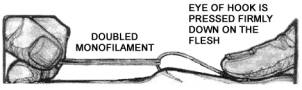
- Double the fishing line and loop it around the hook,
as close to
the skin's surface as possible.
- Hold onto both ends of the doubled line, wrapping
them around your
hand for a firm grip and holding
the line parallel to the skin's
surface in line with
the hook.
- With your other hand, press the eye of the hook
down onto the
surface of the skin and back toward
the hook's bend, as if trying to
back the hook out
of the wound.
- While pressing on the hook eye, yank the line
sharply, parallel to
the skin and in line with the
hook, to snap the hook back out of the
wound.
- Apply antibiotic ointment, bandage wound and
check to make sure
tetanus shots are current.
|
