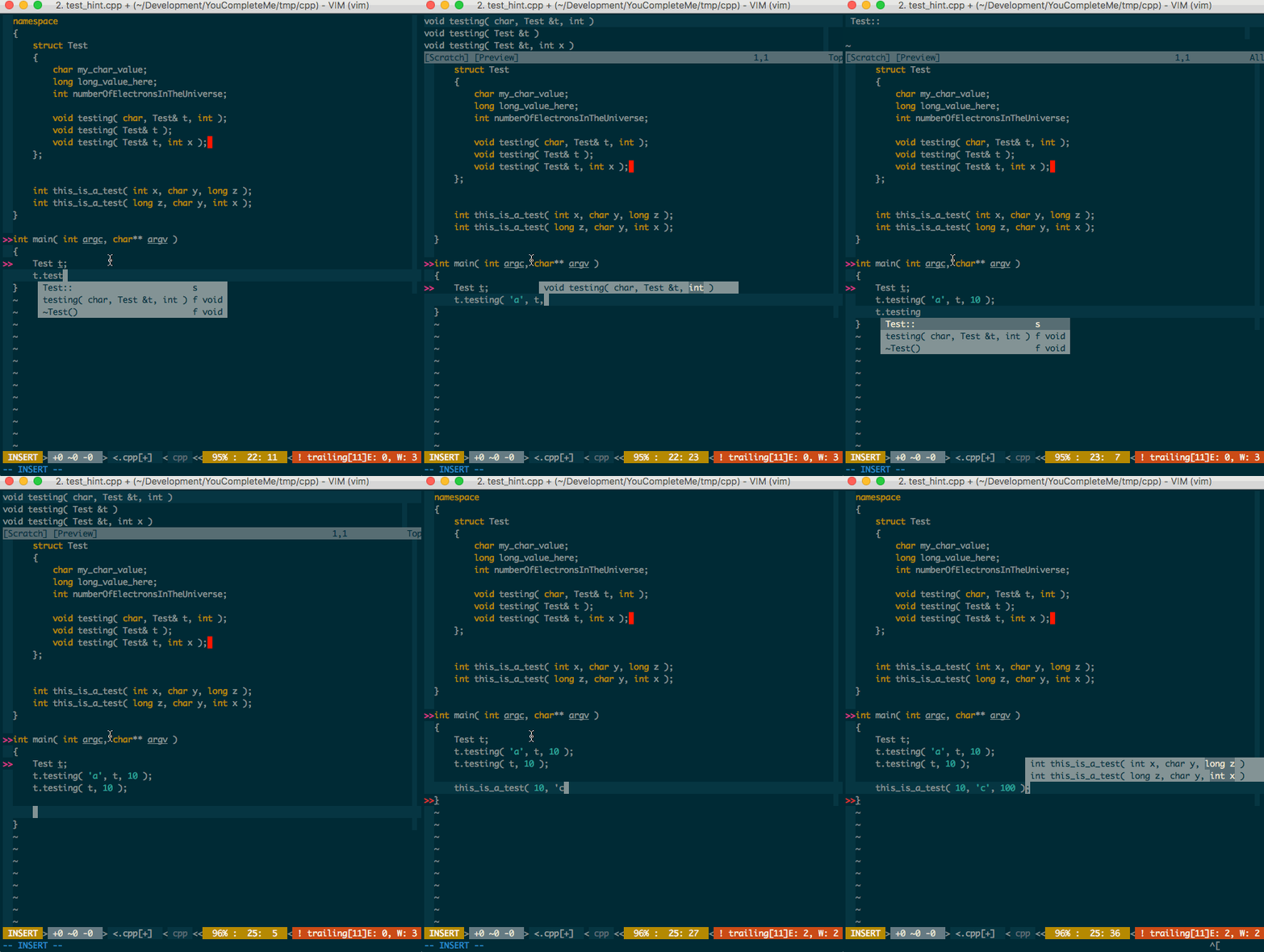
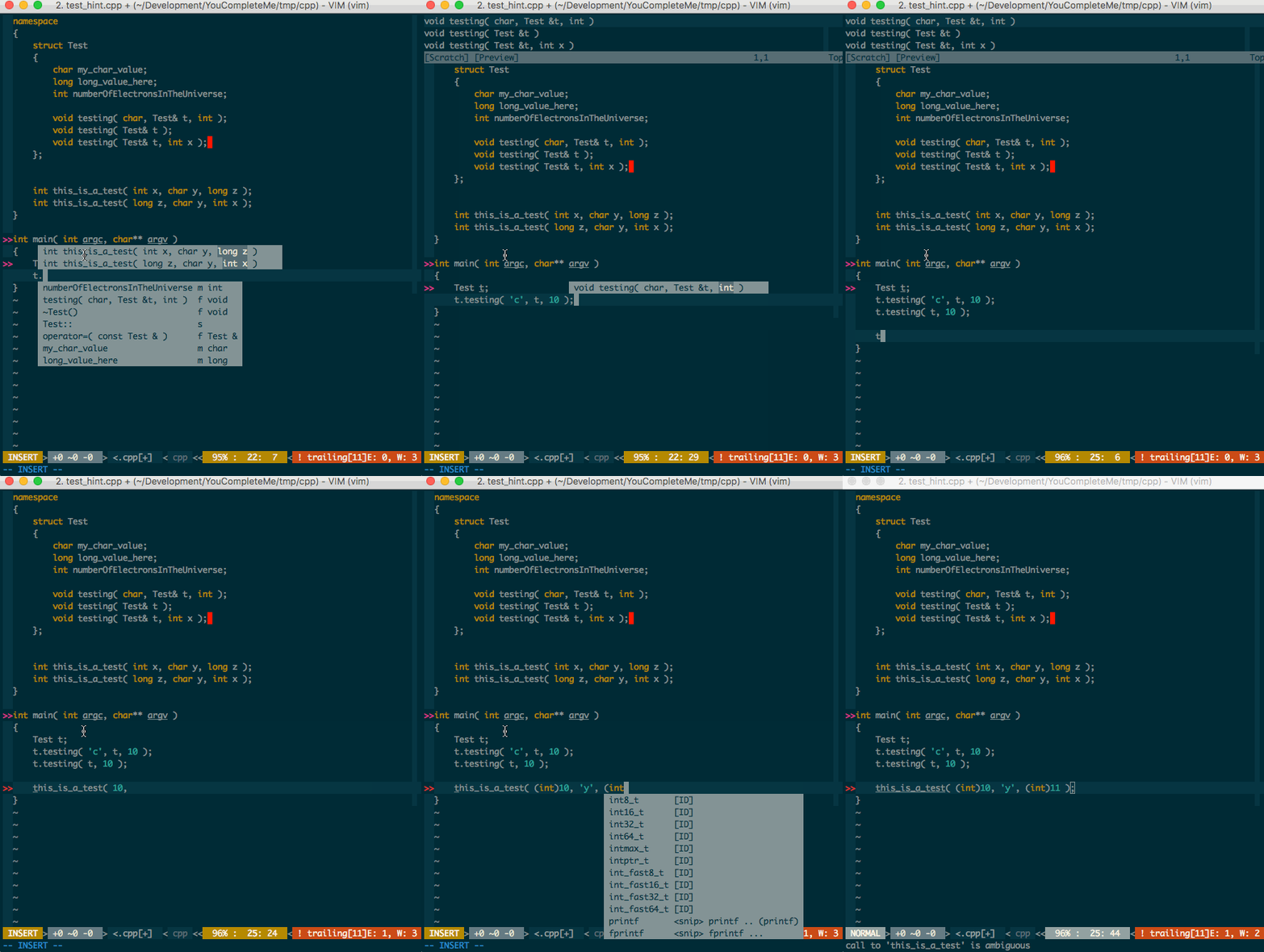
On Saturday, December 23, 2017 at 12:23:43 PM UTC+1, Ben Jackson wrote:
> Hi Bram and community,
>
> I have prepared a brief request for comments on a proposed new Vim feature
> which I am personally very keen on, but would like to gauge the appetite for
> it and the thoughts of the community and maintainers at large before actually
> embarking on a proper implementation.
>
> The feature is IDE-like display of the method signature being entered at the
> same time as the insert-mode completion menu.
>
> The RFC is best viewed in a gist here and includes a POC and some demos in
> animated-gif form:
> https://gist.github.com/puremourning/3ac3be4527ee094250ae516fc26561a2
>
> It's also replicated below for those that prefer plaintext :)
>
> I'd be super grateful for any responses, comments, flames, ideas or even
> insults ;)
>
> Cheers,
> Ben
>
> ---
>
> # TL;DR
>
> This RFC proposes introducing a second popup menu in insert mode to display
> method argument hints, current parameter, etc. similar to a number of IDEs and
> editors. The proposal is to allow scripts to control this (such as on insert
> of
> `(` and `)` characters) and for it to be non-interractive and not to interfere
> with insert-mode completion.
>
> The purpose of the RFC is to guage the appetite from Bram and the community
> for
> such a feature, and to discuss the design/functional behaviours prior to
> committing to an implementation/etc.
>
> # Motivation
>
> There are a number of Vim plugins which attempt to provide some IDE-like
> features using Vim's completion system, in combination with omnifuncs and
> insert-mode completion that is built-in. Examples:
>
> - YouCompleteMe - https://github.com/Valloric/YouCompleteMe
> - neocomplete, deoplete, neocomplcache, and other friends
> - eclim?
> - any number of hundreds of omnifuncs
> - Microsoft language server client?
> - Various other "async complete" plugins
> - possibly any number of other completion plugins, including implementations
>   specific to particular languages (e.g. using omnifunc), or using l
>
> In their simplest form, these provide a list of identifiers which are
> semantically valid to be inserted at the current cursor position (or the
> result
> of the equivalent of omnifunc's 'findstart' request), using the insert-mode
> completion APIs provided by Vim.
>
> One of the most commonly requested features for YouCompleteMe is the ability
> to
> display the valid arguments for function calls, as well as semantically
> correct
> identifiers. This feature is known as "argument hints", "parameter
> completions", "signature help" or suchlike.
> [Microsoft's Language Server Protocol][lsp] refers to them as "Signature
> Help".
>
> # Illustrative example
>
> For example, the user types something like the following, with the cursor on
> `^`:
>
> ```c
>
> typedef struct pum_T
> {
>   int pum_item_count;
>   int pum_selected;
>   pumitem_T* items[];
> } pum;
>
> void pum_display_item( pum_T* pum,
>                        char_u* message,
>                        pumitem_T* item_list );
>
> void pum_display_item( pum_T* pum,
>                        int selected_item,
>                        pumitem_T* item );
>
> void main(void)
> {
>   pum_T pum = init_pum();
>   pum_display_item( pum, pum.^
> }
>
> ```
>
> Current completion systems (or omni-completion, invoked with `<C-x><C-o>`)
> would
> typically present a popup menu with the valid options from the definition,
> such as:
>
> - `int pum_selected`
> - `int pum_item_count`
>
> Methods often have many more arguments than this toy example, and
> the declaration is not likely visible when it is used. Instead, many IDEs and
> other editors provide a second "popup" when the user types the `(`. Typically,
> this is _above_ rather than below the current line and contains the list of
> overloads of the fucntion and their arguments, often highlighting (one way or
> another) the "current" argument being entered.
>
> For example, it might look like this:
>
>     |------------------------------------------------------------------------|
>     | pum_display_item( pum_T* pum, **char_u *message**, pumitem_T* item )   |
>     | pum_display_item( pum_T* pum, **int selected_item**, pumitem_T* item ) |
>     |------------------------------------------------------------------------|
>     pum_display_item( pum, pum.^
>                                |---------------------------|
>                                | pum_selected         int  |
>                                | int pum_item_count   int  |
>                                |---------------------------|
>
> # Known existing attempts in Vim
>
> - **The preview window.**
>   By using the extra data in the completion menu item structure, we can show
>   some static information in the preview window. The drawbacks are that the
>   preview window has to always be visible (taking up valuable screen real
>   estate), or it pops in and out of visibility, causing the current row to
>   shift disconcertingly on the screen. Requires `preview` in the `completeopt`
>   and other autocmds etc. to show/hide it. Cursor moving into and out of
>   the preview window triggers `BufEnter` autocoms, which causes meaningful lag
>   when the completion menu is visible (OK, this could be blamed mostly on the
>   plugins using `BufEnter` autocommand, but you get the picture).
>
> - **Oblitum/YouCompleteMe.**
>   This is an approach using the standard PUM 100% with no hacks. The drawback
> is
>   that only the current argument is displayed, and mutually exclusively with
>   suggestions for the current identifier.
>
> - a YouCompleteMe test which also uses the command line (user experience is
> not
>   good using the command line, as the text can be clobbered by other things,
>   timers, etc.)
>
> - **jedi-vim.**
>   A python omnifunc plugin uses conceal highlighting to simulate a second
> menu.
>   The conceal apprach seems to involve actually changing the buffer contents
> and
>   relying on special highlight groups to make the _appearance_ of a second
>   "menu".  Ingenious, perhaps, but probably not fun to implement or maintain.
>   With no disrespect to the author, it seems like a hack.
>
> There are probably others; I just listed the ones I researched.
>
> # Proposal
>
> Vim currently supports a single popup menu, which is used for:
>
> - insert-mode completion
> - balloons (a more recent addition, only in the terminal)
>
> In the GUI, balloons are implemented as a popover window via a GUI-specific
> mechanism.
>
> The proposal is to allow 2 (mostly) independent popup menus to be displayed
> insert mode:
>
> - the interractive completion menu, controlled without changes (via CTRL-X
> mode)
> - a second menu not overlapping the completion menu controlled only by
> scripts.
>
> For the purposes of this RFC (and brevity), I will refer to the menus as:
>
> - the completion menu, and
> - the hint menu
>
> respectively.
>
> ## Display
>
> Priority in terms of display is always given to the completion menu, as that
> is
> the one the user interracts with. The completion menu prefers to draw below
> the
> cursor (if there is room), above otherwise.
>
> The hint menu prefers (for example):
>  - if there is no completion menu:
>     - if there is room above, above the cursor line
>     - otherwise if there is blow, below the cursor
>     - otherwise not at all
>  - if there is a completion menu, and it wants to be below the cursor:
>     - if there is room above, above the cursor line
>     - otherwise, not at all
>  - if there is a completion menu, and it wants to be above the cursor:
>     - if there is room below, below the cursor line
>     - otherwise, not at all
>
> Both the completion menu and the hint menu are cleared when a balloon is
> displayed.
>
> ## Content
>
> Discussion point: This is open for debate and I would love to hear thoughts on
> it. I see there are a couple of options here:
>
> 1. **"Pass-through"**.  The contents of the hint menu are at the discretion of
>    the script. Borrowing from the approach taken for balloons, the menu
> supports
>    a list of strings, but does not perform any additional formatting (such as
>    spacing/splitting).
>
> 2. **"Call a spoon a spoon"**. The purpose of the feature is argument hints,
> so
>    we make the API specific to that. Anything else is YAGNI.
>    e.g. The API is passed a list of signatures, including the active signature
>    and argument. Vim then handles the display and highlighting, allowing the
>    script interface to be relatively simple, while restricting (perhaps) the
>    amount of innovation.
>
> # Implementation
>
> One could argue that parameter hints are a special case of balloons. The
> special
> case is that they are visible at the same time as completions in insert mode.
> However, I'm not totally convinced that's the right approach. In particular,
> balloons are very different in the terminal and GUI, and I feel like this
> feels
> more similar to insert-mode completion than any existing expected use case for
> balloons.
>
> So instead, the proposal is to actualy just add (yet) another popupmenu, whose
> data is independent of the existing popopmenu and balloon data.
>
> The general idea would be to re-use most (if not all) of the existing
> popupmenu
> code, by factoring its data out and passing an instance of "a" pum to most
> functions. A vimscript API controls the hint pum, and the API for completion
> is
> unchanged.
>
> Here's a (very) brief idea of how I _think_ it could be done:
>
> - Phase 1, refactor so that pum data isn't quite-so global
>   - store all pum-related state in a struct pum_T
>   - declare a single instance of this  called `compl_pum`
>   - use `compl_pum` for completion and balloons exactly as it is used today
>   - No functional change.
>
> - Phase 2, add the second pum
>   - create a vimscript API that allows a script to display the hint pum in
>     insert mode
>   - provide experrimental support for:
>     - hint_pum_set( {arg} )  = set the contents of the hint menu
>        - arg contents TBD, but a list of strings, maybe or something else...
>     - hint_pum_show( column ) = enable display of the hint menu
>     - hint_pum_hide()         = disable display of the hint menu
>     - hint_pum_visible()      = return whether hint menu is displayed
>   - hint the hint pum when exiting insert mode (and probably a load of other
>     things i haven't thought of)
>
> - Phase 3, allow hint menu to highlight the current argument
>   - Details sketchy, as they depend on some of the previous discussion points.
>   - One option is to embed something, perhaps using magic string markers in
> the
>     menu input strings, to "bold" some section.
>   - Another option might be to somehow use new specific highlighting groups,
>     or something along those lines, combined with knowledge about which
> argument
>     is selected.
>
> # Comments
>
> I'd welcome comments on anything including:
>
> - The welcomeness/appetite for such functionality
> - The generality of the proposal (or otherwise)
> - The overall approach, related ideas/works/etc.
> - Niggly bikeshedding; the more the merrirer
>
> Of course nothing is set in stone at this stage, but I did write a proof of
> concept about 12 months ago as part of the research into the idea.
>
> Some demos are attached to the gist as comments. I can point to the code in
> Vim and YouCompleteMe, but it is very hacky and exploratorys, so it would be
> completely re-engineered before any PR/patch is sent.
>
> [lsp]:
> https://github.com/Microsoft/language-server-protocol/blob/master/protocol.md#textDocument_signatureHelp
>
> Demos:
> 1.
> https://user-images.githubusercontent.com/10584846/34235430-99105e76-e5e9-11e7-819e-9ae8e77bc9f8.gif
> 2.
> https://user-images.githubusercontent.com/10584846/34235624-c09472e2-e5ea-11e7-9430-0058389e0a92.gif
> 3.
> https://user-images.githubusercontent.com/10584846/34235626-c2d7faec-e5ea-11e7-99ea-a3122ff377a6.gif
Hello,

I have updated this patch on top of commit 8.1.0360. I haven't added any tests
or help docs, but you can view the updated branch here:

https://github.com/bstaletic/vim/tree/current_argument_update

Best regards,
Boris Staletic

--
--
You received this message from the "vim_dev" maillist.
Do not top-post! Type your reply below the text you are replying to.
For more information, visit http://www.vim.org/maillist.php

---
You received this message because you are subscribed to the Google Groups
"vim_dev" group.
To unsubscribe from this group and stop receiving emails from it, send an email
to [email protected].
For more options, visit https://groups.google.com/d/optout.