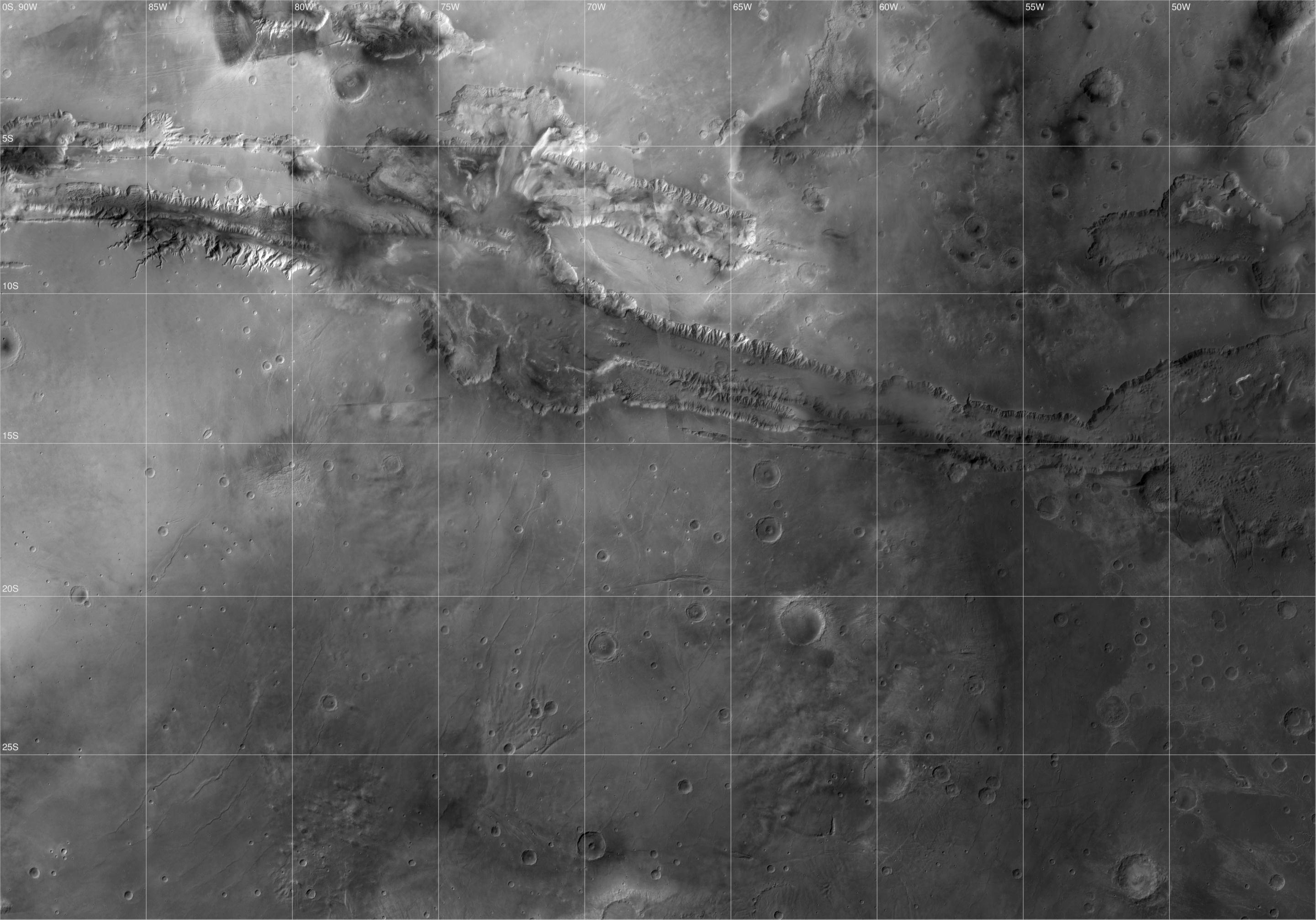
I've long suspected Mars may only be an orphaned moon from whatever planet
is now represented by the asteroid belt in our solar system.  It's density
and composition point in that direction.  These signs of a violent past may
be scars from the cataclysmic end of it's host.
Or not.  8^)


-----Original Message-----
From: revtec [mailto:[EMAIL PROTECTED]
Sent: Friday, September 16, 2005 10:24 AM
To: [email protected]
Subject: Re: totally OT: a fallen moon


Could this be proof that Velikovsky was right after all?  Wouldn't a close
encounter with earth leave the same foot print?  It seems clear that Mars
once had an atmosphere and water.  With Earth being much more massive than
Mars, wouldn't the Earth draw off the atmosphere and perhaps most of the
water during a near miss.  The violent transfer would definitly leave some
kind of track on the Martian surface.  A third Martian moon may also have
been caught up in the process.

Jeff


----- Original Message -----
From: "William Beaty" <[EMAIL PROTECTED]>
To: <[email protected]>
Sent: Thursday, September 15, 2005 10:43 PM
Subject: totally OT: a fallen moon


>
>
> As a kid in the 1960s I remember staring at the world map in the
> classroom and *knowing* that the Americas fit with Europe and Africa
> like a jigsaw puzzle.  In 1965 this was geological heresy, but the
> grade school kids like me were seeing something real, something that
> professional geologists denied.
>
> So now I'm looking at the map of Mars over my desk, and I know enough
> to take my first impressions seriously.  The Valles Marineris
> (http://en.wikipedia.org/wiki/Valles_Marineris) is too straight.  WAY
> too straight.  Well, actually it's curved in a sine wave that extends
> as a discoloration across more than half the planet.  (World maps with
> sine waves drawn on them are plots of orbiting spacecraft, where the
> angled circular orbit is "unrolled" to form a wave.)  Also, Valles
> Marineris is aligned with the Martian equator, so it's also aligned
> with the plane of the ecliptic where moon orbits lie.  Maybe not a
> coincidence.  Also, Valles Marineris has many widely separate parallel
> features which are also perfectly straight.  Also there are all kinds
> of crater chains
> (http://www.msss.com/mars_images/moc/moc_atlas/mc18.jpg) parallel to the
> valley all around the same region.
>
> Yet explanations of this valley talk about a cracking crust.  Perhaps.
> But I don't believe it.  There are linear gouges and broad lines of
> discoloration WAY downstream of the main valley.  I predict that
> within a decade or two the expert opinion will shift: Valles Marineris
> is an astrobleme, it was carved out by a moon that fell from orbit.
> The Valles region doesn't extend all the way around the planet, so it
> probably wasn't caused by a planetary ring.  It's composed of several
> large parallel tracks, so the moon probably exploded and the cloud
> started expanding before it came down.
>
> Imagine the event!  An entire moon hits the atmosphere and breaks up
> into two or three huge chunks plus lots of rubble, into a hundred
> asteroids, which then roll across the land at orbital velocity from
> horizon to horizon like incandescent bowling balls the size of
> Manhattan.
>
>
>
> (((((((((((((((((( ( (  (   (    (O)    )   )  ) ) )))))))))))))))))))
> William J. Beaty                            SCIENCE HOBBYIST website
> billb at amasci com                         http://amasci.com
> EE/programmer/sci-exhibits   amateur science, hobby projects, sci fair
> Seattle, WA  206-789-0775    unusual phenomena, tesla coils, weird sci
>
>