Bob,
Simply stated – we can suggest that we could be seeing a unique chemical
reaction which gives more energy in formation than it requires to decompose
back to the original reactants.


Standard textbooks says NO WAY. Gibbs free energy is balanced. Nevertheless, if
there was to be found such a reaction, and Parkhomov could provide the
evidence, then it would still require the equivalent of mass loss. The
zero-point field could potentially supply mass-equivalence to a chemical
reaction in a number of forms, including your favorite: spin energy. Another
way is ground state redundancy, which is also spin – in the form of angular
momentum.


From: Bob Cook


To show my ignorance, what's a Gibbs energy vector?  Can it point into negative
energy?  Zero point?  I am not sure of all your inferences.

A side note which should be mentioned re: Mark’s listing of citations, given
the extreme energetics of lithium hydride… is whether we are looking at a
subset of violation of parity. Or maybe it is the superset.

A “near miracle” explanation for the Parkhomov anomaly can be called
“asymmetric chemistry.” It involves a net energy deficit between thermal
decomposition compared to the heat of formation. There could exist a small gap
which then is cumulative via a serial process for net gain. Except for the Lamb
shift, this kind of asymmetry is almost unknown in physics. The ultimate source
of gain would be zero point.

The alternative “miracle explanation” for gain, of course … is nuclear fusion,
in the guise of LENR. BUT… if we want to talk about “conservation of miracles”
the nuclear explanation requires 3 miracles to explain the Parkhomov effect.

1)      Overcoming the coulomb barrier

2)      Complete avoidance of gamma rays or bremsstrahlung

3)      Complete avoidance of radioactive ash

While Gibbs asymmetry, as we can call it - requires something less than a
miracle, since it is hinted at already. Until 1947, physics assumed that all
forces of nature were completely symmetric and did not distinguish between
right and left, image and mirror-image or between Gibbs energy vectors. The
discovery of violation of parity in 1956 was more than a sensation, it was a
shocker since it went beyond QM: as the Lamb shift a decade earlier was both
minimal and quantum. Both imply that the universe displays handedness, or
chirality, and this is fundamentally asymmetric. “Enantioselective catalysis”
took that a step further into thermodynamics … and now hydride chemistry could
change everything that we assume about the necessity of symmetry in nature… and
at high probability.

From: Mark Jurich

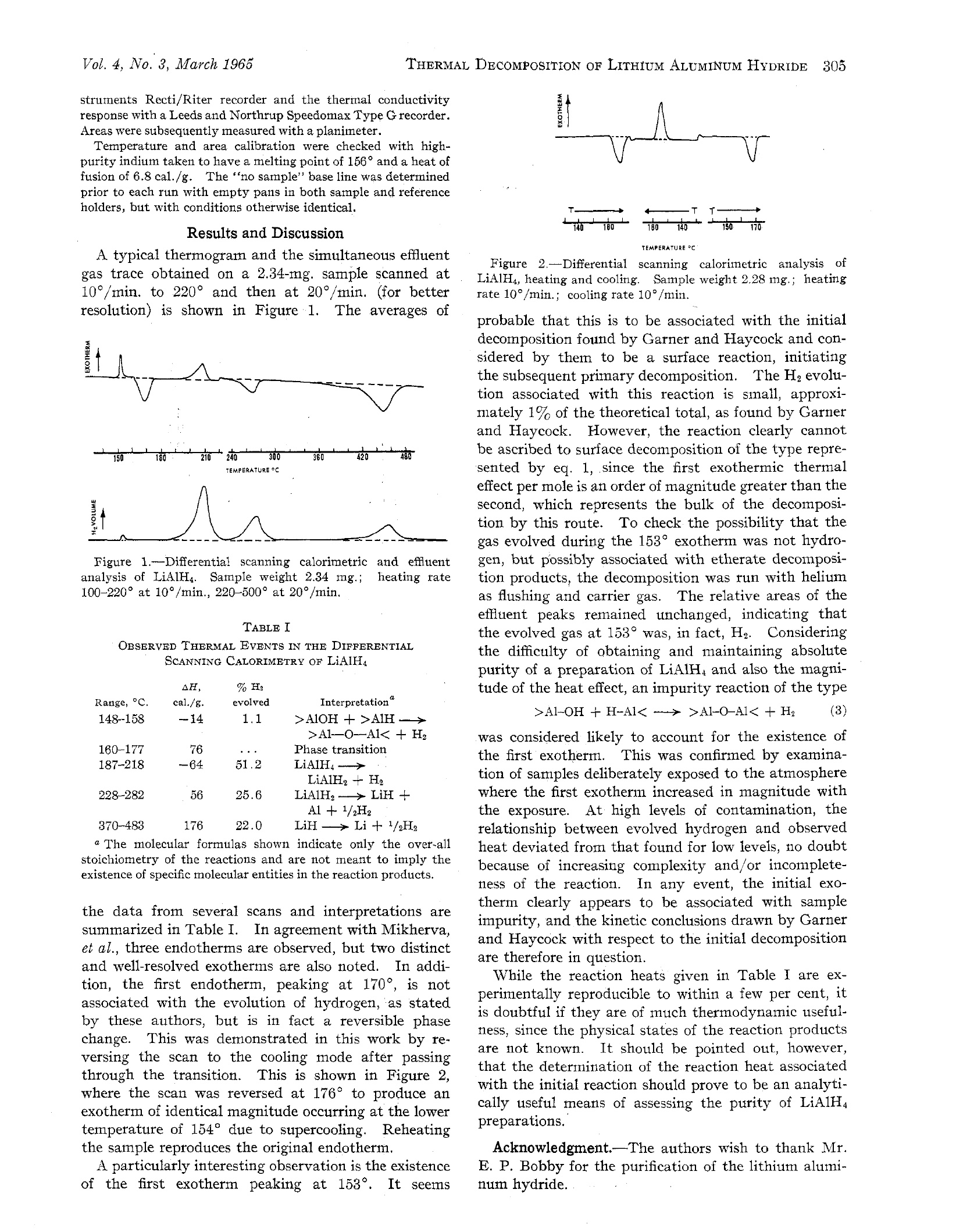
[4] The Thermal Decomposition of Lithium Aluminum Hydride, Block & Gray (1964)

       <http://pubs.acs.org/doi/pdf/10.1021/ic50025a009>
http://pubs.acs.org/doi/pdf/10.1021/ic50025a009

      Page 1 –>
<http://pubs.acs.org/appl/literatum/publisher/achs/journals/content/inocaj/1965/inocaj.1965.4.issue-3/ic50025a009/production/ic50025a009.fp.png_v03>

http://pubs.acs.org/appl/literatum/publisher/achs/journals/content/inocaj/1965/inocaj.1965.4.issue-3/ic50025a009/production/ic50025a009.fp.png_v03

      Page 2 –>  <http://www.tempid.altervista.org/Page2.png>
http://www.tempid.altervista.org/Page2.png


Here are my references, in chronological order:


[1] The thermal decomposition of lithium aluminum hydride, Garner & Haycock
(1951)


<http://rspa.royalsocietypublishing.org/content/royprsa/211/1106/335.full.pdf>
http://rspa.royalsocietypublishing.org/content/royprsa/211/1106/335.full.pdf


[2] PRELIMINARY INVESTIGATION OF LITHIUM HYDRIDE AS A HIGH-TEMPERATURE INTERNAL
COOLANT, Modisette (1957)

       <http://naca.central.cranfield.ac.uk/reports/1957/naca-rm-l57f12a.pdf>
http://naca.central.cranfield.ac.uk/reports/1957/naca-rm-l57f12a.pdf


[3] INVESTIGATION OF LITHIUM HYDRIDE AND MAGNESIUM AS HIGH-TEMPERATURE INTERNAL
COOLANTS WITH SEVERAL SKIN MATERIALS, Modisette (1958)


<http://digital.library.unt.edu/ark:/67531/metadc53069/m2/1/high_res_d/19660024045.pdf>

http://digital.library.unt.edu/ark:/67531/metadc53069/m2/1/high_res_d/19660024045.pdf


[4] The Thermal Decomposition of Lithium Aluminum Hydride, Block & Gray (1964)

       <http://pubs.acs.org/doi/pdf/10.1021/ic50025a009>
http://pubs.acs.org/doi/pdf/10.1021/ic50025a009


[5] Desorption of LiAlH4 with Ti- and V-based additives, Blanchard, Brinks,
Hauback & Norby (2004)

       <http://www.sciencedirect.com/science/article/pii/S0921510703005415>
http://www.sciencedirect.com/science/article/pii/S0921510703005415


[6] Hydrogen, lithium, and lithium hydride production, US 20130047789 A1 (2013)

       <http://www.google.com/patents/US20130047789>
http://www.google.com/patents/US20130047789


Notes

- [1] is the classic paper (1951) everyone seems to refer to.

- [2] is prelim of [3], with slightly different content, describing the
reversible LiH decomposition reaction

- [4] if this isn’t referenced in any paper regarding LiAlH4 Thermal
Decomposition, the paper is suspect (1964, 2 pages, but unfortunately behind a
pay wall, maybe if someone searches hard enough, they’ll find it; I’ll look
after I post this. Has DSC Plots, breaking down the H2 Evolution at various
temps, but at standard pressures)

- [5] Behind a pay wall, but what you see on the page is good enough... The do
NOT reference [4]!

- [6] Some nice Vapor Pressure curves in here!

- I also came across this book via the Internet (as well as Axil), but I do not
have it (looks very useful):


<http://www.bookmantraa.com/thermophysical-properties-lithium-hydride-deuteride-tritide-their-solutions-with-lithium-book-72683.html>

http://www.bookmantraa.com/thermophysical-properties-lithium-hydride-deuteride-tritide-their-solutions-with-lithium-book-72683.html