The assumption that rydberg matter alone is the cause of the reaction is
not correct, IMHO. It is only a means. It's the application of optical
power to lots of rydberg hydrogen that does the trick. An electric arc near
a catalyst in a hydrogen flow that is filtered. We need the arc to produce
the SPPs and fill them to the brim with energy.
Background:

The Hydrogen Rydberg matter acts as an antenna to receive optical
energy.The large rust particles convert the laser light to dipole motion.
The small nanowires of the hydrogen matter act like sharp tips to
concentrate the dipole power. The polaritons only allow dipole power to
flow superconductivly in the outway direction away from the big
microparticles. This flow is called topolariton flow.

physics.aps.org/synopsis-for/10.1103/PhysRevX.5.031001

polariton power build up on the tips of the Rydberg matter were it
accumulates open endedly.

<http://4.bp.blogspot.com/-gkYgLKHkb9Y/UE42Yc7oHXI/AAAAAAAABjM/xPHtKuQMaw4/s1600/Sin+t%C3%ADtulo.png>
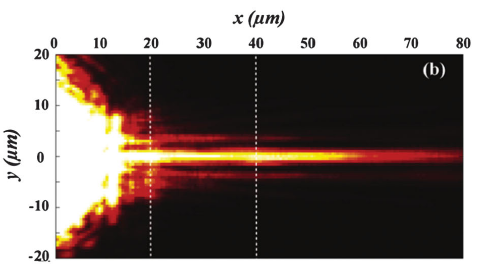
When laser light hits the rust particles (left), it generates surface
plasmon polariton waves that converge and interfere (fano resonance) at the
sharp tip of the hydrogen nanowire to create a nondiffracting beam
(orange). It is this magnetic beam (localized cosine-Gauss beam) that
produces subatomic particles.

Because the rydberg matter has a huge curvature (it is very sharp), it
amplifies the polariton energy greatly. This amplification goes as the size
of the rust particle divided by the size of the tip of the rydberg matter:
hundreds of billions.

The polariton spin is two. So the product of two times the polariton count
(N) times hundreds of billions(maybe as high as 10^^20) is the magnetic
power projected in the beam.

Other types of Rydberg matter will work like hydrogen but not as well.
These types like lithium and potassium produce nanowire that are not as
sharp as hydrogen. The sharper, the more powerful.

We know that the SPPs can free themselves from the substrate because we see
their tracts on photographic emulsions. They float around like ball
lightning. So we also need to entrap them in the filter also. But they are
not easy to trap because they pass through matter. They are dark matter.


On Sun, Oct 25, 2015 at 2:58 PM, Axil Axil <[email protected]> wrote:

> Rydberg Matter Fuel Preparation
>
> Why does the LeClair reactor produce radiation and neutrons and the device
> invented by James Griggs does not?
>
> It’s a matter of temperature. The James Griggs device runs at an operating
> temperature of 400F, whereas, the LeClair reactor is not pressurized and
> does not.
>
> Since the Hydrogen Rydberg matter is a bigger molecule than the water
> molecule, it might be possible to capture the rydberg matter from the
> Griggs device using a properly sized filtration device placed in the flow
> of the circulating water and remove this filter as a feedstock for a laser
> based or electric arc based LENR reactor. The high power potential of an
> electric motor will dump a significant amount of power into the water thus
> amplifying the rate of production of rydberg matter. Any level of power
> could be applied to the water to speed Rydberg matter production.
>
> The level of Rydberg matter production could be determined by exposure of
> a photographic emulsion to the water filters.
>
> Joe Papp used this method of fuel preprocessing to form a Rydberg matter
> fortified water solution that he used as an explosive and fuel for his
> engine.
>
> Just like Papp did, other elements like chlorine might be added to the
> water to enhance the explosive effect. Papp used a electric arc to activate
> and liberate power production from his fuel.
>
> If a nickel or silica aeroform is used as a filter, a Rossi like tube
> reactor could be fueled with the powder make from the powdered aerofoam.
>
> https://www.youtube.com/watch?v=yh_-DUKQ4Uw
>
> The assumption here is that the SPP is the only cause for LENR in all its
> various forms. Also, Rydberg matter is the same no matter how you create
> it.
>
> For example, R Mills is reinventing the Papp engine in the Suncell and so
> is Holmlid. Papp was first and the best so far. Give that devil his due. I
> am not disposed to forgo a valuable tool in LENR engineering just because
> its inventor was a SOB.
>
> No replicator could get the Papp engine to work because of the tricky
> requirement for fuel preparation. We know now that the fuel used in LENR in
> all its forms must be prepared in a time intensive process. This
> preparation takes a lot of time and a lot of energy. The solitons that
> produce the LENR reaction hold a huge amount of energy.
>
> The situation is like a car with a battery the size of a building. It
> takes a long time to pump power into that energy storage device before it
> becomes active enough to produce high grade power with a high enough
> voltage. This is what Holmlid tells us. He says that it takes weeks of
> applying Laser power before the catalyst becomes active.
>
> Lasers and dipoles don’t talk well together. Lasers produce plain waves at
> a single frequency and dipoles don’t take kindly to that type of EMF. An
> electron and a photon must have the same energy level to join together to
> become a polariton. That marriage needs a common energy level. Only a
> meager number of dipoles finely tuned to the exact frequency of the laser
> will become entangled. If there is lots of bumps and nanocavities in the
> substrate, then the Laser light will become decoherent. Decoherent light(
> from an arc that R. Mills uses in the Suncell) is best so that dipoles of
> any stage of development will become polaritons. A scattered shot cloud
> from a shotgun is better at downing a clay pigeon than a 22 is.
>
> Up until now, LENR replicators do not preprocess the fuel that they use
> and they don’t wait long enough for the LENR reaction to take hold. No one
> wants to invest the time and energy to properly prepare the fuel.
>
> This is a lessen that we can draw from Joe Papp. No one understood the
> reason why he invented a fuel preparation process. If the Papp fuel was not
> preprocessed, the Papp engine would need to crank for a week before it
> kicked over. Papp knew he had to load a lot of energy into that fuel before
> it became active.
>
> If we have a trillion SPPs each needing a full charge of 1,000,000 GeV
> before they all become active, that implies that a great deal of energy is
> needed to charge up that fuel.
>
> The various ways currently invented to inject energy into that fuel have
> differing power loading potential. Heat is the least effective method.
> Lasers seem to be somewhat more powerful but a few weeks to get the Holmlid
> fuel up to speed indicates to us that Laser power is marginal. Spark
> discharge and cavitation seem to be the most powerful method of power
> injection.
>
> We can determine how long cavitation takes to charge up the LENR fuel by
> seeing how long it takes for gammas to appear after the pump is turned on
> in the LeClair reactor.
>
> DGT could start their reaction in a few hours because an electric arc is a
> powerful source of incoherent EMF power.
>
> After they saw what problems that Rossi was having, their reactor design
> goal was to start and stop their reactor on a dime and from what I saw,
> they succeeded.
>
> Holmlid’s effect is difficult to duplicate because most replicators don’t
> have the patience to wait for weeks to see positive results.
>
> The choice before the replicator is plainly stated; he can use a powerful
> source of incoherent energy or he could just wait for weeks while energy
> trickles into his power hungry fuel.
>
> On Sun, Oct 25, 2015 at 1:56 PM, Bob Higgins <[email protected]>
> wrote:
>
>> Jones,
>>
>> Once again you slapped your glove on Hotson's face.  Your comment, "No
>> one needs to be convinced that matter and antimatter can be made to
>> annihilate" is just such a slap.  Regarding electrons and positrons in
>> particular, Hotson rightly points out that these two particles are
>> fermions.  As fermions, they are forbidden to be in the same place at the
>> same time, and so cannot annihilate. Instead of annihilation, they fall
>> into orbit around each other.  When (if) they reach a DDL orbit, the become
>> a part of Dirac's negative energy sea.
>>
>> If supposed quark and anti-quark pairs could annihilate, we should be
>> seeing the effects of that in the half life of the proton, reputed to
>> contain quark-anti-quark pairs.  Quarks are also believed to be fermions.
>> Of course, Hotson says that the sub-nucleon constituents are
>> electron-positron epos.
>>
>> On Sun, Oct 25, 2015 at 11:29 AM, Jones Beene <[email protected]>
>> wrote:
>>
>>> There are a number of LENR observers who are skeptical of the past
>>> findings that with Pd-D electrolysis, helium has been detected which is
>>> commensurate with excess heat.
>>>
>>> Notably, this stance has been taken and staunchly defended by Steve
>>> Krivit - and has a certain amount of (wait-and-see) support from those
>>> who otherwise believe in excess heat. The rationale of this argument is
>>> that in subwatt electrolysis, the helium produced is necessarily well below
>>> background levels and must enriched before it can be detected in any
>>> device – and even after enrichment, it can be confused with molecular
>>> deuterium (less of a problem). It is the enrichment step which is the
>>> problem.
>>>
>>> This is not the place to continue that argument, which has been hashed
>>> and rehashed ad nauseum, but it is the place to suggest something more
>>> important - a way in which excess heat – as a general rule - can be
>>> observed without nuclear fusion of any kind.
>>>
>>> That way is Holmlid’s finding of nucleon disintegration following laser
>>> irradiation of dense deuterium clusters. Ironically, it provides far
>>> more net energy than does nuclear fusion.
>>>
>>> The most cogent argument for nucleon disintegration is that in the
>>> standard model, every nucleon contains matter and antimatter in close
>>> proximity. No one needs to be convinced that matter and antimatter can
>>> be made to annihilate.
>>>
>>> An external stimulus, especially an intense coherent stimulus of photons
>>> , forming plasmon polaritons (SPP), need only find a coupling window
>>> where any of the matter/antimatter component of the nucleus is
>>> annihilated. This disruption will trigger a further instability resulting
>>> in complete disintegration.  The evidence is somewhat compelling.
>>> Replication is demanded.
>>>
>>> _____________________________________________
>>> Deuteron disintegration which supplies about 1 GeV per nucleon is about
>>> 167 times more energy dense than nuclear fusion of deuterium to helium.
>>> Assumption: 1 GeV per nucleon vs 24 MeV per 4 nucleons (in the He-4
>>> nucleus).
>>>
>>> However, a sizeable percentage of that disintegration energy will
>>> disappear as neutrinos, and thus the usable energy is still a mystery. The
>>> bad news for LENR: If the muon pathway is favored, as seems to be the case
>>> from Holmlid’s studies, then most of the excess energy will indeed
>>> disappear as neutrinos.
>>>
>>> The good news for LENR is that even if 90% of the energy disappears, the
>>> fraction which remains is about 16.7 times more energetic than fusion of
>>> deuterium to helium. And if 99% disappears as neutrinos – the reaction is
>>> still more energetic than what is expected in palladium D+D fusion to
>>> helium, and yet could be easily confused with that reaction… EXCEPT there
>>> would be little helium detected (the occasional alpha particle).
>>>
>>>
>>
>