It has be recently revealed that each 250kVA E-Cat tiger reactor module is
composed of 16 reactors. Only one of those reactors  is a powered
activator(mouse). The other 15 are drones driven by the activator. The
activator produces a reaction catalyst that drives the other drones. I say
that the reaction catalyst is the magnetic Exotic Neutral Particle(ENP)
that becomes mobile as its energy content level reaches a self sustaining
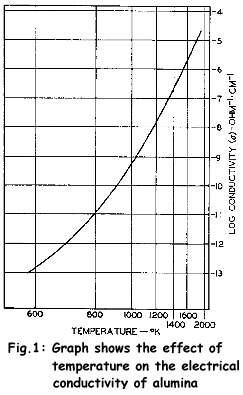
threshold. At low temperatures the alumina tub reactor shell that all these
reactors are comprised of confines the ENP. But as all these reactors heat
up, the alumina shell becomes electrically conductive. At high
temperatures, the alumina becomes magnetically transparent and this allows
the ENP to leave the activator an enter the drone where the ENP catalyzes
the LENR reaction.
http://www.thevalvepage.com/valvetek/heater/fig1.gif

Electrical conductivity Vs, temperature.

On Tue, Dec 1, 2015 at 7:02 PM, Axil Axil <[email protected]> wrote:

> The so called Erzion phenomenon was discovered in a series of electrolytic
> experiments marked by unexplained changes in a pool of cooling water
> outside of the catalytic cell. After 40 minutes of electrolytic cell
> operation, water on the tungsten anode side of the cooling vessel started
> loosing its transparency.
>
> Water on the stainless steel cathode of the pool of cooling water remained
> transparent, at the same 40 C temperature. A sample of bubbly water,
> removed from the anode side, was tested for induced gamma radioactivity. No
> such radioactivity was found in it; the sample became transparent after 24
> hours. Attempts to reproduce the long-term loss of cooling water
> transparency with other electrolytes, and under different electrical
> discharge conditions, were not successful. But the effect was highly
> reproducible when experimenting with the tungsten-anode electrolytic cell
> and the 7 M KF electrolyte containing 50% of heavy water.
>
> [image: Thumbnail]
> <http://pages.csam.montclair.edu/~kowalski/cf/341fig1.jpg>
>
> That cooling water on the outside of the electrolytic cell's glass reactor
> shell at the right side (see Figure 1) is close to the anode while cooling
> water on the left side is close to the cathode. The disappearance of
> bubbles, after the electrolysis, was very slow (half-life of about 10 hrs).
> Attempts to explain the phenomenon in terms of cavitation, and other
> ultrasonic effects, were not successful. The only satisfactory explanation
> was possible within the framework of the erzion model. Authors believe that
> bubbles are produced through the action of neutral Erzions.
>
> The Erzons phenomenon behavior is consistent with the magnetic based
> Exotic Neutral Particle(ENP). To begin with, the glass container is
> transparent to the magnetically based ENPs both optically and magnetically.
> The LENR reaction that keeps the ENPs viable produce the vapor that forms
> the water bubbles. The ENPs become energetically self sufficient in the
> water of the cooling pool where the ENPs remain viable for hours.
>
> If the Erzons phenomenon is produced by magnetically based ENPs, an iron
> plate placed just on the outside of the glass wall adjacent to the anode
> would prevent the ENPs from exiting the glass electrolytic cell. With the
> ENPs blocked from travel, bubble production would be eliminated.
>
> On Tue, Dec 1, 2015 at 5:37 PM, Axil Axil <[email protected]> wrote:
>
>> In my opinion, the fundamental nature of the Rossi effect is based on
>> magnetism. The catalytic particle that produces the reaction is magnetic in
>> nature. This particle is produced by heat pumping and EMF stimulation. The
>> nature of this Exotic Neutral Particle (ENP)is reflected by the behaviour
>> of the E-Cat itself and reflect how the E-Cat operates.
>>
>> The ENP can exist at low energy pumping where the energy coming into the
>> particle is equal to the energy leaving the particle. This is similar to
>> the way Rossi keeps his reactor under control. Too much external energy
>> pumping will result in the E-Cat going critical.
>>
>> The same process of over pumping happens with the ENP. Overpumping brings
>> it to the stage where it becomes self-sufficient requiring no additional
>> EMF input. The energized ENP can get EMF from the environment around it not
>> requiring external heat or EMF simulation to be applied.
>>
>> The same is true for the E-Cat. When the E-Cat is subcritical, it
>> requires heat and EMF stimulation to be applied. But when it is "over
>> stimulated" it begins to meltdown since it has become independent from
>> externally applied stimulation.
>>
>> The ENP can live as long as it can catalyze energy production from the
>> material around it. The ENP can live for days on its own as it brings in
>> energy from the environment to sustain its internal LENR reaction processes.
>>
>> Magnetic confinement increases efficiency of the reaction. Such
>> confinement saves the externally applied energy that produced the ENP from
>> being wasted.
>>
>> The ENP can leave the reactor if the material that makes up the reactor
>> enclosure is transparent to the optical and magnetic nature of the ENP.
>> This might be why electrolytic cells have difficulty in sustaining powerful
>> LENR reactions. In this case, the ENPs escape the glass beaker reactor
>> enclosure and all the input energy that was pumped into the ENP is wasted
>> to the environment. outside the electrolytic cell.
>>
>> If the cell is made of material that can contain the ENP both optically
>> and magnetically, the reactor will be efficent. Alumina is
>> antiferromagnetic and will confine magnetic particles thy to escape the
>> reactor shell. Another method of ENP confinement that Rossi might use is a
>> solenoidal confinement coil that keeps the ENPs away from the reactor walls
>> in the center axis of the reactor.
>>
>>
>>
>