Rare cosmological events recorded in muscovite mica.
F. M. Russell, School of Computing and Engineering University of
Huddersfield, HD1 3DH, U.K.


https://uploads.disquscdn.com/images/2f7ad4fe6232404eca928274d022ca00dbd699f1790550d820b93ccbca7c61a7.png

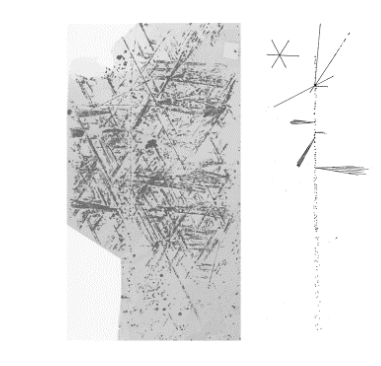
Figure 1. Scan of sheet of muscovite showing the fossil tracks of
charged particles. The  diagram  identifies  the  relevant  parts  of
the  fossil  tracks resulting from a nuclear star. The directions of
the principal atomic chains are shown.Most of the tracks lying in
these directions are due  to  quodons.Some tracks can  be  channelling
 relativistic particles  but  these  usually  show  fans from  nuclear
 scattering events, which quodons cannot create. The direction of
flight of the particle  causing  the  star  is  unknown.  It  results
in  at  least  eighttracks. When  tracks  lie  in  the  (001)-plane
they  are  usually continuous.  For  those  moving  at  an  angle  to
this  plane  they  will intersect  the  potassium  sheets,  where  the
 recording  occurs,  at separated points. The long vertical chains of
dots are of this type. The  fan  shaped patterns  are  caused  by
nuclear  scattering  events that   produced   atomic   cascades   in
which   kink-like   lattice excitations  are  created.  These  fans
are  clustered  around  the principal crystal directions.The sheet of
mica is 15cm x 29cm.

<strong>Abstract.</strong>

A study of fossil tracks of charged particles recorded in crystals of
muscovite has revealed evidence  of  rare  events  of  cosmological
origin. The  events  are  not  compatible  with  known  particle
interactions with matter. They were recorded during a period when the
crystals were in a metastable state during cooling after growth 13km
water equivalent underground. In this state a phase transition can be
triggered by low energy events in the range 1eV to 10keV, when the
crystals effectively behave as solid-state bubble chambers. At higher
energies the chemical etching technique can be used to reveal massive
damage to the lattice. The rare events show evidence of interaction
with the crystal over a great range of energies. They leave a
distinctive record that is easily recognised.

 <strong>Introduction.</strong>


The  search  for  evidence  of exotic  events of  cosmological  origin
usually  starts  with assumptions about possible interactions with
ordinary matter. Irrespective of these the detector should offer  a
large  sensitive  volume  and  a moderately long  recording
time.Ideally,  it  also  should  enable detailed  study  of
individual  recorded  events.  An  interesting approach looked  for
fossil evidence of scattering of WIMPs in crystals of muscovite
[1,2].It was based on the possibility that an atom recoiling from  a
scattering  event  might  cause sufficient damage  to  a  lattice that
 it could  be  revealed  by  the technique  of  chemical  etching.
This  technique  is  limited by  the  extent  of  damage  needed  to
allow etching  and  by background recoils generated  over geologic
time  scales  from radioactivity,  nuclear fission and cosmic
radiation.Ifatomic force microscopy is used to determine the depth of
etch pits thenthe lower limit on recoil energies to give an etchable
track is a few tens of keV.This contrasts with the lower limit of
about 1eV for recording in muscovite when in the metastable state
considered here. Crystals of muscovite often show visible
defectsconsisting of a hatch-work of black lineslying in the cleavage
(001)-plane. Many of these lines lie in principal crystallographic
directions at 60ointervals but not all.A study of the properties of
these exceptions showed that some were the fossil tracks of charged
leptons. In particular, somewere the tracks of positrons emitted from
the isotope 40K that occursin the monatomic sheets of potassium
forming part of the crystalstructure. It was found that the recoil of
the nucleus  arising  from  the dominant beta  decay channelcreated  a
 mobile  lattice  excitation  called  a quodon. These quodons cantrap
a charge and propagate unimpeded along chains of potassium atoms for
great  distances.They move  at ~3km/s  and  are the  cause  of  the
majority  of lines lying  in  the  60o directions.Evidence  also  was
found  for  fossil  tracks  due  to  e-p  showers[3].  These  showed
that  the tracks  were  recorded  after  the  crystal  had  grown  but
 the  temperature  was  still  above  700K,  which allowed migration
of atoms to formthe black lines.Therecording process operating in the
metastable state does  not  depend  on  ionisation.  It arises  from a
 phase  transition  triggered  by the  presence  of a positive charge
when the crystal is in a metastable state during cooling.In this state
the lattice needs nucleation sitesto  expel  excess  iron  to  form
the  black ribbons  of  magnetite. The sensitivity  of  this process
is shown by the lower limit of energy of a quodon of about 1eV for it
to be recorded.In effect, the crystals behave as a solid-state bubble
chamber.In  common  with  many  silicate  minerals  the  composition
of  muscovite  is  variable,  as  is  the  impurity content. This
results in variability of the recording sensitivity for different
causesof the nucleation sites. One consequence is the extent to which
the initial delineation of a track at nanometre-scale subsequently
growsby  lateral  accretion  to  become  several  orders  of
magnitude  wider.  This decoration does  not change the occurrence,
origin, orientation and physical properties of the initial fossil
trackbutaffects their  visibility. Clearly,  in  a  perfect  crystal
the  recording  process  cannot  operate. The  most  finely decorated
tracks are caused by charged relativisticparticles, such as
muons,passing through crystals with little iron and few other
impurities.The tracks of quodons are seldom found in these crystals
even though  they  are  created  copiouslyin  beta  decay  of 40K.  As
 the  iron  content  increases  the  recording sensitivity also
increases allowing quodons to be recordedas well. Eventually, when the
ironcontent has risen to about 6 atomic percent the decoration is
extensive. It is then possible for laterally unstable kink-like
excitations of the lattice, created in atomic cascades caused by
nuclear scattering events, also to be recorded. Their fossil tracks
are distinctive because of their fan-shape. Almost all the decoration
is composed of the black mineral magnetite in the form of very thin
ribbons. These ribbons are intrusive in the potassium (001)-planes,
where the lattice is weakest and easily cleaved.Figure  1 shows the
scan of a  sheet of muscovite containing a  nuclear star and
illustrates the detail that can be recorded by the phase transition
recording process. The sensitivity is similar to that of photography.

continued at:  https://arxiv.org/pdf/1902.00354.pdf


https://uploads.disquscdn.com/images/8ec79c395b462ebb0c2b5cd85c1066353444f5788590b5a41d9bcd9c35f8b41c.png