On Fri, 29 Sep 2006, William Beaty wrote:

> Then take a look at THIS one:
>
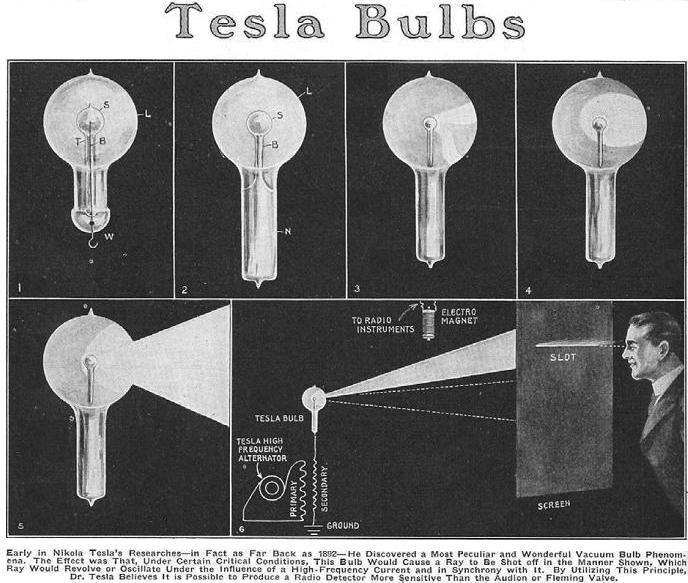
>   http://amasci.com/graphics/tesblb1b.jpg
>
> It's from "Electrical Experimenter" from 1919.  June issue, I think.
Note that lots of "Electrical Experimenter" 1910 era magazine issues are
available for five bucks as PDF files.  The guy at
http://store.g-books.com is selling them.


More weird stuff:  on teslaflyingmachine group on yahoo.com, the author of
"Occult Ether Physics" says that Tesla later built a bulb from a metal
hemisphere but WITHOUT ANY VACUUM BULB.

In thinking about this, I think it's possible.  The bulb will self-pump
its own vacuum during operation, just like Tesla observed in his lecture
on the bulb shown at http://amasci.com/graphics/tesblb1b.jpg. Suppose we
take a solid aluminum hemisphere with a flat polished face.  Put a glass
disk against the flat face and seal the edge and cover the whole thing in
thick insulator.  If this device is then operated with a CW tesla coil, a
high-frequency AC plasma will appear in the thin air film between the
glass plate and the aluminum.  The air will vanish!  There's an "ion pump"
effect which drives the gas ions at high velocity into the metal surface
where they're permanently trapped.  Given enough time, a hard vacuum will
form in that narrow gap.

Now if we have a capacitor-like device with:  a metal plate, a glass
plate, and a vacuum layer between them, and if we drive the metal plate at
extremely high voltage AC of high frequency, then something interesting
should occur.  The voltage drop should mostly appear across the vacuum
layer!!!!  This happens because glass is conductive at high frequencies
(because it contains movable charges.)  The higher the dielectric constant
of the glass, the more AC voltage will be impressed across that vacuum
layer.

Second, a glow discharge will develop in the air surrounding the device,
and this gives a second "conductive plate" as well as a long conductive
"wire," so our vacuum capacitor develops two real terminals.  The
conductive plasma path connects capacitively to ground.  This again should
increase that voltage drop impressed across the thin vacuum layer.

And finally, with that high a voltage on a hard vacuum next to a metal,
the metal will send out electrons via high-field emission.  And on
alternate cycles, the electron cloud will smash into the metal at extreme
high velocity, producing Bremssralung x-rays.  The metal should be highly
polished in order to create a parallel beam of x-rays, and supposedly this
is a necessary feature of the device.  The electron trajectories are
short.  But how high is the voltage drop over which the electrons travel?
Heaven only knows.  Could be astronomical, especially when compared to a
conventional x-ray tube.  The thing might even be producing extremely hard
x-rays (gamma radiation.)

The beam of ionizing radiation will launch a narrow corona discharge out
of the face of the tube.  There will be a high-capacitance connection
between the metal Tesla Coil terminal and the plasma (remember that the
vacuum is conductive, since it contains an electron cloud.)   A purple
beam should shoot out of this simple device.

One more thing springs to mind:  it might be better to use PZT or Barium
Titanate instead of glass.  This would force a larger potential drop
across the vacuum layer.  (But perhaps this change might screw things up.
Maybe high-temperature ceramic would be a better choice.)

The only trouble is that we'd need a high-wattage CW tesla coil to run
this beast.  Tesla said that the spark-gap type of coil doesn't work very
well in this application.  I sort of see why:  the electron cloud inside
the vacuum layer might need constant drive once it forms, and if it was
driven in short bursts with long dead-time between, it might quench out
between bursts.  Or at least the onset might be delayed, so the total
on-time would be very small when compared with a CW system.  In any case
it probably would behave very differently under pulse drive than under CW
drive.

Pretty cool, eh?   A GAMMA-RAY EMITTING CAPACITOR!  No vacuum pumps
needed.


> I always thought that these old Tesla bulb devices were the same as
> "plasma globes" with fingers of glowing gas inside.  But instead, the glow
> penetrates the glass and extends into the room as a feet-long glowing
> discharge!  Most probably it is a tesla-coil lightning bolt, but one which
> is following a beam of x-rays, so it becomes silent and constant, not
> branched like normal lightning.  The x-rays pre-ionize the path.   And
> because the x-ray flux would be different during the positive and negative
> parts of the AC, it probably functions as a rectifier, so it would put out
> some milliamps of DC into the room.   (And therefore would become
> sensitive to magnetic fields!)
>
> Apparently this answers questions about the material below.   If Tesla
> mounted such vacuum bulbs on the tips of his high-voltage antennas, they
> would produce ion beams which visibly glowed, and which functioned as
> antennas having not just long lenghts, but large surface areas (large
> capacitive coupling to distant emitters!)
>
>
>
>
>
> billb wrote:
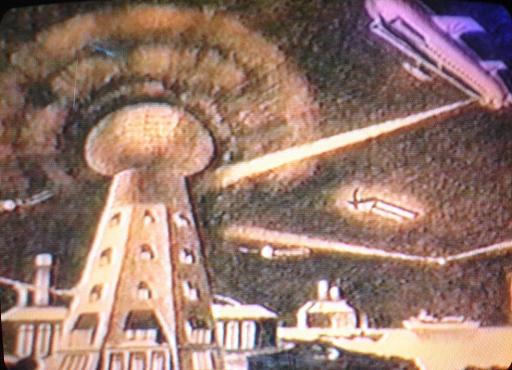
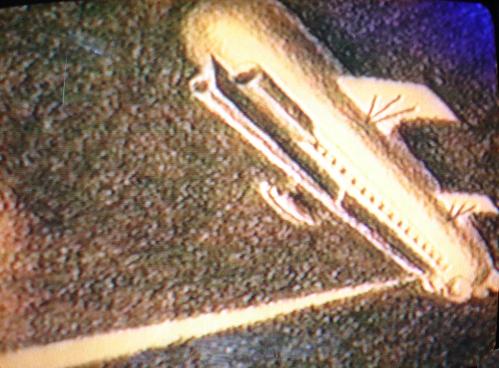
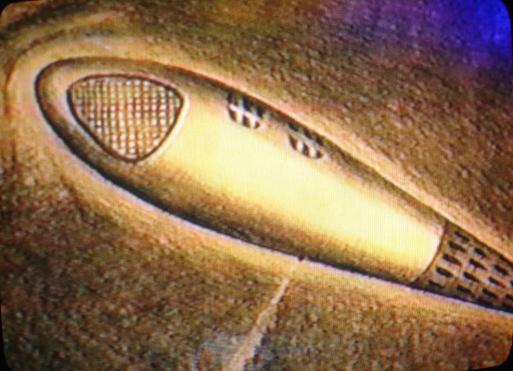
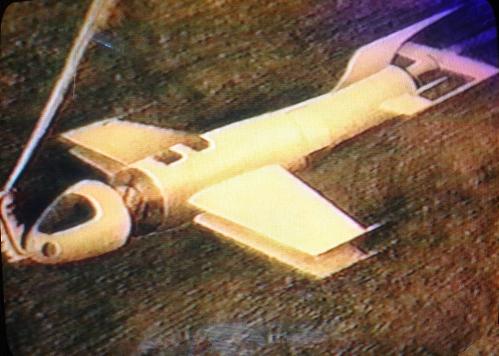
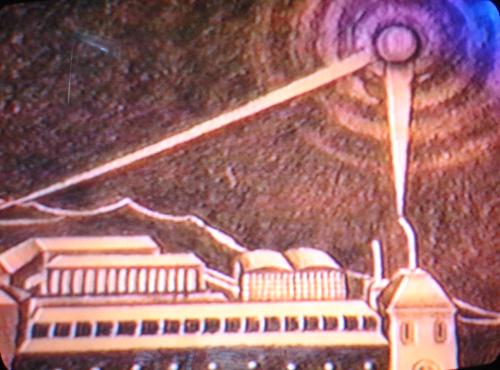
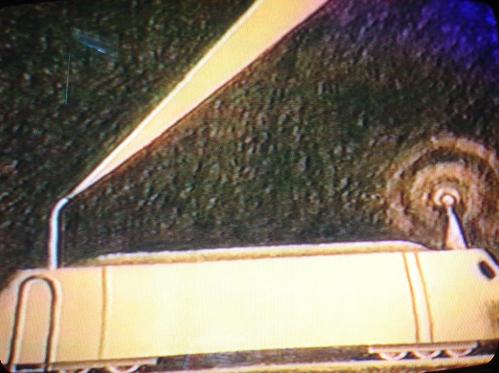
> > I uploaded some crude screenshots taken from the film "The Secret of
> > Nikola Tesla."   I'm very curious as to the original source of these
> > images.  Who was the artist?  On what were they based?  From what I
> > understand of Tesla technology, they seem very accurate (also quite
> > revealing.)
> >
> >
> > http://amasci.com/graphics/tstowr.jpg
> > http://amasci.com/graphics/tsflyr.jpg
> > http://amasci.com/graphics/tspjctl.jpg
> > http://amasci.com/graphics/tsplane.jpg
> > http://amasci.com/graphics/tscar.jpg
> > http://amasci.com/graphics/tsfactry.jpg
> > http://amasci.com/graphics/tstrain.jpg
> >

(((((((((((((((((( ( (  (   (    (O)    )   )  ) ) )))))))))))))))))))
William J. Beaty                            SCIENCE HOBBYIST website
billb at amasci com                         http://amasci.com
EE/programmer/sci-exhibits   amateur science, hobby projects, sci fair
Seattle, WA  425-222-5066    unusual phenomena, tesla coils, weird sci