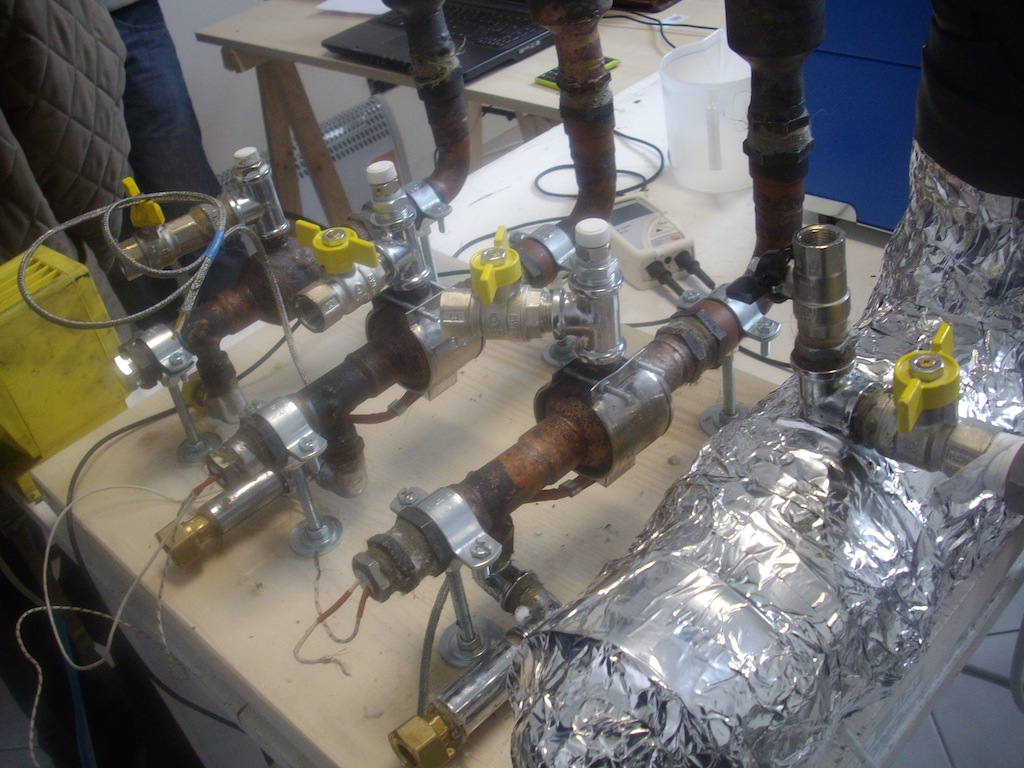
For those who have not paid particular attention to the images which started
the hypothesis of the last two days - that the precise operation of the
E-Cat reactor could be either a triode (MAHG) type of accelerator, or a
massive semiconductor bipolar junction transistor (as opposed to simply a
resistively heated chamber) here is the largest image I could find:
http://dibattiti.files.wordpress.com/2011/04/ecat_.jpg

... showing what appears to see a single lead from the band heater and the
double leads to the axial component, which was labeled as "auxiliary". When
Terry noticed the single lead, it was pointed out that there are similar
heaters available online with two leads. And there are similar cartridge
heaters available, which could be the axial component.

Therefore, if one were to believe that Andrea Rossi is being honest about
the setup, even though he does not want anyone to replicate his work - then
one would have to reject the transistor hypothesis, in favor of a simple
configuration with two resistive heaters...

... despite the fact the main heater must transfer its heat THROUGH the
water flow, meaning that in the low water temperature run (in February) the
internal reactor could not have been heated to much over the water
temperature from either heater, and that temperature was well below the
trigger temperature.

In fact, when one considers all the options, the PNP "big transistor" mode
of operation, possibly combined with some kind of inherent photo-diode
effect, makes sense on several levels.

Jones
<<attachment: winmail.dat>>