Tom Clarke States:

*The biggest problem for LENR is the lack of nuclear products. It is also
the easiest way to detect LENR - if it were real the nuclear products
produced, even at very low levels, could be detected and would be
unambiguously nuclear in origin.*
Informed through experimental results, Hora and Miley proposed a LENR
nuclear products mechanism that is very close to  what goes on in the NiH
reactor..

http://www.fondazionefrisone.it/eventi/catania07/MileyGclusterreactio.pdf

*Cluster Reactions in Low Energy Nuclear Reactions (LENRs)*

*ABSTRACT*


*Cold fusion reactions can be divided into two broad classes: deuterium
reactions producing excess heat and helium; and transmutations of host
metal atoms, termed Low Energy Nuclear Reactions (LENRs). Here we review
some unique facts about a special class of LENRs leading to an array of
transmutation products in thin-film electrodes of palladium(Pd) or nickel
(Ni) highly loaded with hydrogen (H) or deuterium (D). This phenomena is
explained in terms of the formation of an intermediate compound nucleus,
one of which is identified as the double magic number compound nucleus =
306X126. The formation of thisnucleus requires a multi-body reaction
between the D (or H) and the host metal. This is explained in terms of a
proposed D (H) cluster formation. Such clusters can react collectively with
palladium nuclei leading to a compound nucleus.*

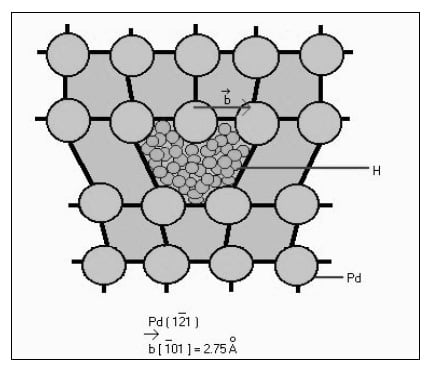
http://coldfusionnow.org/wp-content/uploads/2012/04/1-clusters-diagram.jpg

A cluster of hydrogen squeezed between the metallic lattice from Condensed
Matter Cluster Reactions in LENR Miley Hora Yang

The clusters are collections of hydrogen nuclei called protons, or
deuterium nuclei called deuterons (which are protons with an added
neutron). Clusters are thought to be composed of 1000 hydrogen nuclei or
more, all bunched up together.

Dr. Miley uses the language nuclear active environment NAE to describe
these localized clusters that lead to a reaction, cratering the surface.

When the hydrogen is so close together, an NAE will ultimately produce
fusion products, creating both excess heat energy and heavier elements. It
is these heavier elements which then may break apart, fissioning, creating
the plethora of new transmutation elements directly measured in his cells.

Dr. Miley proposed that a very heavey element is produced by cluster fusion
of many protons in the NAE: Compound nucleus = 306Xe126.

Then the very heavy Compound nucleus fissions.

In reality, the intense magnetic field projected by the polariton soliton
energized the vacuum into the accelerated production of virtual particles.
This roiling volume of vacuum will destabilize an enveloped Rydberg crystal
of hydrogen atoms up to 1000 in number.

The magnetic field up to 10^^16 tesla in strength will catalyze pions that
create a quark gluon plasma which then cools into a predictable array of
elements based on the 3 fold nature of the quark.

This cooling produces elements favoring magic numbers of protons and
neutrons.

See section” LENR Results” in the reference.

The distributions of elements that are formed are identical to what was
produced during the big bang and therefor difficult to delineate from
normal matter in the universe.

Light elements like boron, lithium and beryllium are predominate in this
condensation of the quark soup as seen in the results provided by DGT at
iccf-17: a conference.

Radioactive isotopes are stabilized within picoseconds because of the high
virtual particle creation rates inside the active volume of energized
vacuum.

It is hard to understand this key concept in LENR: how a strong magnetic
field can produce pions which destabilize matter, so here are two
references to this process.

http://physik.uni-graz.at/~dk-user/talks/Chernodub_25112013.pdf


QCD in strong magnetic field

http://hector.elte.hu/budapest14/slides/endrodi_0203_0204.pdf

QCD transition in magnetic fields