You can also change the "represent" attribute of readonly fields so they
are wrapped in a div with a special class, and then use CSS to style that
class to your liking.
Anthony

On Friday, March 31, 2017 at 11:49:51 AM UTC-4, Anthony wrote:
>
> We should probably make what you are doing a built-in option (maybe even
> the default), but for now, you can try something like this:
>
> def sqlform2(*args, **kwargs):
>     table = kwargs.get('table', args[0])
>     fields = kwargs.get('fields', [f for f in table])
>     readonly_fields = [f for f in fields if not f.writable]
>     [setattr(f, 'writable', True) for f in readonly_fields]
>     form = SQLFORM(*args, **kwargs)
>     [form.custom.widget[f.name].update(_readonly=True) for f in
> readonly_fields]
>     [setattr(f, 'writable', False) for f in readonly_fields]
>     return form
>
> def myform():
>     form = sqlform2(db.mytable, request.args(0)).process()
>     return dict(form=form)
>
> The above sets the readonly fields to writable before creating the form,
> and then sets the _readonly HTML attribute of the widgets after creating
> the form (you could also set _disabled=True if desired). It then resets all
> the readonly fields so they are not writable before returning, so when the
> form is processed, those fields will not be included in the database write.
>
> Anthony
>
> On Friday, March 31, 2017 at 5:25:59 AM UTC-4, Joe Barnhart wrote:
>>
>> I'm going a little nuts with forms that have readonly fields.  Examples
>> are forms where some fields are shown to the user so they can see the
>> contents, but they aren't allowed to change them.  For example, an
>> "expiration date" for a subscription.  They can see when it expires, but
>> they can't just edit it.  They have to go thru an ordering process for that.
>>
>> The Field flag of writable=False has not proved useful.  It changes the
>> field to a simple piece of text and thus breaks any custom formstyle I'm
>> using.  The simple text without an input field looks ugly and doesn't match
>> spacing, fonts, or any of the other myriad styles used in the read/write
>> fields.  Sad to say, writable=False just is not useful.
>>
>> I have created an alternative that creates the fields as usual, but marks
>> them with a "readonly" attribute.  Javascript can then be used to ensure
>> the contents are not modified, even for tricky fields like date selectors
>> and list box widgets.  But now we get to the underlying problem -- the form
>> validator fails when I take this approach.
>>
>> Because the readonly fields are readonly, they do not show up in the
>> request.vars when the form is submitted.  But since the SQLFORM knows
>> nothing of this, it just sees null values for the fields and throws a
>> validation error for elements like list boxes (which can't be empty).
>>
>> It's almost like I want to change the SQLFORM definition after the form
>> is created (with the readonly list boxes) and then remove those fields from
>> the SQLFORM when it does its validate processing, so it would just ignore
>> the missing fields and not try to update the record with empty values.
>>
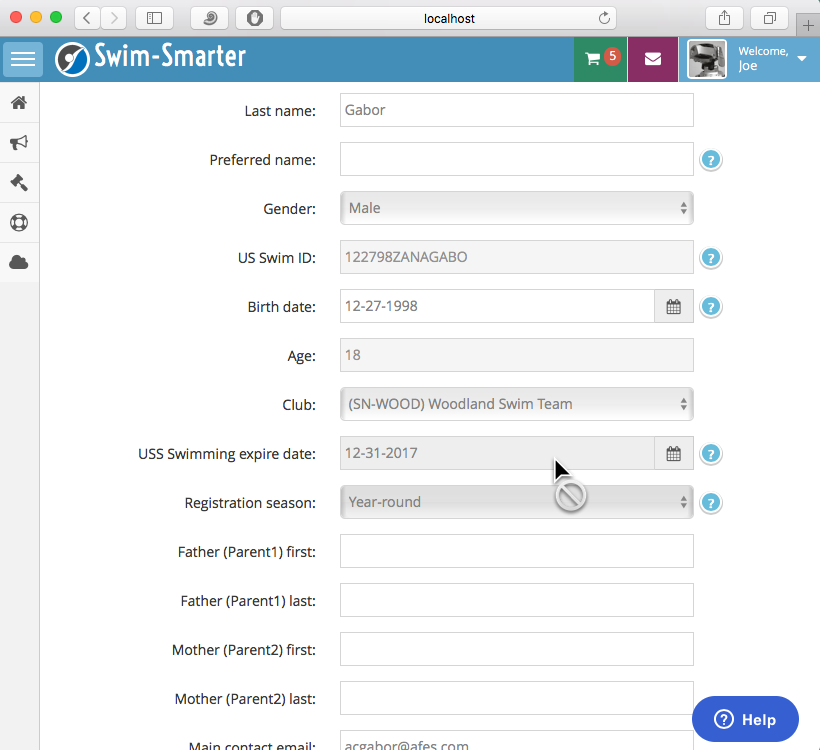
>> Here's an example.  You can see the cursor which tells the user the field
>> is not editable.  On this view the expire date, the season, the age, and
>> the US Swim ID are all non-editable fields.  But the season is an example
>> of an option list which causes the form processing to throw an error and
>> fail.
>>
>> Just looking for some ideas.
>>
>> Joe
>>
>>
>> <https://lh3.googleusercontent.com/-BqVuGZtmcZw/WN4frOAVqLI/AAAAAAAAAoc/Hd37dU2uKB89UIRmwZTI5bfx9q2wqDN-QCLcB/s1600/Form_with_readonly.png>
>>
>>

--
Resources:
- http://web2py.com
- http://web2py.com/book (Documentation)
- http://github.com/web2py/web2py (Source code)
- https://code.google.com/p/web2py/issues/list (Report Issues)
---
You received this message because you are subscribed to the Google Groups
"web2py-users" group.
To unsubscribe from this group and stop receiving emails from it, send an email
to [email protected].
For more options, visit https://groups.google.com/d/optout.