New question #254339 on Yade:
https://answers.launchpad.net/yade/+question/254339
Dear Prof. Chareyre and all users:

  Thanks for helping me last time and today my questions are just about the
flexible boundary in Yade.

  The deformations within soils in plane strain state are commonly concentrated
in narrow zones called shear bands. These can be determined as a significant
representation of material instability and progressive failure. After employing
the local moment law to apply the rolling resistance in each contact of pair of
particles, I have run some simulations to test the formation and evaluation of
shear bands in Yade, but just get some not so good results.

The attributes of shear bands depend on both the material properties, such as
particle size, shape and initial density and loading condition, such as loading
path and rate, as well as boundary condition. I think that an improper boundary
treatment used in my tasks may probably lead my results to failure.

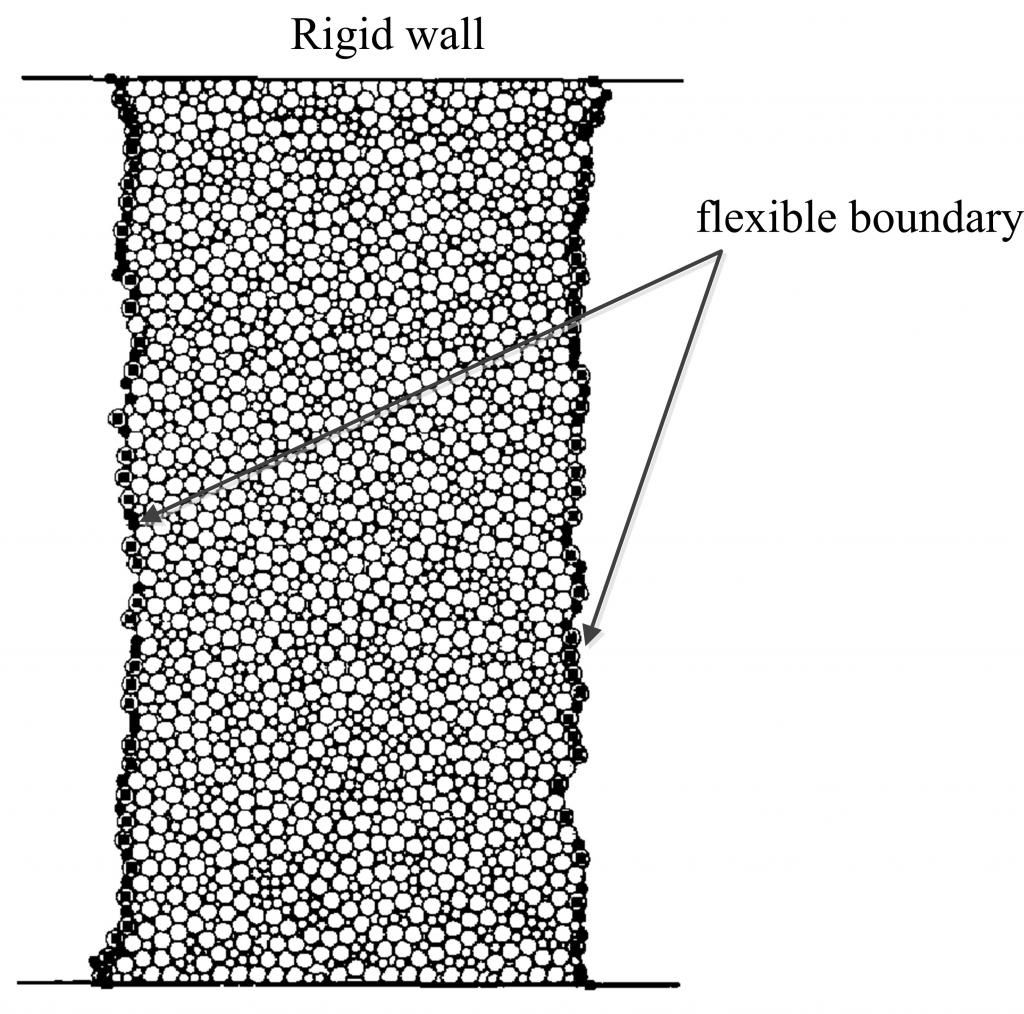
  In most of experiments in plain strain condition, rubber membranes are
commonly used in horizontal direction. In order to construct this type of
boundary in simulation, a kind of flexible boundary was adopted firstly by J.
P. BARDET(1991) in his 2D DEM simulation, and then was extended by
M.R.KUHN(1995) to 3D simulation. In J. P. BARDET(1991), this flexible boundary
was described as follow (Fig.1):
‘The left and right boundaries are stress controlled, or flexible boundaries.
Such a boundary is made of straight segments connecting the centers of external
particles. Forces and moments are externally applied to the boundary particles
by specifying the prescribed stress tensor.…..’

Lots of later achievements paying attention to shear bands in DEM framework
were used to employ this boundary as a necessary tool to capture those narrow
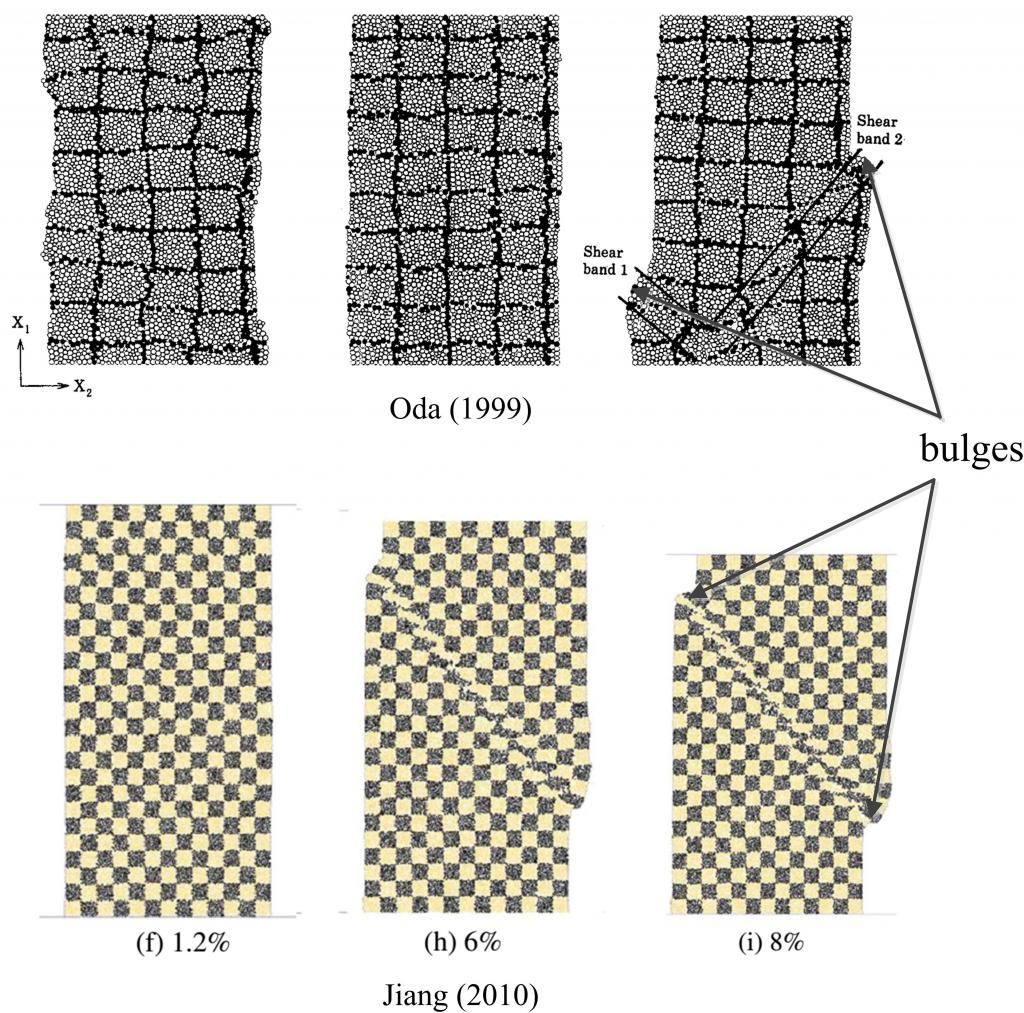
zones in their simulations. Both Oda (1999) and Jiang (2010) got many of
perfect results in their original purposes with applying this flexible
boundary. Fig.2 is the results of them. It is obvious that there exists a bulge
in each horizontal boundary as the end point of shear band. This bulge is
caused directly by deviatoric loading and be intensely by the weak of
horizontal constraints in this flexible boundary. After the shear bands are
relatively stable (inclination and width cannot change any more), these two
bulges can be then used to measure the geometric attributes of the zones.

But now in Yade, I always used the rigid walls (aabb walls) as the only type of
boundary condition. This kind of rigid boundary made it a little difficult to
capture the narrow zones than what the flexible boundary did. Fig.3 was my
simulation results. Neither small number of particles task nor large number can
give me a clear description of the shear bands and none of the two have no
bulges in each horizontal boundaries. The main reason, I think, is that the
rigid boundaries used in the two simulations bring an overly strict constraint
in horizontal direction to restrict the rotations of particles inside the shear
bands.

Today my questions are:
[1] Are there something wrong in my descriptions of flexible boundary? If yes,
please tell that.
[2] Can rigid walls be replaced by flexible boundary in Yade when I want to run
2D simulation? If yes, which example can help me for that purpose, if not, can
you give me some suggestions on my 2D simulations.

Seeking your help!

Fig 1 http://i1287.photobucket.com/albums/a628/fzgkkk/graph1_zpsfeea4d20.jpg
Fig 2 http://i1287.photobucket.com/albums/a628/fzgkkk/graph2_zps909c0847.jpg
Fig 3 http://i1287.photobucket.com/user/fzgkkk/media/grapl3_zps359307c0.jpg

Ref.
[1] A numerical investigation of the structure of persistent shear bands in
granular media.
[2] A flexible boundary for three-dimensional dem particle assemblies.
[3] Rolling resistance at contacts in simulation of shear band development by
DEM.
[4] Modeling shear behavior and strain localization in cemented sands by
two-dimensional distinct element method analyses


--
You received this question notification because you are a member of
yade-users, which is an answer contact for Yade.

_______________________________________________
Mailing list: https://launchpad.net/~yade-users
Post to     : [email protected]
Unsubscribe : https://launchpad.net/~yade-users
More help   : https://help.launchpad.net/ListHelp