Comrade, thanks for this constructive information...Do you know the links to
other chapters? I would like to join in your study sessions/groups to
enlightened myself even more....How do I ago about that?  I'm based at Jozi
CBD.
Thanking in advance for your assistance.


Kind Regards,
Sibongile Mbele

Mobile: +27 76 9001858
Fax:     +27 86 695 1227

"Successful people make a habit of doing things other people aren't willing
to do"

On Wed, Oct 20, 2010 at 12:14 PM, DomzaNet <[email protected]>wrote:

>
>  *Course on Marx's Capital: Part 23*
>
>
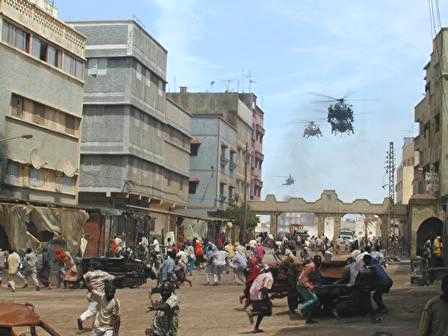
> <http://1.bp.blogspot.com/_D4UK2kWf5ik/TL7Ajwn-FGI/AAAAAAAACsk/uwpbulseC3A/s1600/MogadishuApril2007+-+2.jpg>
>  *Mogadishu, 1993*
>
>  *Colonialism*
>
>  Here we are, nearly at the end of Capital, Volume 1, the famous and huge
> book that so many people talk about and so few people read. We have read it.
> We are more fit to be cadres. We are more fit to be the vanguard. What
> remain are only the three last chapters, which are not difficult to read,
> although as always they challenge us to be brave and to act, and action will
> never be easy.
>
>  In *Chapter 31* Marx states that the origin of the industrial (not
> farming) capitalist is in colonialism.
>
>  *“The discovery of gold and silver in America, the extirpation,
> enslavement and entombment in mines of the aboriginal population, the
> beginning of the conquest and looting of the East Indies, the turning of
> Africa into a warren for the commercial hunting of black-skins, signalised
> the rosy dawn of the era of capitalist production. These idyllic proceedings
> are the chief momenta of primitive accumulation. On their heels treads the
> commercial war of the European nations, with the globe for a theatre.”*
>
>  *“To-day industrial supremacy implies commercial supremacy. In the period
> of manufacture properly so called, it is, on the other hand, the commercial
> supremacy that gives industrial predominance. Hence the preponderant rôle
> that the colonial system plays at that time. It was "the strange God" who
> perched himself on the altar cheek by jowl with the old Gods of Europe, and
> one fine day with a shove and a kick chucked them all of a heap. It
> proclaimed surplus-value making as the sole end and aim of humanity.”*
>
>  This last describes in a single sentence, the state of affairs that
> Marx's book was written to expose; and Marx did succeed in exposing
> “capital” as “surplus-value making”.
>
>  Yet it appears that Marx did not deal with Primitive Accumulation in the
> sense that the phrase would nowadays be understood. Marx does not establish
> that capitalism required a ready pile of money or its equivalent. What he
> establishes is how the requisite class forces were brought into being, in
> Western Europe, in the revolutions that overthrew feudalism.
>
>  It is a mistake to think that a capitalist business requires “capital” in
> advance, if by “capital” is meant money in the bank, or land, buildings,
> equipment et cetera. It does require such things, but they do not make it a
> capitalist business as opposed to any other kind of project. What makes a
> business work as capitalism is a dual relationship. The first part of it is
> the relationship between the worker and the capitalist. The second part is
> the relationship of the capitalist with his market. If these two
> relationships do not exist, or are faulty, then a capitalist business will
> not survive. But if they do exist, then the other means will probably be
> found without too much difficulty.
>
>  Marx shows clearly how the proletariat arose historically in Europe in
> the 16th century. He shows how the bourgeois class arrives on the scene. He
> shows how all the social building blocks including proletariat and market,
> are assembled, but not the money. In any case, capital is not money, it is a
> relation. Marx says so, directly, in Chapter 33. So the accumulation
> necessary for capitalism is not treasure, but is an accumulation of
> relationships; this is what we learn from the chapters in “Capital” on
> Primitive Accumulation.
>
>  Marx does not, in Capital, make a strong distinction between slavery and
> capitalism. He describes slavery candidly and without flinching from the
> horror of it. But he never discusses slavery in a comparative way, as
> distinct from surplus-value-extracting bourgeois-and-proletarian capitalism.
> Yet (bourgeois) slavery also started in the 16th century, or slightly
> before, and it ran on as a transcontinental Atlantic system for the next
> three hundred years, in parallel with the early development of capitalism
> proper, until Marx’s time, such that the last end of bourgeois slavery was
> the cataclysm of the American Civil War, that was happening while Marx was
> writing Capital.
>
>  *Chapter 32* of Capital, Volume 1 contains about 1000 words in only four
> paragraphs. It is a full historical sweep from the past of slaves and serfs
> through present capitalism to the future, when the expropriators will be
> expropriated. It resembles the Communist Manifesto.
>
>  *Chapter 33* is very interesting but in spite of its title, it is not
> really about colonialism. Instead, Marx uses the example of part of one
> colony of the time, Australia, to make points about capitalism and to
> “discover in the Colonies the truth as to the conditions of capitalist
> production in the mother country”. Also note the very last paragraph of the
> chapter (and the book), which says:
>
>  *“We are not concerned here with the conditions of the colonies. The only
> thing that interests us is the secret discovered in the new world by the
> Political Economy of the old world, and proclaimed on the housetops: that
> the capitalist mode of production and accumulation, and therefore capitalist
> private property, have for their fundamental condition the annihilation of
> self-earned private property; in other words, the expropriation of the
> laborer.”*
>
>  *“...capital is not a thing, but a social relation between persons,
> established by the instrumentality of things,”* says Marx.
>
>  In the next part, we will commence a ten-week course Capital, Volumes 2
> and 3.
>
>  *Please download and read the following document**:*
>
>  *Click here to download Capital V1, C31, 32, 33, Capitalist,
> Accumulation, Colonialism, in MS-Word file
> format<http://communist-university.googlegroups.com/web/1524%2C+Capital+V1%2C+C31%2C+32%2C+33%2C+Capitalist%2C+Accumulation%2C+Colonialism%2C+1867.doc?gda=D_mB4JUAAAB4MbH-vDwpNagN2sDR9UloMzSG2ynLnrFM4apJjB-9d2hlX2dxbRLV-W0NNomDNgD-0xTaH0GwBed3K-ed6TiTgoourxM03oqR>
> *
>
>
>
> --
> Posted By DomzaNet to
> CUAfrica<http://cuafrica.blogspot.com/2010/10/colonialism.html>at 10/20/2010
> 12:14:00 PM
>
> --
> You are subscribed. This footer can help you.
> Please POST your comments to [email protected] or reply to
> this message.
> You can visit the group WEB SITE at
> http://groups.google.com/group/yclsa-eom-forum for different delivery
> options, pages, files and membership.
> To UNSUBSCRIBE, please email [email protected].
> You don't have to put anything in the "Subject:" field. You don't have to
> put anything in the message part. All you have to do is to send an e-mail to
> this address (repeat): [email protected] .
>


--

--
You are subscribed. This footer can help you.
Please POST your comments to [email protected] or reply to this
message.
You can visit the group WEB SITE at
http://groups.google.com/group/yclsa-eom-forum for different delivery options,
pages, files and membership.
To UNSUBSCRIBE, please email [email protected] . You
don't have to put anything in the "Subject:" field. You don't have to put
anything in the message part. All you have to do is to send an e-mail to this
address (repeat): [email protected] .