-Caveat Lector-

http://knorek.com/RR/Ohio/ohio.htm
Welcome to Ohio, the Land of Trains


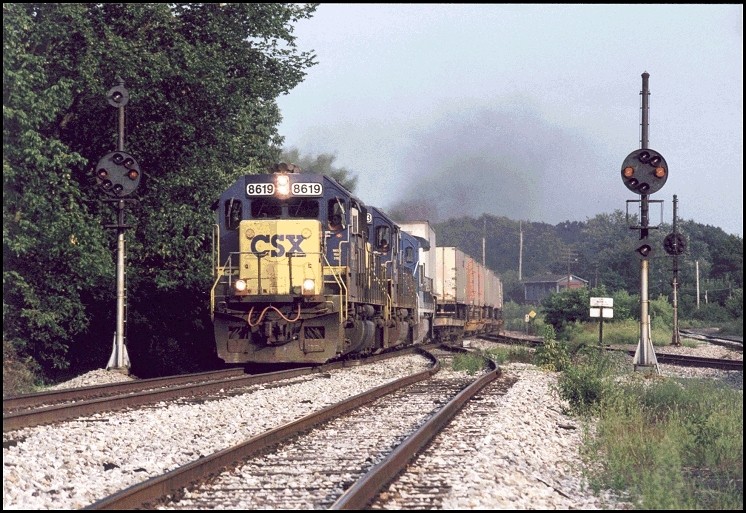
CSX train Q137-18 (Baltimore Penn Mary-Chicago 63rd St) is accelerating

westward on track #1 past the EAS Warwick on the CSXT New Castle Subdivision

in Clinton, Ohio at 6:35pm on August 18, 2000. CSX train S297-17 (Baltimore

Curtice Bay-Toledo Walbridge) has taken the siding to let Q137 go around

him. The siding is in the forground; Track #2 is in the background heading

off to the right. This was once part of the Baltimore & Ohio's mainline from

Pittsburgh to Chicago, which wasn't completed until late in the 19th

Century. It remains a vital link between Chicago and the Mid-Atlantic

states.


Photograph copyright 2000-2002 Jeff Knorek


Take a look at any map of the United States and you will see that the state

of Ohio is between all of the major port cities on the East Coast north of

Tidewater Virginia and the cities of Chicago, St. Louis, and Detroit, as

well as most of the port cities on the West Coast. Only traffic to/from from

Canada and Chicago through the state of Michigan, and traffic to/from Los

Angeles and the East Coast by way of Memphis can avoid passing through the

Buckeye State.


Map courtesy of the Central Intelligence Agency


----------------------------------------------------------------------------

----


Long ago, in the 1820's, 30's, and 40's, the big port cites along the East

Coast all had designs on being the predominant port once the fertile land

west of the Appalachian Mountains was developed and farmed. The rich

agriculture that this land would ultimately sustain should be transloaded at

eastern ports for export to Europe, the plan went, so toward this end many

of the port cities chartered the early railroads themselves or politically

supported those chartered by other private interests (the same method

similarly funded canal building).


Remember, at this period in American history there were only primitive roads

to the western states and territories (Ohio, Michigan, Kentucky, Wisconsin,

Indiana, and Illinois). The Federal Highway System would not be developed

until the Great Depression during the NINETEEN Thirties. Transporting goods

from farm or manufacturer to market by wagon was slow and expensive. Canals

were used in concert with navigable rivers and the Great Lakes as a cheaper

and easier alternative to roads for long distance bulk transport on boats to

and from the West (as well as within the territories and new states), but it

was still slow.


The business and industry of railroading was itself a new technology to the

United States, imported from England. It held the promise of being both

cheaper than road transport and faster than canal transport. The Eastern

States were farming cereal grains, but the land was not rich for farming,

and domestic consumption did not leave much grain left over for export to

Europe. The West was growing more grain than its own population could use,

and the Eastern port cities wanted in on the action.


Unfortunately for them, a mountain range, the Appalachians, lay between this

abundant grain and the merchants who wanted to sell it overseas. The

importance of canals in the development of Ohio and other states cannot be

overstated. However, the prevailing transportation modes of the day were not

suited to the task of hauling a large volume of heavy goods up and over the

mountains. This was the impetus behind the first railroad construction in

the United States, the B&O, which was chartered in 1825 (by comparison, the

Erie and Ohio Canal connecting the Ohio villages of Cleveland on Lake Erie

and Portsmouth on the Ohio River by 1832, was also chartered in 1825).


The Pennsylvania Railroad and the New York Central System (or their proxies

and/or acquisitions) would be major players in this Nineteenth Century push

from the East Coast to the Ohio River, Lake Erie, and beyond. The Baltimore

& Ohio, Chesapeake & Ohio, Norfolk & Western, Erie, and other railroad

companies and their proxies or acquisitions would follow (each with a rich,

interesting, and sometimes dramatic history).


Over the course of some fifty years the state of Ohio would be both a goal

and then a thoroughfare as the major eastern railroads reached Chicago and

St. Louis. During this time many regional railroads within the state were

chartered as well. These companies hauled the raw materials used in iron

production from the mines to the mills, as well as finished products and

agricultural goods from the mills and farm bureaus to market. They proved to

be every bit as vital to the industries and communities that they served as

their larger brethren.


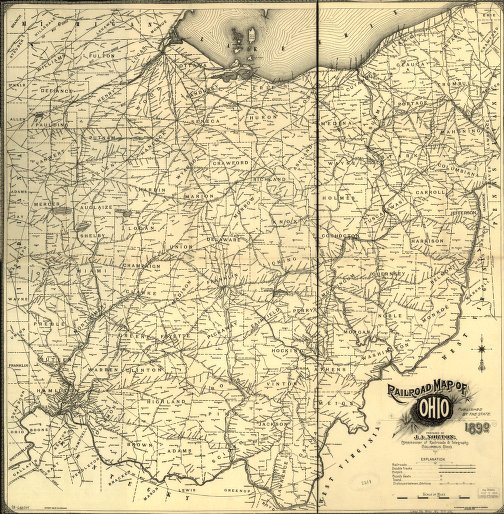
Railroad map of Ohio published by the State. 1890. Prepared by J. A. Norton,

commissioner of railroads & telegraphs. Copyright by H. B. Stranahan.

Provided by the Library of Congress.


By 1890 Ohio was a maze of railroads moving north and south, east and west.


Along the way west, immigrant and domestic migration from the east exploded,

providing a vast and hungry labor pool. With the benefits of this new

overland transportation technology married with those of water shipping to

carry raw materials (as well as recently emmigrated workers) to Ohio cities,

many industrial manufacturing facilities soon sprang up all along Lake Erie

and in the region between Toledo Ohio and Pittsburgh Pennsylvania, as well

as the area around Cincinnati. By 1920, the factories that manufactured Iron

and Steel, Glass, Rubber, Automobiles, Locomotives, Tractors, Trucks, Ships,

Chemicals, Machine Tools, Foodstuffs, Household Products and Appliances all

combined to create one of the largest and most concentrated industrial zones

on earth.


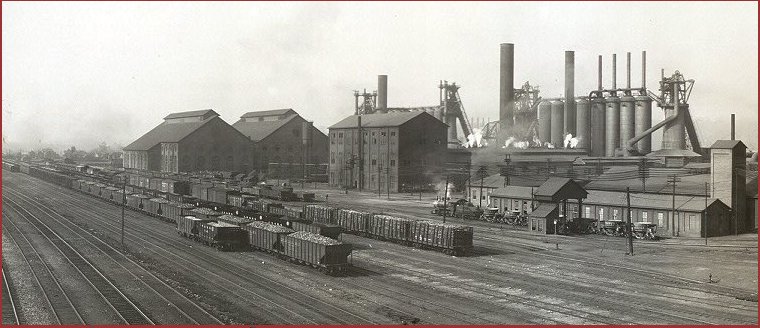
Ohio Works of the Carnegie Steel Co., Youngstown, O. c1910. Copyright Haines

Photo Co. September 19, 1910. Courtesy Library of Congress Prints and

Photographs Division. Digital ID# pan 6a15367


The coal needed to make iron and steel, as well as to generate the steam and

electricity for production, was (and still is) conveniently located just

south and east of the Ohio River in West Virginia and Kentucky, and to a les

ser extent, in Ohio. The iron ore smelted with this coal to make iron was

mined in the Michigan's Upper Peninsula (and now in Minnesota's Missabe

Range), was (and still is) shipped by Lake Boat to Ohio ports on Lake Erie

and thence by railroad to the various mills in Ohio and Pennsylvania.

Limestone needed to smelt the ore was quarried all over Ohio and Michigan.

Everything needed to forge a modern economy from material mined from the

earth was no more than 600 miles away by ship or 300 miles away by rail, and

in many instances was much closer than that.


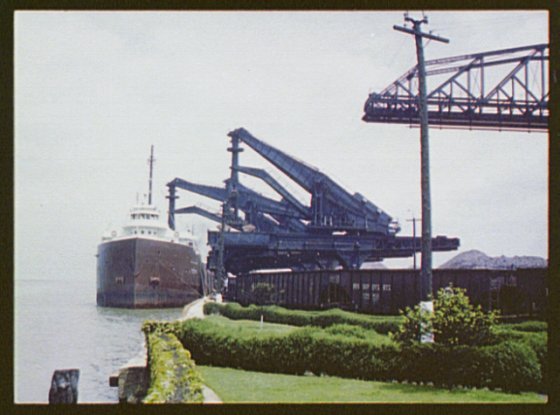
A pair of the Pennsylvania Railroad's Hulett Unloaders at the Cleveland

docks shovel iron ore out of a Great Lakes Freighter. The ore is then dumped

into waiting hopper cars and then delivered to an Ohio, Pennsylvania, or

West Virginia steel mill. Photograph by Jack Delano, May 1943. Courtesy

Library of Congress, Prints & Photographs Division, FSA-OWI Collection,

reproduction number LC-USW361-677 DLC


Ohio's location west of the Appalachians, sandwiched between the Great Lakes

and the Ohio River, lends itself to a large and vibrant industrial base. The

realities of the Global Economy have reduced the number of operating mills

and factories in the region. However, those that remain still need almost

all of their raw materials brought to them by train, not to mention many of

their finished products delivered to market by train.


When you add this home grown traffic with the traffic flowing from those now

mature east coast ports to the still vital cities of St. Louis, Chicago,

Detroit, and to points beyond, you'll understand why there are so many high

density mainlines that bisect Ohio, and why it is such a great place to

watch trains.


With a limitless budget, a lot of time, and a good vehicle you can explore

the railroads of Ohio from end to end, and from Lake Erie to the Ohio River.

Most of us can't do this, at least not all at once. Therefore we have to be

somewhat more selective about where to go in order to see a lot of trains,

or to frame that once-in-a-lifetime photograph.


Contained herein is a guide that can help steer you to that location. While

we are at it, we are providing an overview of contemporary railroad

operations in Ohio, as well as a general history of their development and

evolution.


None of this happens in a vacuum under laboratory conditions, so we'll also

be talking about the role that Ohio railroads have played in the development

(or the shared demise) of other industries. In addition, we'll take a look

at certain social issues that these other industries have created (as in

Appalachian coal mining areas and grundgy Steel towns).


In some cases there will be no point in either reinventing the wheel or

plagiarizing someone else's work, so we'll just steer you to a good link.

Pages within this website which are authored by someone other than myself

can be easily identified by the white background, with credit given at the

bottom of the page.


We like watching trains in Ohio. And we hope you do, too.


Table of Contents

If you'd like to contribute any photos or text, feel free to email me using

the link at the bottom of the page.


  a.. A Brief Overview and History of Ohio

  b.. A Brief Look at Ohio Transportation

  c.. Where to go to watch trains in Ohio

  d.. Contemporary Railroads in Ohio

  e.. The Old Railroads of Ohio

  f.. A Brief History of Industries Related to Ohio Railroading

  g.. Maps!

Text and html - Jeff Knorek [EMAIL PROTECTED]


----------------------------------------------------------------------------

----


You are visitor #

thank you for dropping by


----------------------------------------------------------------------------

----


Back Home to Knorek.com


Satisfy your online Train Craving at RailRoadInfo.com


Talk to me [EMAIL PROTECTED]


This website and all contents herein Copyright � 2001 by Jeff Knorek except

where noted.


<!DOCTYPE HTML PUBLIC "-//W3C//DTD HTML 4.0 Transitional//EN">

<HEAD>

<META http-equiv=Content-Type content="text/html; charset=iso-8859-1">

<META content="MSHTML 6.00.2722.900" name=GENERATOR>

<STYLE></STYLE>

</HEAD>


<DIV>http://knorek.com/RR/Ohio/ohio.htm</DIV>

<DIV> </DIV>

<DIV>

<H1 align=center>Welcome to Ohio, the Land of Trains


<A HREF="http://knorek.com/RR/Ohio/Frontpage/csx8619.jpg";>
http://knorek.com/RR/Ohio/Frontpage/csx8619.jpg</A>


CSX train Q137-18 (Baltimore Penn Mary-Chicago 63rd St) is accelerating

westward on track #1 past the EAS Warwick on the CSXT New Castle Subdivision
in

Clinton, Ohio at 6:35pm on August 18, 2000. CSX train S297-17 (Baltimore
Curtice

Bay-Toledo Walbridge) has taken the siding to let Q137 go around him. The
siding

is in the forground; Track #2 is in the background heading off to the right.

This was once part of the Baltimore & Ohio's mainline from Pittsburgh to

Chicago, which wasn't completed until late in the 19th Century. It remains a

vital link between Chicago and the Mid-Atlantic states.

<CENTER>Photograph copyright 2000-2002 Jeff Knorek

</CENTER>

Take a look at any map of the United States and you will see that the state

of Ohio is between all of the major port cities on the East Coast north of

Tidewater Virginia and the cities of Chicago, St. Louis, and Detroit, as well
as

most of the port cities on the West Coast. Only traffic to/from from Canada
and

Chicago through the state of Michigan, and traffic to/from Los Angeles and
the

East Coast by way of Memphis can avoid passing through the Buckeye State.

<CENTER>[Unable to display image]

</CENTER>

Map courtesy of the Central Intelligence

Agency

<HR>


Long ago, in the 1820's, 30's, and 40's, the big port cites along the East

Coast all had designs on being the predominant port once the fertile land

west of the Appalachian Mountains was developed and farmed. The rich
agriculture

that this land would ultimately sustain should be transloaded at eastern
ports

for export to Europe, the plan went, so toward this end many of the port
cities

chartered the early railroads themselves or politically supported those

chartered by other private interests (the same method similarly funded canal

building).

Remember, at this period in American history there were only primitive roads

to the western states and territories (Ohio, Michigan, Kentucky, Wisconsin,

Indiana, and Illinois). The Federal Highway System would not be developed
until

the Great Depression during the NINETEEN Thirties. Transporting goods

from farm or manufacturer to market by wagon was slow and expensive. Canals
were

used in concert with navigable rivers and the Great Lakes as a cheaper and

easier alternative to roads for long distance bulk transport on boats to and

from the West (as well as within the territories and new states), but it was

still slow.

The business and industry of railroading was itself a new technology to the

United States, imported from England. It held the promise of being both
cheaper

than road transport and faster than canal transport. The Eastern States were

farming cereal grains, but the land was not rich for farming, and domestic

consumption did not leave much grain left over for export to Europe. The West

was growing more grain than its own population could use, and the Eastern
port

cities wanted in on the action.

Unfortunately for them, a mountain range, the Appalachians, lay

between this abundant grain and the merchants who wanted to sell it overseas.

The importance of canals in the development of Ohio and other states cannot
be

overstated. However, the prevailing transportation modes of the day were not

suited to the task of hauling a large volume of heavy goods up and over the

mountains. This was the impetus behind the first railroad construction in the

United States, the B&O, which was chartered in 1825 (by comparison, the Erie

and Ohio Canal connecting the Ohio villages of Cleveland on Lake Erie and

Portsmouth on the Ohio River by 1832, was also chartered in 1825).

The Pennsylvania Railroad and the New York Central System (or their proxies

and/or acquisitions) would be major players in this Nineteenth Century push
from

the East Coast to the Ohio River, Lake Erie, and beyond. The Baltimore &

Ohio, Chesapeake & Ohio, Norfolk & Western, Erie, and other railroad

companies and their proxies or acquisitions would follow (each with a

rich, interesting, and sometimes dramatic history).

Over the course of some fifty years the state of Ohio would be both a goal

and then a thoroughfare as the major eastern railroads reached Chicago and
St.

Louis. During this time many regional railroads within the state were
chartered

as well. These companies hauled the raw materials used in iron production
from

the mines to the mills, as well as finished products and agricultural goods
from

the mills and farm bureaus to market. They proved to be every bit as vital to

the industries and communities that they served as their larger brethren.

<A HREF="http://knorek.com/RR/Ohio/Frontpage/ohiorr.1890.jpg";>
http://knorek.com/RR/Ohio/Frontpage/ohiorr.1890.jpg</A>

Railroad map of Ohio published by the State. 1890. Prepared by J. A. Norton,

commissioner of railroads & telegraphs. Copyright by H. B. Stranahan.

Provided by the Library of Congress.

By 1890 Ohio was a maze of railroads moving north and south, east and west.


Along the way west, immigrant and domestic migration from the east exploded,

providing a vast and hungry labor pool. With the benefits of this new
overland

transportation technology married with those of water shipping to carry raw

materials (as well as recently emmigrated workers) to Ohio cities, many

industrial manufacturing facilities soon sprang up all along Lake Erie and in

the region between Toledo Ohio and Pittsburgh Pennsylvania, as well as the
area

around Cincinnati. By 1920, the factories that manufactured Iron and Steel,

Glass, Rubber, Automobiles, Locomotives, Tractors, Trucks, Ships, Chemicals,

Machine Tools, Foodstuffs, Household Products and Appliances all combined to

create one of the largest and most concentrated industrial zones on earth.

<A HREF="http://knorek.com/RR/Ohio/Frontpage/ytown4.jpg";>
http://knorek.com/RR/Ohio/Frontpage/ytown4.jpg</A>

Ohio Works of the Carnegie Steel Co., Youngstown, O. c1910. Copyright Haines

Photo Co. September 19, 1910. Courtesy Library of Congress Prints and

Photographs Division. Digital ID# pan 6a15367

The coal needed to make iron and steel, as well as to generate the steam and

electricity for production, was (and still is) conveniently located just
south

and east of the Ohio River in West Virginia and Kentucky, and to a lesser

extent, in Ohio. The iron ore smelted with this coal to make iron was mined
in

the Michigan's Upper Peninsula (and now in Minnesota's Missabe Range), was
(and

still is) shipped by Lake Boat to Ohio ports on Lake Erie and thence by
railroad

to the various mills in Ohio and Pennsylvania. Limestone needed to smelt the
ore

was quarried all over Ohio and Michigan. Everything needed to forge a modern

economy from material mined from the earth was no more than 600 miles away by

ship or 300 miles away by rail, and in many instances was much closer than

that.

<A HREF="http://knorek.com/RR/Ohio/Frontpage/Hulett1.jpg";>
http://knorek.com/RR/Ohio/Frontpage/Hulett1.jpg</A>

A pair of the Pennsylvania Railroad's Hulett Unloaders at the Cleveland docks

shovel iron ore out of a Great Lakes Freighter. The ore is then dumped into

waiting hopper cars and then delivered to an Ohio, Pennsylvania, or West

Virginia steel mill. Photograph by Jack Delano, May 1943. Courtesy Library of

Congress, Prints & Photographs Division, FSA-OWI Collection, reproduction

number LC-USW361-677 DLC

Ohio's location west of the Appalachians, sandwiched between the Great Lakes

and the Ohio River, lends itself to a large and vibrant industrial base. The

realities of the Global Economy have reduced the number of operating mills
and

factories in the region. However, those that remain still need almost all of

their raw materials brought to them by train, not to mention many of their

finished products delivered to market by train.

When you add this home grown traffic with the traffic flowing from those now

mature east coast ports to the still vital cities of St. Louis, Chicago,

Detroit, and to points beyond, you'll understand why there are so many high

density mainlines that bisect Ohio, and why it is such a great place to watch

trains.

With a limitless budget, a lot of time, and a good vehicle you can explore

the railroads of Ohio from end to end, and from Lake Erie to the Ohio River.

Most of us can't do this, at least not all at once. Therefore we have to be

somewhat more selective about where to go in order to see a lot of trains, or
to

frame that once-in-a-lifetime photograph.

Contained herein is a guide that can help steer you to that location. While

we are at it, we are providing an overview of contemporary railroad
operations

in Ohio, as well as a general history of their development and evolution.

None of this happens in a vacuum under laboratory conditions, so we'll also

be talking about the role that Ohio railroads have played in the development
(or

the shared demise) of other industries. In addition, we'll take a look at

certain social issues that these other industries have created (as in

Appalachian coal mining areas and grundgy Steel towns).

In some cases there will be no point in either reinventing the wheel or

plagiarizing someone else's work, so we'll just steer you to a good link.
Pages

within this website which are authored by someone other than myself can be

easily identified by the white background, with credit given at the bottom of

the page.

We like watching trains in Ohio. And we hope you do, too.


Table of Contents


If you'd like to contribute any photos or text, feel free to email me

using
the link at the bottom of the page.

<UL>

  <LI><A HREF="http://knorek.com/RR/Ohio/History/historyOH.htm";>A Brief
Overview

  and History of Ohio</A>

  <LI><A HREF="http://knorek.com/RR/Ohio/History/historyTransportation.htm";>A

  Brief Look at Ohio Transportation</A>

  <LI><A HREF="http://knorek.com/RR/Ohio/Current/fave.htm";>Where to go to
watch

  trains in Ohio</A>

  <LI><A HREF="http://knorek.com/RR/Ohio/Current/contemporary.htm";>
Contemporary

  Railroads in Ohio</A>

  <LI><A HREF="http://knorek.com/RR/Ohio/History/old.htm";>The Old Railroads
of

  Ohio</A>

  <LI><A HREF="http://knorek.com/RR/Ohio/History/relatedIndustry.htm";>A Brief

  History of Industries Related to Ohio Railroading</A>

  <LI><A HREF="http://knorek.com/RR/Ohio/Current/Maps/maps.htm";>Maps!</A>

</LI></UL>

<CENTER>

Text and html - Jeff Knorek [EMAIL PROTECTED]

<HR align=center>


You are visitor # <A HREF="http://knorek.com/cgi-bin/Count.cgi?df=ohio.dat&;
pad=0&dd=B&st=3255">http://knorek.com/cgi-bin/Count.cgi?df=ohio.dat&pad=0&;
dd=B&st=3255</A>

thank you for dropping by

<HR>


<A HREF="http://knorek.com/index.html";>Back Home</A> to Knorek.com

<A HREF="http://www.railroadinfo.com/";>Satisfy</A> your online Train Craving

at RailRoadInfo.com

<CENTER>

Talk to me <A HREF="mailto:[EMAIL PROTECTED]";>[EMAIL PROTECTED]</A>

This website and all contents herein Copyright � 2001 by Jeff

Knorek except where noted.

<UL></UL></CENTER></CENTER></DIV>

<A HREF="http://www.ctrl.org/";>www.ctrl.org</A>
DECLARATION & DISCLAIMER
==========
CTRL is a discussion & informational exchange list. Proselytizing propagandic
screeds are unwelcomed. Substance�not soap-boxing�please!  These are
sordid matters and 'conspiracy theory'�with its many half-truths, mis-
directions and outright frauds�is used politically by different groups with
major and minor effects spread throughout the spectrum of time and thought.
That being said, CTRLgives no endorsement to the validity of posts, and
always suggests to readers; be wary of what you read. CTRL gives no
credence to Holocaust denial and nazi's need not apply.

Let us please be civil and as always, Caveat Lector.
========================================================================
Archives Available at:
http://peach.ease.lsoft.com/archives/ctrl.html
 <A HREF="http://peach.ease.lsoft.com/archives/ctrl.html";>Archives of
[EMAIL PROTECTED]</A>

http:[EMAIL PROTECTED]/
 <A HREF="http:[EMAIL PROTECTED]/";>ctrl</A>
========================================================================
To subscribe to Conspiracy Theory Research List[CTRL] send email:
SUBSCRIBE CTRL [to:] [EMAIL PROTECTED]

To UNsubscribe to Conspiracy Theory Research List[CTRL] send email:
SIGNOFF CTRL [to:] [EMAIL PROTECTED]

Om