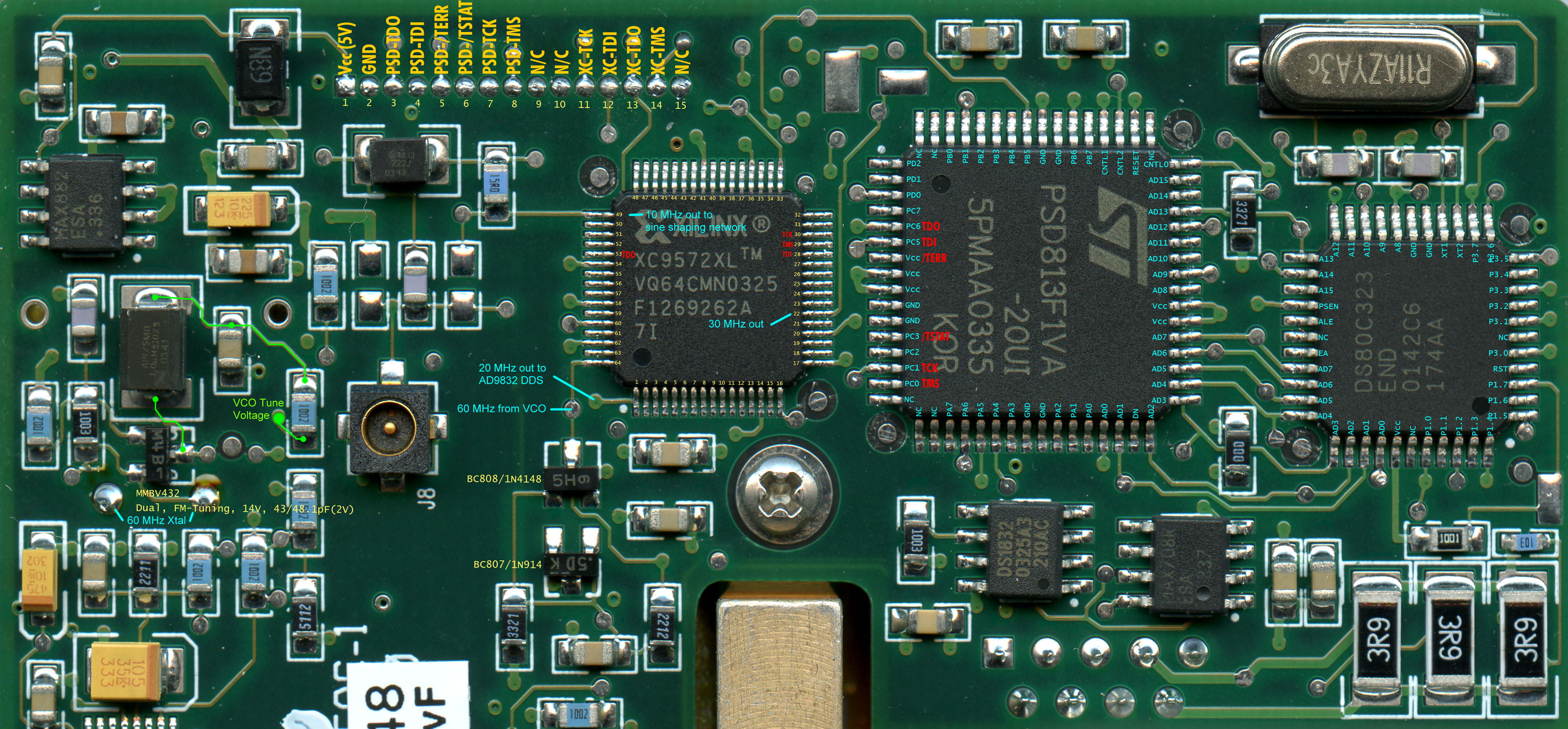
Thanks guys!

Updated Elio's picture with the additional info John provided.
Revised picture posted here...
http://www.xertech.net/FE5680A/FE-5680A_annotated_2.jpg
Let me know if I got anything wrong. Elio, feel free to update your
original if you want to keep control of it.
-Rex


On 2/1/2012 10:39 PM, John Beale wrote:
> http://www.rhodiatoce.com/pics/time-nuts/FE-5680A_annotated.jpg

Excellent work!  I look forward to any further info.
Great picture with the pins and some parts labelled. By the way, if
you want you could add the frequencies going into and out of the
Xilinx XC9572XL CPLD part:
Pin 64: 60 MHz in from VCXO
Pin 1: 20 MHz out to AD9832 DDS chip
Pin 22: 30 MHz out
Pin 49: 10 MHz out to sine shaping network

See also:
https://plus.google.com/photos/109928236040342205185/albums/5680473650837554113/5685304134718133138
It might clarify things to point out the 60 MHz through-hole crystal
pins visible immediately below the MMBV432 varactor diode.
Knowing that's the varactor, and looking at the circuit I'm guessing
the VCXO tuning voltage must pass through the 10K resistor next to
mini-coax connector J8 (then past the bypass cap, through the 1.0 uH
inductor, to the diode). That 10k connects through a 1k to pin 8
(output 3) of the TLC27M4B quad opamp on the other side of the board,
near the 60 MHz xtal. Hmm.... sure enough: at startup, pin 8 swings
between 0 and 11.9V, before the unit locks, which in my case happens
at 7.3 Volts. (The opamp is powered from a 13.16V supply, output
swings typ. 1.3V below the + rail.)
Just for fun, here's a plot of the VCXO tuning voltage at startup:
https://picasaweb.google.com/109928236040342205185/FE5680A#5704421825887557874
_______________________________________________
time-nuts mailing list -- [email protected]
To unsubscribe, go to
https://www.febo.com/cgi-bin/mailman/listinfo/time-nuts
and follow the instructions there.
_______________________________________________
time-nuts mailing list -- [email protected]
To unsubscribe, go to https://www.febo.com/cgi-bin/mailman/listinfo/time-nuts
and follow the instructions there.