For anyone interested,

I managed to go about this a slightly difference way but using transclusion
and just writing the inputs straight in to the directive within a sub
element (which works.great for allowing users to format their inputs
specifically to their needs)
<some-directive>
<some-controls>
<input name="start_date" type="date"/>
<input name="end_date" type="date"/>
</some-controls>
</some-directive>

The directive has a post method which calls a remote location, when this
occurs a function extracts all of the key:value pairs within some-controls
and passes them along automatically. It's obviously up to the server what
it does with this information.


</some-directive>

On Friday, July 4, 2014 5:07:30 PM UTC+1, Chris Mingay wrote:
>
> Hi all,
>
> I am quite new to AngularJS and specifically chart rendering through it. I
> have currently spent the most time looking at D3 and I think that's what I
> will probably go with for the simple pie/donut/line/bar charts I require.
> I've spent a couple of weeks looking at directives and that's clearly the
> way to go for what I require.
>
> I would like to create a directive that I can supply to colleagues and
> have them build reasonably complex elements without having  any particular
> knowledge of the underlying code.
>
> I am by no means asking anyone to tell me exactly how to do it, I'm just
> trying to make sure it's possible and that I haven't missed a glaring
> limitation with Angular. That said, if you are able to show me anything
> details, be my guest :D
>
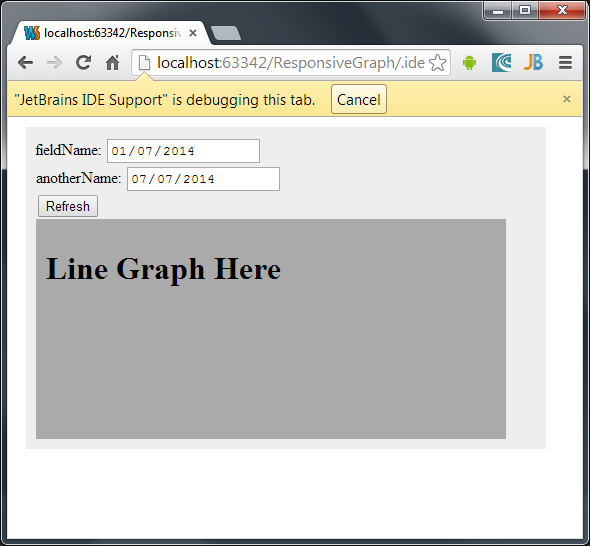
> Right, I would like to turn something like this this
>
> <my-bar-chart data-api="www.someserver.com/data/graph"
> data-filter="[['fieldName','date'],['anotherName','date']]"
> data-type="line"></my-bar-chart>
>
> Into something like this (crude styling to be ignored)
>
>
> <https://lh4.googleusercontent.com/-Hazthes_gPI/U7bPmbfYu1I/AAAAAAAAABc/pekBf3b_vic/s1600/chart.png>
>
> Pressing refresh makes a $http call to the data-api location, providing
> the specified filters (fieldName and anotherName, both of which are date
> fields) with the $http post. The server takes this request and returns the
> relevant data in JSON format. The directive renders this data as a line
> chart (specified with data-type) in the designated area ("Line Graph Here")
>
> So, is that possible?
>
> Thanks
>
> -Chris
>
>

--
You received this message because you are subscribed to the Google Groups
"AngularJS" group.
To unsubscribe from this group and stop receiving emails from it, send an email
to [email protected].
To post to this group, send email to [email protected].
Visit this group at http://groups.google.com/group/angular.
For more options, visit https://groups.google.com/d/optout.