Tom Jackson schrieb:
Actually 2MB / request sounds like a massive memory leak. Maybe something
isn't getting cleaned up?
this would be as wel my first guess. Note, that the aolserver cleans after
each request only the global variables in the toplevel (::)
namespace, not in other namespaces.
note as well, that in cases, where you create c-level objects in a
connection tread (e.g. dom-nodes with tdom, or xotcl objects),
one has to delete these as well, if they should not survive a request.
xotcl-core in openacs has some support for making this more
conveniant.

Up to my experience, both aolserver 4.0.10 and aolserver 4.5
grow, but not in the numbers you are reporting.

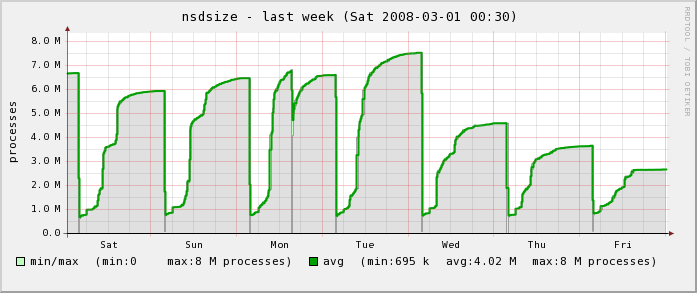
below is a monitoring result from one of our larger servers, running
aolserver 4.0.10 in 64 bit on REL on POWER5+. The y axis shows
memory usage in GB (labels are wrong).

During the last week, we had up to 7 mio hits per day (1.3 mio
page views), thursday and friday just around 3 mio hits.
one can see the rapid growth after start-time (when more connection
threads are started) and a certain slowdown in the growth rate
(my interpretation is that this is from some
saturation from memory fragmentation/over-allocation and less
requests in the evening). If we would assume, that the growth rate
is just depending on the hits, it would be about 1kb per hit (or
5kb per view). The "leaks" must be actually much less, since
we are running up to 100 connection threads, with 9000
tcl procs each, also these take some significant memory.

For us, the dailly reboot is not a problem. A view years
ago, we did not reboot, but we figured out that for our
applications, the aolserver/openacs system became about
5% slower every day running. After a reboot, it is again
at "full speed".

-gustaf neumann


http://media.wu-wien.ac.at/download/nsdsize-week.png


--
AOLserver - http://www.aolserver.com/

To Remove yourself from this list, simply send an email to <[EMAIL PROTECTED]>
with the
body of "SIGNOFF AOLSERVER" in the email message. You can leave the Subject:
field of your email blank.