Hi Suho,

Please loot this, and some of the scenarios should be handy for IoT
--Srinath

On Mon, Sep 12, 2016 at 9:52 AM, Janaka Thilakarathna <[email protected]>
wrote:

> Hi all,
>
> I am currently working on the project Multidimensional Space Search with
> Lucene 6 for DAS. Here is a list of possible functionalities (and some
> example scenarios) that we can provide using Lucene 6.1 's multi
> dimensional space search.
> (This is a brief description on collected details, to see more info and
> the test codes, please visit my git repo
> <https://github.com/janakact/test_lucene>.)
>
> Multidimensional space points in Lucene 6 can be categorized into two
> types of space points depending on their query types and distribution of
> points in the space.
>
>    1. General Multidimensional space points.
>    2. Locations on the planet surface.
>
>
> *1. General Multidimensional Space Points*
> This is the generic type of multi dimensional space points. Those are
> actually vector spaces. Space has a dimension K. In a K-dimensional space a
> point is represented by a K number of numeric values.
>
> For an example 3D point will be represented by 3 float/double values.
> (because distance is measured as a floating point number.)
>
> *Possible Queries for API*
>
>    - Search for points with exact given values.
>    - Search for points which has one of the value from a given set of
>    values.
>    - Search for points within a given range.
>    - Get the number of points which has exact point.
>    - Get the number of points within a given range. (Ranges are
>    multidimensional ranges. In 3D, they are boxes.)
>    - Divide points into range-buckets and get the count in each buckets.
>    (Range bucket is a range which has a label in it)
>
> *Scenarios*
>
> Since this is a more general space definition this could have many general
> applications. These dimensions can be used to represent any numeric field.
> They can be used to represent locations in a 3D space if we use 3
> dimensional points. We can use it to represent both space and time if we
> use 4 dimensions. (X, Y, Z, time all are numeric fields. Double can be
> used).
>
> *Independent Parameters*
>
> It can be used to represent completely independent parameters. Think there
> is a set of employees. A multi dimensional space can be used to represent
> different parameters of them.
>
> *Example:* Age, salary, height, average number of leaves per month. These
> are 4 numeric fields which are completely independent. It can be
> represented as a 4 Dimensional Space. Each person will be represented as a
> point in this space. Then the user can use Lucene to query  on these
> people.
>
>    - What is the number of people who's age is 25-30 years, Height is
>    160cm to 180cm, Salary is 50,000 to 75,000 and take 1-5 average number of
>    leaves per month?
>    - Or user can divide people into different buckets and count them
>    depending on the ranges for each parameter.
>
> (Of course this can be done by indexing those parameters separately and
> query using 'AND' keyword, but indexing them together as a multidimensional
> space will make searching more efficient)
>
> *2. Locations on the planet surface. (Latitude, Longitude)*
> Here points represents locations on top of the planet surface. This is a
> more specific type of search provided by Lucene to index and search
> geographical locations.
>
> These points are created using only the latitude and longitude values of
> locations.
> **Please consider altitude is not yet supported by Lucene.*
>
> Since this is specifically designed for Locations search it has more
> useful queries than General Multidimensional Points.
>
> *Possible Queries for the API*
>
>    - Search for the K-nearest points from a given location. (return the
>    given number of points)
>    - Search for the Points within a given radius from a given point.
>    - Sort them by the distance from a given location.
>    - Points inside a polygon.(Polygons are geometric shapes on the
>    surface of the planet. Example: map of a country)
>    - Get the number of points inside a polygon.*
>    - Get the number of points in each bucket where buckets are specified
>    as polygons.
>    - Get the number of points in each bucket where buckets are specified
>    by the distance from a given location.
>
> * Composite polygons are possible.
> *Scenarios*
>
> *Airport Scenario *
> If we index the set of airports in the world as GeoPoints. Following
> queries are possible examples. (Here is the test code I implemented as an
> example.)
> <https://github.com/janakact/test_lucene/blob/master/src/test/java/TestMultiDimensionalQueries.java>
>
>    - Find closest set of airports to a given town.
>    - Find the set of airports within a given radius from a particular
>    town.
>    - Find the set of airports inside a country. (Country can be given as
>    a polygon)
>    - Find the set of airports within a given range of Latitudes and
>    Longitudes. It is a Latitude, Longitude box query. (For a examples:
>    Airports closer to the equatorial)
>    - Find the set of airports closer to a given path. (Path can be
>    something like a road. Find the airports which are less than 50km away from
>    a given highway)
>    - Count the airports in each country by giving country maps as
>    polygons.
>
> *Indexing airplane paths*
>
>    - It is possible to query for paths which goes through an interesting
>    area.
>
> Above example covers most of the functionalities that Lucene Space search
> provides.
> Here are some other examples,
>
>    - Number of television users a satellite can cover.(by indexing
>    receivers' locations)
>    - To find the number of stationary telescopes that can be used to
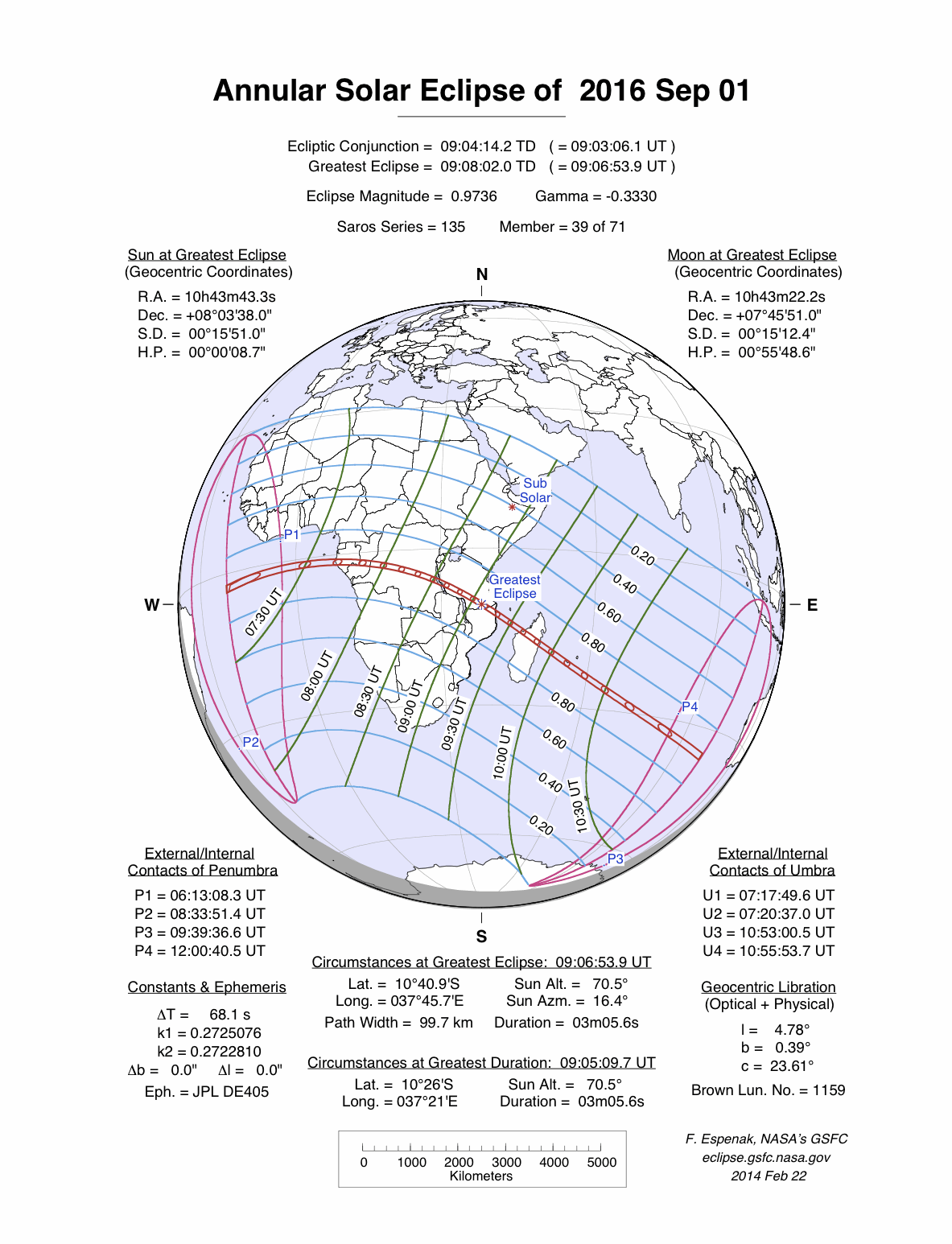
>    observe a solar eclipse. (by indexing telescope locations. Area the solar
>    eclipse is visible, can be represented as a polygon
>    http://eclipse.gsfc.nasa.gov/SEplot/SEplot2001/SE2016Sep01A.GIF
>    <http://eclipse.gsfc.nasa.gov/SEplot/SEplot2001/SE2016Sep01A.GIF>)
>
> So, that's it.
> Thank you.
>
> Regards,
> Janaka Chathuranga
>
> --
> Janaka Chathuranga
> *Software Engineering Intern*
> Mobile : *+94 (**071) 3315 725*
> [email protected]
>
> <https://wso2.com/signature>
>
>


--
============================
Srinath Perera, Ph.D.
   http://people.apache.org/~hemapani/
   http://srinathsview.blogspot.com/
_______________________________________________
Architecture mailing list
[email protected]
https://mail.wso2.org/cgi-bin/mailman/listinfo/architecture