Good summary of the features Janaka! .. So using this I guess we can
implement plenty of useful scenario when it comes to geospatial analysis.
So we already have the geo dashboard in CEP which demonstrates some of the
existing realtime features we have related to this. I guess we can improve
that as well to use this feature, @Suho/Mohan WDYT? ..
Anyways, so simply as a general set of operations this would be very useful
to anyone to create their own customer solution. I'm looping in Mifan here
also, to possibly get some suggestions on any additional usecases we would
probably have.

Cheers,
Anjana.

On Mon, Sep 12, 2016 at 9:52 AM, Janaka Thilakarathna <[email protected]>
wrote:

> Hi all,
>
> I am currently working on the project Multidimensional Space Search with
> Lucene 6 for DAS. Here is a list of possible functionalities (and some
> example scenarios) that we can provide using Lucene 6.1 's multi
> dimensional space search.
> (This is a brief description on collected details, to see more info and
> the test codes, please visit my git repo
> <https://github.com/janakact/test_lucene>.)
>
> Multidimensional space points in Lucene 6 can be categorized into two
> types of space points depending on their query types and distribution of
> points in the space.
>
>    1. General Multidimensional space points.
>    2. Locations on the planet surface.
>
>
> *1. General Multidimensional Space Points*
> This is the generic type of multi dimensional space points. Those are
> actually vector spaces. Space has a dimension K. In a K-dimensional space a
> point is represented by a K number of numeric values.
>
> For an example 3D point will be represented by 3 float/double values.
> (because distance is measured as a floating point number.)
>
> *Possible Queries for API*
>
>    - Search for points with exact given values.
>    - Search for points which has one of the value from a given set of
>    values.
>    - Search for points within a given range.
>    - Get the number of points which has exact point.
>    - Get the number of points within a given range. (Ranges are
>    multidimensional ranges. In 3D, they are boxes.)
>    - Divide points into range-buckets and get the count in each buckets.
>    (Range bucket is a range which has a label in it)
>
> *Scenarios*
>
> Since this is a more general space definition this could have many general
> applications. These dimensions can be used to represent any numeric field.
> They can be used to represent locations in a 3D space if we use 3
> dimensional points. We can use it to represent both space and time if we
> use 4 dimensions. (X, Y, Z, time all are numeric fields. Double can be
> used).
>
> *Independent Parameters*
>
> It can be used to represent completely independent parameters. Think there
> is a set of employees. A multi dimensional space can be used to represent
> different parameters of them.
>
> *Example:* Age, salary, height, average number of leaves per month. These
> are 4 numeric fields which are completely independent. It can be
> represented as a 4 Dimensional Space. Each person will be represented as a
> point in this space. Then the user can use Lucene to query  on these
> people.
>
>    - What is the number of people who's age is 25-30 years, Height is
>    160cm to 180cm, Salary is 50,000 to 75,000 and take 1-5 average number of
>    leaves per month?
>    - Or user can divide people into different buckets and count them
>    depending on the ranges for each parameter.
>
> (Of course this can be done by indexing those parameters separately and
> query using 'AND' keyword, but indexing them together as a multidimensional
> space will make searching more efficient)
>
> *2. Locations on the planet surface. (Latitude, Longitude)*
> Here points represents locations on top of the planet surface. This is a
> more specific type of search provided by Lucene to index and search
> geographical locations.
>
> These points are created using only the latitude and longitude values of
> locations.
> **Please consider altitude is not yet supported by Lucene.*
>
> Since this is specifically designed for Locations search it has more
> useful queries than General Multidimensional Points.
>
> *Possible Queries for the API*
>
>    - Search for the K-nearest points from a given location. (return the
>    given number of points)
>    - Search for the Points within a given radius from a given point.
>    - Sort them by the distance from a given location.
>    - Points inside a polygon.(Polygons are geometric shapes on the
>    surface of the planet. Example: map of a country)
>    - Get the number of points inside a polygon.*
>    - Get the number of points in each bucket where buckets are specified
>    as polygons.
>    - Get the number of points in each bucket where buckets are specified
>    by the distance from a given location.
>
> * Composite polygons are possible.
> *Scenarios*
>
> *Airport Scenario *
> If we index the set of airports in the world as GeoPoints. Following
> queries are possible examples. (Here is the test code I implemented as an
> example.)
> <https://github.com/janakact/test_lucene/blob/master/src/test/java/TestMultiDimensionalQueries.java>
>
>    - Find closest set of airports to a given town.
>    - Find the set of airports within a given radius from a particular
>    town.
>    - Find the set of airports inside a country. (Country can be given as
>    a polygon)
>    - Find the set of airports within a given range of Latitudes and
>    Longitudes. It is a Latitude, Longitude box query. (For a examples:
>    Airports closer to the equatorial)
>    - Find the set of airports closer to a given path. (Path can be
>    something like a road. Find the airports which are less than 50km away from
>    a given highway)
>    - Count the airports in each country by giving country maps as
>    polygons.
>
> *Indexing airplane paths*
>
>    - It is possible to query for paths which goes through an interesting
>    area.
>
> Above example covers most of the functionalities that Lucene Space search
> provides.
> Here are some other examples,
>
>    - Number of television users a satellite can cover.(by indexing
>    receivers' locations)
>    - To find the number of stationary telescopes that can be used to
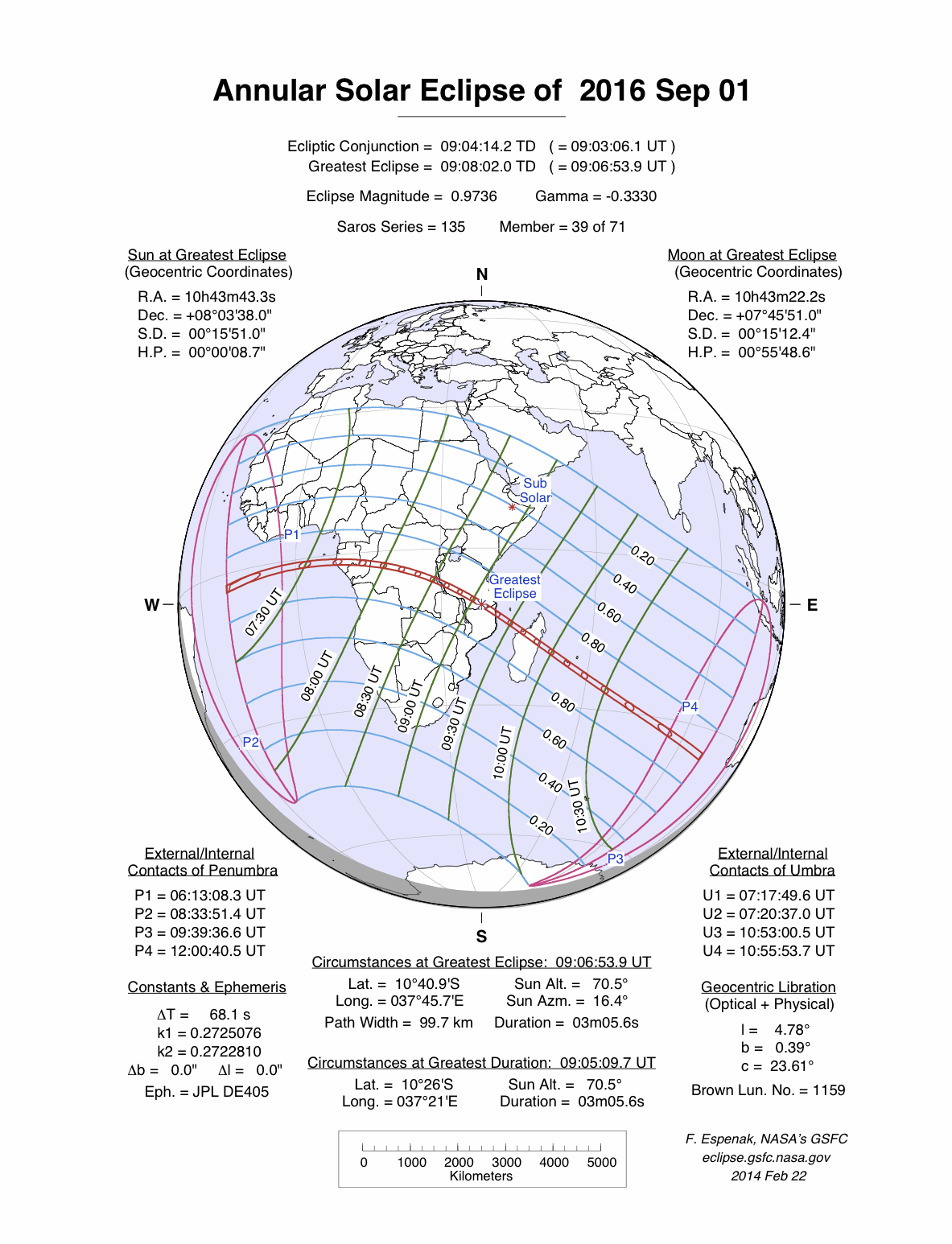
>    observe a solar eclipse. (by indexing telescope locations. Area the solar
>    eclipse is visible, can be represented as a polygon
>    http://eclipse.gsfc.nasa.gov/SEplot/SEplot2001/SE2016Sep01A.GIF
>    <http://eclipse.gsfc.nasa.gov/SEplot/SEplot2001/SE2016Sep01A.GIF>)
>
> So, that's it.
> Thank you.
>
> Regards,
> Janaka Chathuranga
>
> --
> Janaka Chathuranga
> *Software Engineering Intern*
> Mobile : *+94 (**071) 3315 725*
> [email protected]
>
> <https://wso2.com/signature>
>
>


--
*Anjana Fernando*
Associate Director / Architect
WSO2 Inc. | http://wso2.com
lean . enterprise . middleware
_______________________________________________
Architecture mailing list
[email protected]
https://mail.wso2.org/cgi-bin/mailman/listinfo/architecture