'Twas brillig, and the slithy toves/ Did gyre and gimble in the wabe/ All mimsy were the borogoves/ And the mome raths outgrabe.
Saturday, September 09, 2006
In Spite of the Gods: Edward Luce on India
When a foreign correspondent spends five years living and working in a country and then writes a book about it, there's bound to be a measure of scepticism – murmurs, perhaps, about why an outsider with little emotional stake in the place should hold forth on its problems and the possible remedies. But Edward Luce's In Spite of the Gods: The Strange Rise of Modern India isn't that sort of book. It doesn't make overreaching judgements; it prefers to chronicle and to drop the sharp observation or two, which is often the best anyone can do with a country this vast and complex. Luce is respectful of the complexities, and of Amartya Sen's observation that "anything one might say about India, the opposite can also be shown to be true".
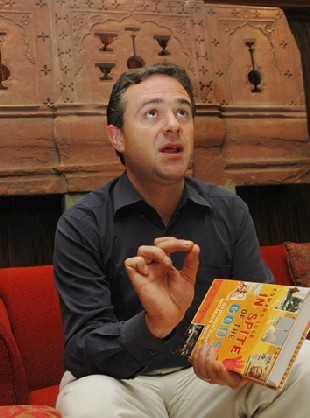 He's also quick to stress that India isn't just another pitstop in his itinerant career. He considers it a second home, and after all he's related to it by marriage; his wife Priya, a development economist, is half Bengali and half Gujarati. They first met as students in Oxford and were married in Delhi in 1994 – years before he came here in a professional capacity, as the South Asia bureau chief of the
Financial Times.
He's also quick to stress that India isn't just another pitstop in his itinerant career. He considers it a second home, and after all he's related to it by marriage; his wife Priya, a development economist, is half Bengali and half Gujarati. They first met as students in Oxford and were married in Delhi in 1994 – years before he came here in a professional capacity, as the South Asia bureau chief of the
Financial Times.The stated aim of In Spite of the Gods is to "provide an unsentimental evaluation of contemporary India against the backdrop of its widely expected ascent to great-power status in the 21st century". Without coming across as patronising, Luce discusses the many contradictions in India's society; the lopsided growth of the economy; the enduring legacies of leaders like Gandhi, Nehru and Ambedkar; the repercussions of the caste conflicts; the often-peculiar nature of Indian modernity in the new century; and the country's relations with China and the US, which he describes as a triangular dance that will be crucial to the world's future.
All this adds up to a welcome perspective by someone who cares about the country but can also look at it from a standpoint denied to those of us who have been on the inside for years, each with our own sets of prejudices and crosses – many of which are unconscious, some that have been handed down over generations. Luce's writing here is understandably more friendly and personal than the many features he has written about India for the FT. There are amusing anecdotes, including one about Amar Singh's Lodhi Estate bungalow, with a heavy stone ceiling that divides ("as in a Bond film") to present a dazzling view of the terrace beyond. "There might be a little corruption here and there," a beaming Singh tells the author later. "You cannot check everything." Luce meets activists who have been battling corruption for years, records their near-surreal stories – being taken to the same dam by many different routes, for instance (because the authorities have built one and tucked away money for four).
Notably, however, the chapter on the nature of corruption in India's government offices and courtrooms begins with an encounter with a man who has succeeded in getting work done in the face of the system's flaws: V J Kurian, a senior IAS officer who heads the highways department in Kerala and who was briefly transferred to an isolated district as punishment for not accepting a bribe. Kurian's integrity was largely responsible for the success of the new international airport at Cochin, but even he admits that there are little compromises that one has to make in this job: securing a business-class upgrade for another official, for instance. One of the book's most telling passages has Luce taking his leave of Kurian and then very briefly wondering if he might ask him to arrange an upgrade for his flight back to Delhi. "But the moment passed."
The book's title (perhaps partly directed at those who continue to think of India in principally spiritual – and exotic – terms) is inspired by Jawaharlal Nehru's thesis that the country's greatest strengths are not exclusively located in its religious traditions. Luce believes India's heterogeneity is central to its success as a democracy: "The long tradition of pluralism has given the country hundreds of years of practice at managing social conflicts without automatic resort to violence." This, he feels, is also one of the reasons why an increase in India's power in the coming decades would be in the world's larger interests. "Having dealt with diversity for centuries, India has a lot of experience in managing a multi-ethnic society," he says. "One of its great strengths is that – unlike China, say – it has never been an absolutist country. It has a lot to teach the world."
Among the things that worry him are the callousness of the metropolitan elite towards less privileged Indians, and the strange need for affirmation from other countries – all mixed up, of course, with proclamations of India's moral superiority to the rest of the world. "This simultaneous existence of superiority and inferiority complexes isn't peculiar to India, of course," he says, citing the British ambivalence towards the French; the surface condescension that conceals a layer of envy for their sophistication. "But it often acquires worrying proportions here."
None of this is unusual. Though it sounds contradictory, economic globalisation is usually accompanied by increasing ethnic nationalism. "As the world opens up and one feels familiar things slipping away, the need to cling to one's identity becomes even more imperative," says Luce. "Often people overcompensate for this by becoming more partisan, even jingoistic about their own culture and values."
"India isn't on an autopilot to greatness," Luce writes at one point, "but it would take an incompetent pilot to crash the plane." I ask him what his worst-case scenario is for the country, say 30 years from now, and not counting something as disastrous as a nuclear conflict. "The further widening of inequality," he replies, "as the result of the government's inability to get infrastructure programmes going and to plug rural India into the economy. That would lead to greater migration to the cities, the alienation of the more efficient states from the Centre and – eventually – genuine political tensions about the nature of Indian federalism."
This is what he describes as "a reasonably plausible bad-case scenario", though naturally he hopes none of it will come to pass. Luce is working now for the FT in Washington, DC, but he expects to live in India again sometime in the future; the country has clearly got under his skin. At his book launch he told of his first few weeks staying alone in a hotel in Delhi and how, when his wife joined him and the hotel staff realised he was married to an Indian, they began addressing him as "Mr Basu". "India takes hold of you very quickly," he laughs, and it's obvious that he doesn't mind being appropriated.
(Photo: Priyanka Parashar)
Please see what Umesh already posted: You have all the answers there(for now ).
> This is one option for a quick global career.
>
> Umesh
>
> -------------------------
> Saturday Interview With Azim H. Premji
> Outsourcing: It's Been Good to Him
>
http://www.nytimes.com/2006/09/16/business/16interview.html?_r=1&oref=slogin
> By SARITHA RAI
mm
From: [EMAIL PROTECTED]
To: [EMAIL PROTECTED]
CC: [EMAIL PROTECTED], [email protected]
Subject: Re: [Assam] New book by Edward Luce
Date: Mon, 18 Sep 2006 02:39:04 EDT
Ram/Rajen
This is no doubt a commendable article reflecting on the booming software industry of India.
A few years ago I read in a journal that all this progress can be attributed to multinationals or other large industries that operate from abroad. Only an insignificant part of the global trade is indigenous confined to South India, I now forget the names of the States, I think they are Andhra Pradesh, Tamil Nadu or Kerala (Knowledgeable netters may kindly correct me).
During my visit to India last May, I happen to look at some chemical products like disinfectants, hair colours etc. I found that these ordinary household items are actually produced by giant German and other foreign companies employing highly-paid Indian executives, jobs which are pursued relentlessly by our MBAs. (Incidentally in Nepal I found an abundance of articles of all sorts imported from China, South Korea and of course Western countries; and of course these cheap goods are available in the Western markets as well).
Regards
Bhuban
>_______________________________________________
>assam mailing list
>[email protected]
>http://assamnet.org/mailman/listinfo/assam_assamnet.org
_______________________________________________
assam mailing list
[email protected]
http://assamnet.org/mailman/listinfo/assam_assamnet.org
_______________________________________________ assam mailing list [email protected] http://assamnet.org/mailman/listinfo/assam_assamnet.org

4 Comments:
i think i must read it..seems to be a good book
Mrs Basu-Luce did the best single sentence review I ever heard of The Sexual Life of Catherine M - to wit: "She slept with so many people and there was no guilt, no remorse!"
DD
Thanks for the review. I looked the book up on Amazon, they are removing the "strange" from the title in the American version (date of release Jan 2007) :-)
I must pick up this book.
gg
Thanks for posting the review Jai. It is an intersting write up, one that mixes review and interview so skillfully.