Dear Michal,
You can change in hostapd code to stop OBSS. Change function
hostapd_2040_coex_action to avoid primary change in case of OBSS.
Kamran

On Mon, Jun 27, 2016 at 4:57 PM, Michal Kazior <[email protected]> wrote:
> On 27 June 2016 at 10:58, Gaurang Ramesh Naik <[email protected]> wrote:
>> Hi All,
>>
>> I have some difficulty in understanding how HT40, HT40- and HT40+
>> modes work. My objective is to set a particular 20 MHz channel as the
>> primary channel when channel bonding is enabled. From what I
>> understand, HT40- means secondary channel is below the primary, while
>> HT40+ means secondary channel is above the primary channel. I am
>> particularly dealing with channels 149, 153, 157 and 161.
>
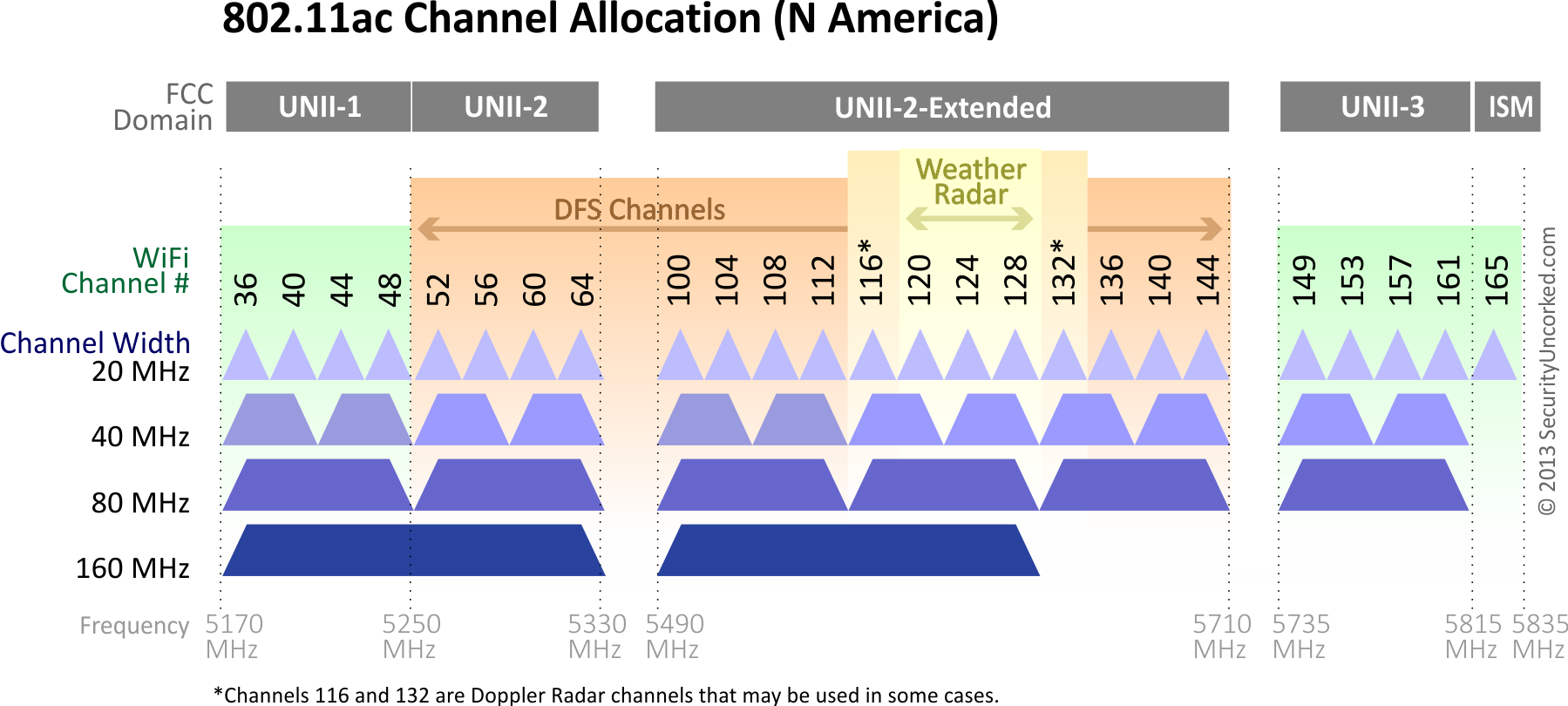
> http://securityuncorked.com/wordpress/wp-content/uploads/2013/11/graphic-80211-acChannels-all.png
>
>
>> When I set the channel to say 157, whether I use HT40+ or HT40-, the
>> primary channel is always set to channel 161. I am inferring this
>> because when I scan using iwlist scan, my SSID shows on Channel 161.
>> Does ath10k not set the primary and secondary channel in this manner?
>
> ath10k doesn't care. hostapd can do a channel swap if it detects OBSS.
> Not sure how much OpenWRT scripts mingle in (I'm guessing you're using
> `uci`, hence the mention).
>
>
>> If not, is there a mechanism by which I can explicitly mention which
>> channel must be primary, and which must be secondary?
>
> You can't. OBSS can still end up swapping your primary and extension channels.
>
>
>> Also, how is the
>> primary channel decided for VHT80 mode?
>
> VHT80 is backward compat for HT40 and HT20 clients. See the channel
> allocation link above.
>
>
> Michał
>
> _______________________________________________
> ath10k mailing list
> [email protected]
> http://lists.infradead.org/mailman/listinfo/ath10k

_______________________________________________
ath10k mailing list
[email protected]
http://lists.infradead.org/mailman/listinfo/ath10k