It's the shell causing your problems, not the UART. First, it should be

"echo -n \\x00 > /dev/ttyO4"
Two backslashes (my error, sorry). Second, "man echo" and take a look at
the syntax, you can't just do "\xNNNNNNNNN". To repeat, you should really
write some software to do this rather than doing it from the shell.


On 27 November 2013 09:42, Andrei <[email protected]> wrote:

> Hi Mike,
>
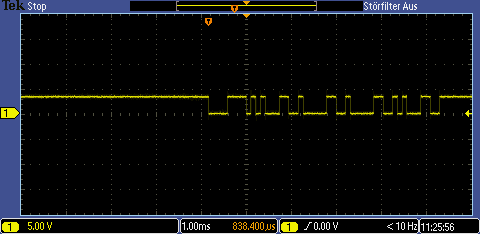
> I want to send the string of binary data, like 10001111 or 11110011 etc.,
>  and I expect to see HIGH and LOW on Oscilloscope.
>
> When I use command set "echo -n \x01 > /dev/ttyO4" i can see on
> oscilloscope
> <https://lh5.googleusercontent.com/-SFyPNhrmt1Q/UpW8pMOL1QI/AAAAAAAAAIc/vXwys02_w9k/s1600/TEK00001.PNG>
> "echo -n \x1001 >
> /dev/ttyO4"<https://lh3.googleusercontent.com/-FM4duvgj-Js/UpW87M2poNI/AAAAAAAAAIk/NiFsI8K2u98/s1600/TEK00002.PNG>
>
> It is still in ascii, is there a way how to get it to work and send
> standard binary string , because my device needs CMOS/TTL logic.
>
>
>
> On Tuesday, 26 November 2013 19:53:44 UTC+1, Mike Bremford wrote:
>
>> I'm really not sure this question at all.  UART4 Tx a single wire which
>> is high by default. Put a multimeter on the uart4tx pin to confirm this. If
>> you send data to it then it goes out in blocks of N bits (N normally being
>> 10 - start bit, 8 data bits, stop bit), then returns to the default state
>> of high until the next transmission. http://en.wikipedia.org/wiki/
>> Asynchronous_start-stop
>>
>> Do you want to send binary data bit-by-bit, as in: write 1 to it, the pin
>> goes high, write 0 and the pin goes low? Then that's not what a UART does -
>> sounds like GPIO to me.
>>
>> Do you want to send the byte 0, as in: start bit, 8 x low bits, stop bit?
>> Then "echo -n \x00 > /dev/ttyO4" should do it. But much easier to do this
>> in C (or any other language) as the ttyO4 is just a file: open it, set it
>> up as a TTY (in C with functions tcsetattr, cfmakeraw etc), then write the
>> zero byte to the stream.
>>
>>
>> On 26 November 2013 14:42, Andrei <[email protected]> wrote:
>>
>>> Hello Rod,
>>>
>>> Thanks  you for the help on this, was really helpful.
>>> But do you know how can I send the binary instead of ascii?  (Do I need
>>> to put maybe prefix of SB before the value to send binary?)
>>>
>>> After many unsuccessful attempts of sending binary over UART,  I'm
>>> looking at possibility to change the UART MODE described in *TI AM335x
>>> ARM A8 Microprocessors technical reference manual  ,  *maybe this will
>>> allow me to send the binary then.
>>>
>>>
>>> For my project, the transceiver that I wan to connect to UART needs
>>> CMOS/TTL logic.
>>>
>>>
>>> On Monday, 25 November 2013 21:05:16 UTC+1, rod calabio wrote:
>>>>
>>>> Andrei
>>>>
>>>>    ascii for "1"  is 00110001
>>>>    ascii for Line feed is 00001010
>>>>
>>>>   so you will get
>>>>    st=0
>>>>    d0 = 1
>>>>    d1 = 0
>>>>    d2 = 0
>>>>    d3 = 0
>>>>    d4 = 1
>>>>    d5 =1
>>>>    d6 = 0
>>>>    d7 =0
>>>>    sp = 1
>>>>    st = 0
>>>>    d0 = 0
>>>>    d1 = 1
>>>>    d2 = 0
>>>>    d3 = 1
>>>>    d4 - d7  =0
>>>>     sp = 1
>>>>     idle = 1
>>>>
>>>>   --
>>> For more options, visit http://beagleboard.org/discuss
>>> ---
>>> You received this message because you are subscribed to the Google
>>> Groups "BeagleBoard" group.
>>> To unsubscribe from this group and stop receiving emails from it, send
>>> an email to [email protected].
>>>
>>> For more options, visit https://groups.google.com/groups/opt_out.
>>>
>>
>>  --
> For more options, visit http://beagleboard.org/discuss
> ---
> You received this message because you are subscribed to the Google Groups
> "BeagleBoard" group.
> To unsubscribe from this group and stop receiving emails from it, send an
> email to [email protected].
> For more options, visit https://groups.google.com/groups/opt_out.
>

--
For more options, visit http://beagleboard.org/discuss
---
You received this message because you are subscribed to the Google Groups
"BeagleBoard" group.
To unsubscribe from this group and stop receiving emails from it, send an email
to [email protected].
For more options, visit https://groups.google.com/groups/opt_out.