Thanks again,

Yes, I know I need to write a software, I initially wanted to check the
method of sending the data over the UART on shell and then write the
software to do the same thing.
I suppose it's not the best way to include the:  system ("echo ..... >
/dev/ttyO4"),  call in the software, as it's the shell that causes the
problems for me.

Can you maybe suggest the best way how I should address the UART in my
software, I haven't seen any examples for the UART programming using c/c++
 on beaglebone online.

Thanks


On 28 November 2013 18:35, Mike Bremford <[email protected]> wrote:

> It's the shell causing your problems, not the UART. First, it should be
>
> "echo -n \\x00 > /dev/ttyO4"
>
> Two backslashes (my error, sorry). Second, "man echo" and take a look at
> the syntax, you can't just do "\xNNNNNNNNN". To repeat, you should really
> write some software to do this rather than doing it from the shell.
>
>
> On 27 November 2013 09:42, Andrei <[email protected]> wrote:
>
>> Hi Mike,
>>
>> I want to send the string of binary data, like 10001111 or 11110011 etc.,
>>  and I expect to see HIGH and LOW on Oscilloscope.
>>
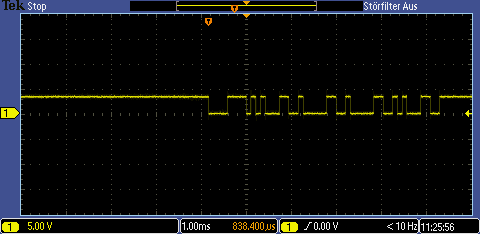
>> When I use command set "echo -n \x01 > /dev/ttyO4" i can see on
>> oscilloscope
>> <https://lh5.googleusercontent.com/-SFyPNhrmt1Q/UpW8pMOL1QI/AAAAAAAAAIc/vXwys02_w9k/s1600/TEK00001.PNG>
>> "echo -n \x1001 >
>> /dev/ttyO4"<https://lh3.googleusercontent.com/-FM4duvgj-Js/UpW87M2poNI/AAAAAAAAAIk/NiFsI8K2u98/s1600/TEK00002.PNG>
>>
>> It is still in ascii, is there a way how to get it to work and send
>> standard binary string , because my device needs CMOS/TTL logic.
>>
>>
>>
>> On Tuesday, 26 November 2013 19:53:44 UTC+1, Mike Bremford wrote:
>>
>>> I'm really not sure this question at all.  UART4 Tx a single wire which
>>> is high by default. Put a multimeter on the uart4tx pin to confirm this. If
>>> you send data to it then it goes out in blocks of N bits (N normally being
>>> 10 - start bit, 8 data bits, stop bit), then returns to the default state
>>> of high until the next transmission. http://en.wikipedia.org/wiki/
>>> Asynchronous_start-stop
>>>
>>> Do you want to send binary data bit-by-bit, as in: write 1 to it, the
>>> pin goes high, write 0 and the pin goes low? Then that's not what a UART
>>> does - sounds like GPIO to me.
>>>
>>> Do you want to send the byte 0, as in: start bit, 8 x low bits, stop
>>> bit? Then "echo -n \x00 > /dev/ttyO4" should do it. But much easier to do
>>> this in C (or any other language) as the ttyO4 is just a file: open it, set
>>> it up as a TTY (in C with functions tcsetattr, cfmakeraw etc), then write
>>> the zero byte to the stream.
>>>
>>>
>>> On 26 November 2013 14:42, Andrei <[email protected]> wrote:
>>>
>>>> Hello Rod,
>>>>
>>>> Thanks  you for the help on this, was really helpful.
>>>> But do you know how can I send the binary instead of ascii?  (Do I need
>>>> to put maybe prefix of SB before the value to send binary?)
>>>>
>>>> After many unsuccessful attempts of sending binary over UART,  I'm
>>>> looking at possibility to change the UART MODE described in *TI AM335x
>>>> ARM A8 Microprocessors technical reference manual  ,  *maybe this will
>>>> allow me to send the binary then.
>>>>
>>>>
>>>> For my project, the transceiver that I wan to connect to UART needs
>>>> CMOS/TTL logic.
>>>>
>>>>
>>>> On Monday, 25 November 2013 21:05:16 UTC+1, rod calabio wrote:
>>>>>
>>>>> Andrei
>>>>>
>>>>>    ascii for "1"  is 00110001
>>>>>    ascii for Line feed is 00001010
>>>>>
>>>>>   so you will get
>>>>>    st=0
>>>>>    d0 = 1
>>>>>    d1 = 0
>>>>>    d2 = 0
>>>>>    d3 = 0
>>>>>    d4 = 1
>>>>>    d5 =1
>>>>>    d6 = 0
>>>>>    d7 =0
>>>>>    sp = 1
>>>>>    st = 0
>>>>>    d0 = 0
>>>>>    d1 = 1
>>>>>    d2 = 0
>>>>>    d3 = 1
>>>>>    d4 - d7  =0
>>>>>     sp = 1
>>>>>     idle = 1
>>>>>
>>>>>   --
>>>> For more options, visit http://beagleboard.org/discuss
>>>> ---
>>>> You received this message because you are subscribed to the Google
>>>> Groups "BeagleBoard" group.
>>>> To unsubscribe from this group and stop receiving emails from it, send
>>>> an email to [email protected].
>>>>
>>>> For more options, visit https://groups.google.com/groups/opt_out.
>>>>
>>>
>>>  --
>> For more options, visit http://beagleboard.org/discuss
>> ---
>> You received this message because you are subscribed to the Google Groups
>> "BeagleBoard" group.
>> To unsubscribe from this group and stop receiving emails from it, send an
>> email to [email protected].
>>
>> For more options, visit https://groups.google.com/groups/opt_out.
>>
>
>  --
> For more options, visit http://beagleboard.org/discuss
> ---
> You received this message because you are subscribed to a topic in the
> Google Groups "BeagleBoard" group.
> To unsubscribe from this topic, visit
> https://groups.google.com/d/topic/beagleboard/ytnqeNF6gik/unsubscribe.
> To unsubscribe from this group and all its topics, send an email to
> [email protected].
> For more options, visit https://groups.google.com/groups/opt_out.
>

--
For more options, visit http://beagleboard.org/discuss
---
You received this message because you are subscribed to the Google Groups
"BeagleBoard" group.
To unsubscribe from this group and stop receiving emails from it, send an email
to [email protected].
For more options, visit https://groups.google.com/groups/opt_out.