Jean Iron phoned me this morning from Moosonee before flying out to
the James Bay coast. A crew headed by Mark Peck of the Royal Ontario
Museum (ROM) will be surveying migrating shorebirds with a particular
focus on Red Knots. Jean is a volunteer with the ROM. The crew
comprises Mark Peck, Amy Whitear, Gerry Binsfeld, Doug McRae, Don
Shanahan and Jean Iron. This morning (16 July) they flew by
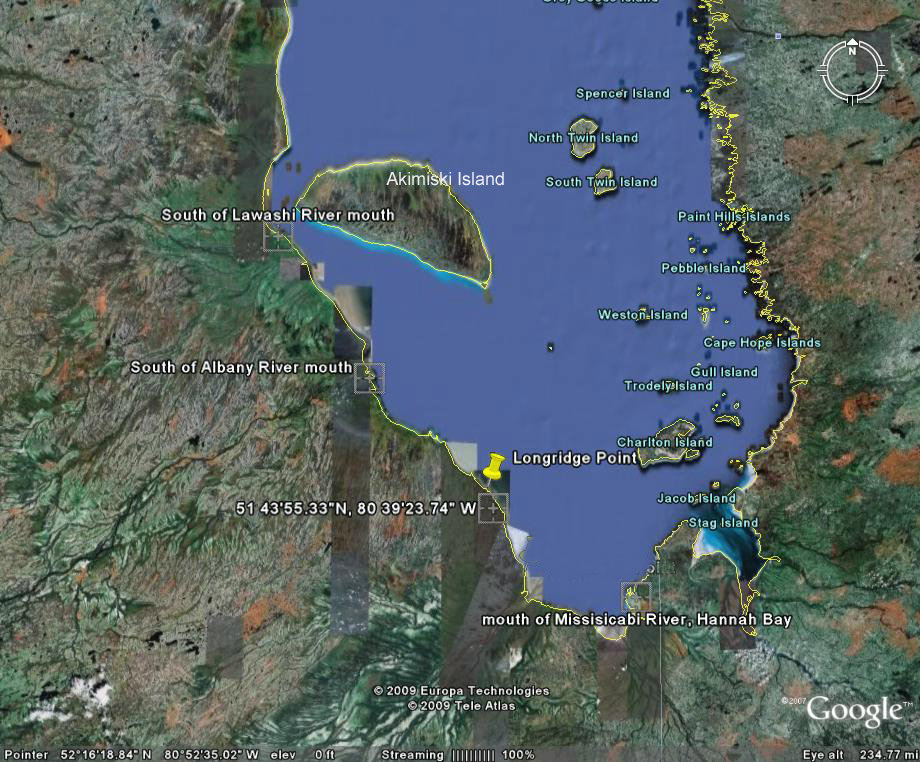
helicopter to Longridge Point about 60 km north of Moosonee on the
southwestern coast of James Bay. They are camping and surveying there
until 3 August. See map link below.
RECENT OBSERVATIONS
Waterfowl: A poor nesting season for Canada Geese (subspecies
interior); small flocks of molting male Mallards and male Northern
Pintails along coast south of Attawapiskat; small flocks of molting
male Black Scoters at several locations long coast.
American White Pelican: 16 at Longridge Point in early July by Don
Sutherland et al. 150 on coast south of Attawapiskat on 15 July by
Stacy Gan et al. This species has recently expanded its range to
James Bay and first found breeding there in 2006. Numbers are increasing.
Great Egret: 1 in coastal marsh just south of North Bluff Point by
Don Sutherland et al. Well north of normal range.
Bald Eagle: 7 south of Attawapiskat on 15 July by Stacy Gan et al.
Nonbreeding eagles, mostly Balds, are now summering along the Hudson
and James Bay coasts presumably preying on abundant Snow and Canada Geese.
Golden Eagle: adult south of Attawapiskat on 15 July by Stacy Gan et al.
Yellow Rail: ROM crews (Mark Peck et al.) from 1 - 11 July found 300+
birds including 5 seen in sedge marshes at 5 survey sites along coast
between the Quebec border to Attawapiskat.
Virginia Rail: at least 2 calling in early July in coastal cattail
marsh south of North Bluff Point by Don Sutherland et al. Well north
of normal range.
Sora: heard at North Bluff Point by Don Sutherland et al. This rail
is regular and probably widely distributed in the Hudson Bay Lowlands.
Sandhill Crane: common
Shorebird Migration: only small numbers of southbound adults reported
to date possibly due to a delayed onset of nesting because of below
normal temperatures in May and June and a late snow melt. Numbers of
adults expected to increase soon. Juveniles to follow in August.
Hudsonian Godwit: 60 adults along coast south of Attawapiskat on 15
July fide Stacy Gan et al.
Marbled Godwit: One in early July in vast graminoid peatland 10+ km
inland from Hannah Bay by Don Sutherland et al. 20 adults along coast
south of Attawapiskat on 15 July fide Stacy Gan et al.
Little Gull: Five adults, some performing courtship flight displays,
in coastal fen southeast of Moosonee by Don Sutherland et al. Most
Little Gulls in North America probably breed in the Hudson Bay
Lowlands between Moosonee and Churchill, Manitoba.
Black Tern: scattered sightings along coast at North Point and Fort Albany.
Great Black-backed Gull: mostly immatures in various plumages at
several sites by Don Sutherland et al.
Great Gray Owl: 1 in early July between Moosonee and James Bay by Don
Sutherland et al.
Eastern Kingbird: 1 in early July south of North Bluff Point by Don
Sutherland et al. Well north of normal range.
Swallows: Tree, Cliff, and Barn Swallows all fairly common flying
over Moose River in Moosonee on 14 July.
Wood Thrush: A male singing in riparian willow thickets south of Fort
Albany from 3 - 10 July by ROM crew. Well north of normal range.
Gray Catbird: A male singing in early July in willow thickets on an
island at mouth of the Harricanaw River by Don Sutherland et al. Well
north of normal range.
Northern Mockingbird: one (very rare) in Moosonee seen by ROM group on 15 July.
Clay-colored Sparrow: 5 sightings in willow scrub along coast. This
species is regular in the coastal strip along James and Hudson Bays in Ontario.
Le Conte's Sparrow: fairly common, but less so than Nelson's
Sparrows, and on drier sites than Nelson's along coast.
Nelson's Sparrow (subspecies alterus): common along coast in same
sedge marsh habitats as Yellow Rails.
Winter Finches: Don Sutherland et al. in early July observed
White-winged Crossbills every day, usually in flocks of 15 - 30, but
several larger flocks of more than 100 birds; small flocks of Common
Redpolls at several sites; Pine Siskins were seen most days; and
Purple Finches were widespread and singing; no Pine Grosbeaks observed.
Map link below of southern James Bay. Note yellow marker showing
location of Longridge Point where the ROM group is camped. Ontario
borders the west coast of James Bay and Quebec borders the east
coast. However, the provincial boundaries extend only to the high
water marks on James Bay. Offshore islands are in Nunavut Territory
whereas the waters and seabed of James Bay are under federal jurisdiction.
http://www.jeaniron.ca/2009/James-Bay-2009-REKN.jpg
Acknowledgements: Thanks to Mark Peck of the Royal Ontario Museum
(ROM) and Don Sutherland and Stacy Gan of the Ontario Ministry of
Natural Resources (OMNR). Thanks also to the other ROM and OMNR crew
members (sorry if your names were omitted) who surveyed Yellow Rails
and Species At Risk in early July.
Jean will be calling me by satellite phone from Longridge and I'll
post several updates over the next three weeks.
Ron Pittaway
Minden and Toronto ON

_______________________________________________
ONTBIRDS is presented by the Ontario Field Ornithologists - the provincial
birding organization.
Send bird reports to ONTBIRDS mailing list [email protected]
For information about ONTBIRDS visit http://www.ofo.ca/