On Mon, Jun 27, 2022 at 06:29:55PM +0200, Martin Pieuchot wrote:
> On 27/06/22(Mon) 18:04, Caspar Schutijser wrote:
> > On Sun, Jun 26, 2022 at 10:03:59PM +0200, Martin Pieuchot wrote:
> > > On 26/06/22(Sun) 20:36, Caspar Schutijser wrote:
> > > > A laptop of mine (dmesg below) frequently hangs. After some bisecting
> > > > and extensive testing I think I found the commit that causes this:
> > > > mpi@'s
> > > > "Always acquire the `vmobjlock' before incrementing an object's
> > > > reference."
> > > > commit from 2022-04-28.
> > > >
> > > > My definition of "the system hangs":
> > > >  * Display is frozen
> > > >  * Switching to ttyC0 using Ctrl+Alt+F1 doesn't do anything
> > > >  * System does not respond to keyboard or mouse input
> > > >  * Pressing the power button for 1-2 seconds doesn't achieve anything
> > > > (usually this initiates a system shutdown)
> > > >  * And also the fan starts spinning
> > > >
> > > > The system sometimes hangs very soon after booting the system, I've
> > > > seen it happen once while I was typing my username in xenodm to log in.
> > > > But sometimes it takes a couple of hours.
> > > >
> > > > For some reason I put
> > > > "@reboot while sleep 1 ; do sync ; done"
> > > > in my crontab and it *seems* (I'm not sure) that the hangs occur more
> > > > frequently this way. Not sure if that is useful information.
> > > >
> > > > I don't see similar problems on my other machines.
> > > >
> > > > It looks like when the system hangs, it's stuck spinning in the new
> > > > code that was added in that commit; to confirm that I added some code
> > > > (see the diff below) to enter ddb if it's spinning there for 10 seconds
> > > > (and then it indeed enters ddb). If my thinking and diff make sense
> > > > I think that indeed confirms that is the problem.
> > > >
> > > > Any tips for debugging this?
> > >
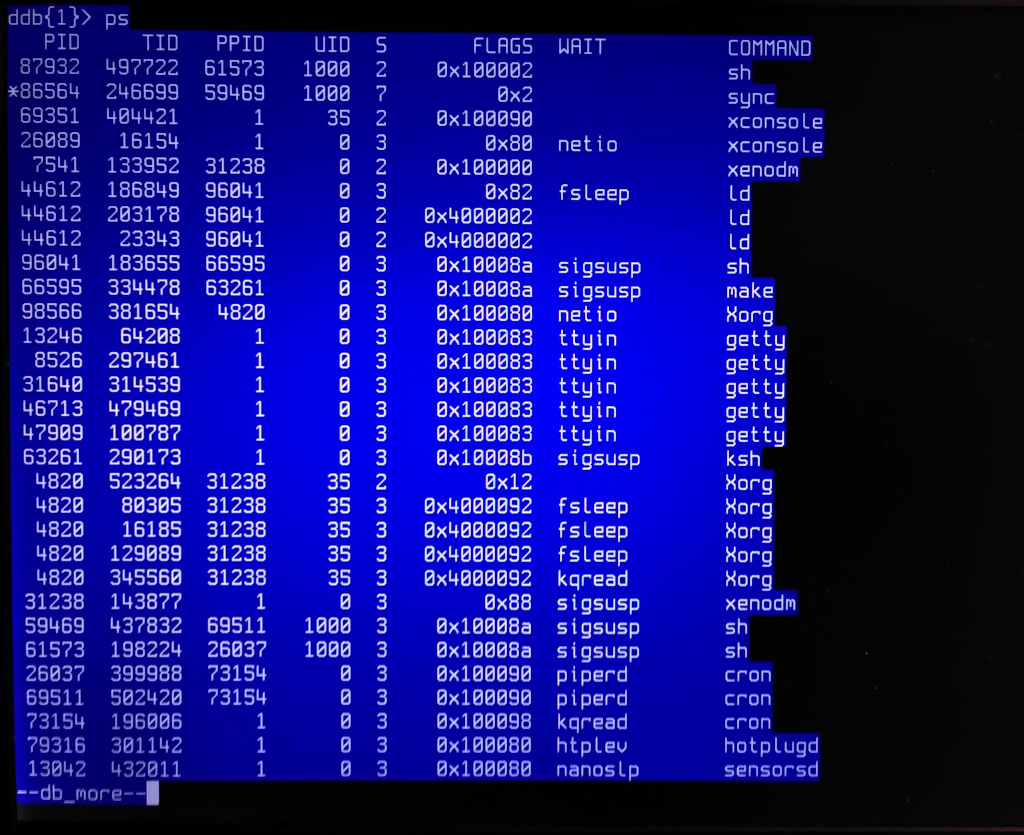
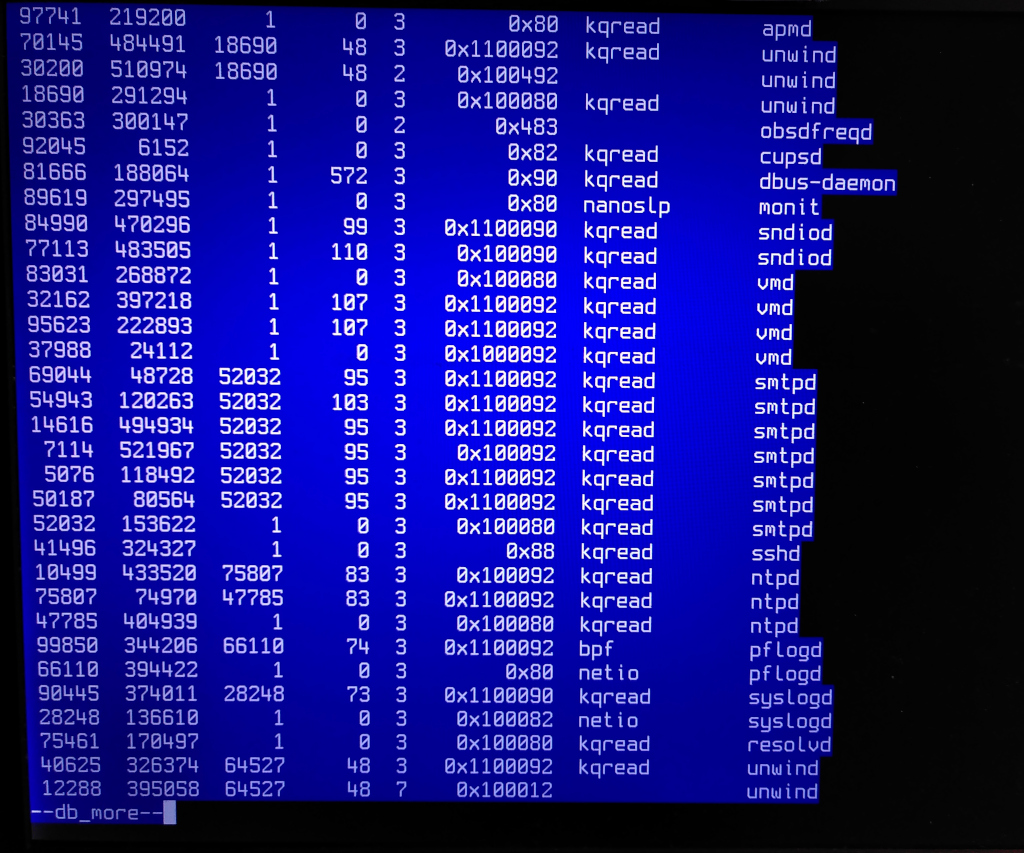
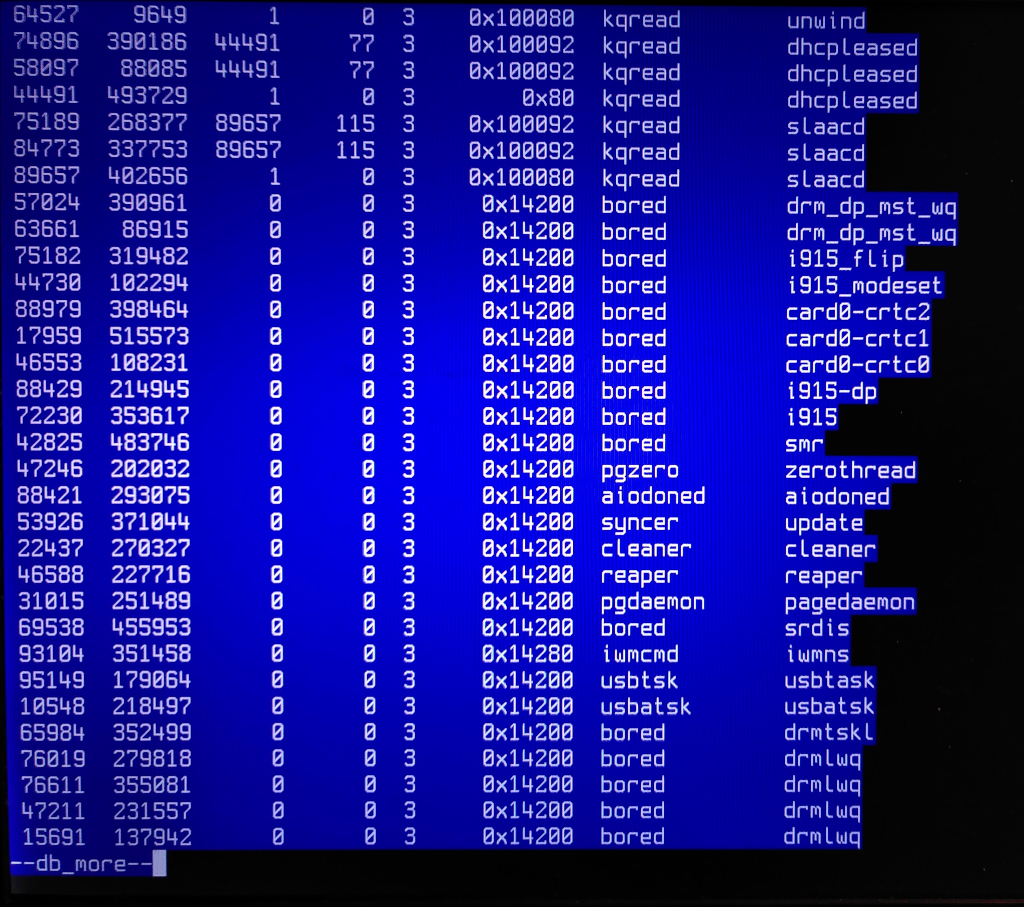
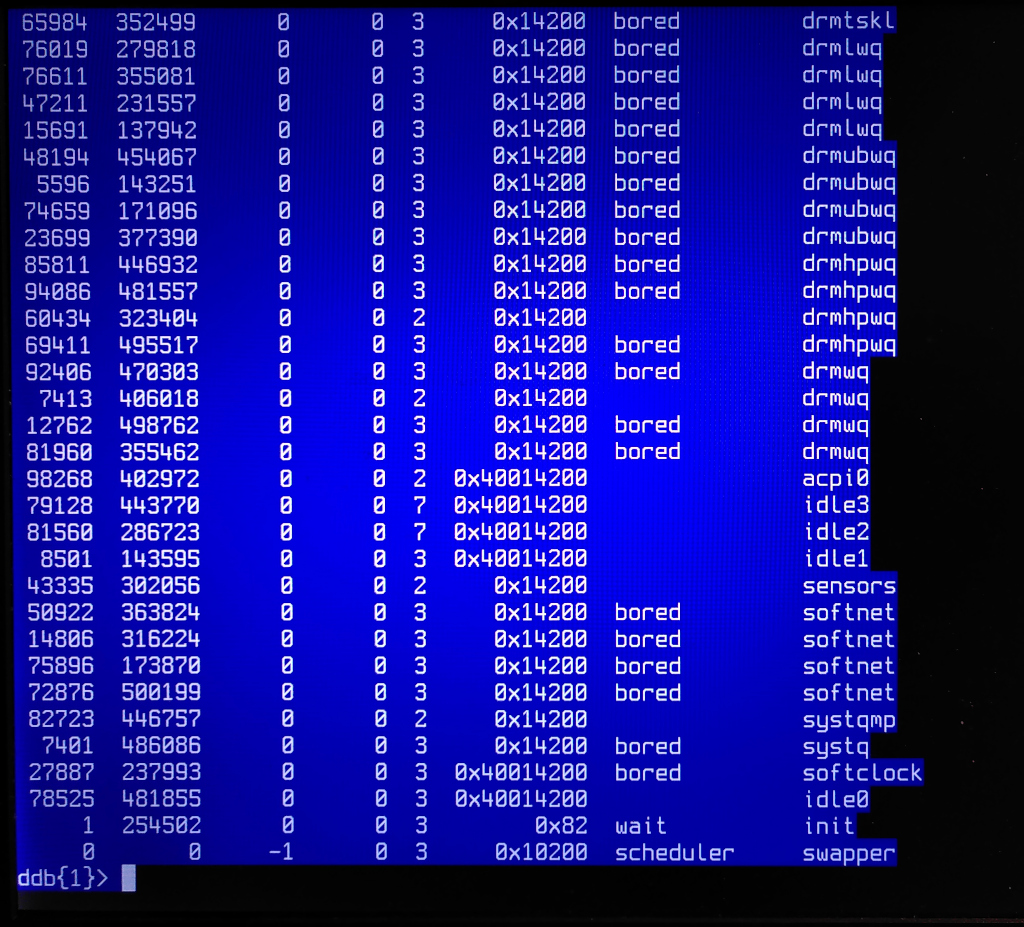
> > > I believe I introduced a deadlock.  If you can reproduce it could you
> > > get us the output of `ps' in ddb(4) and the trace of all the active
> > > processes.
> > >
> > > I guess one is waiting for the KERNEL_LOCK() while holding the uobj's
> > > vmobjlock.
> >
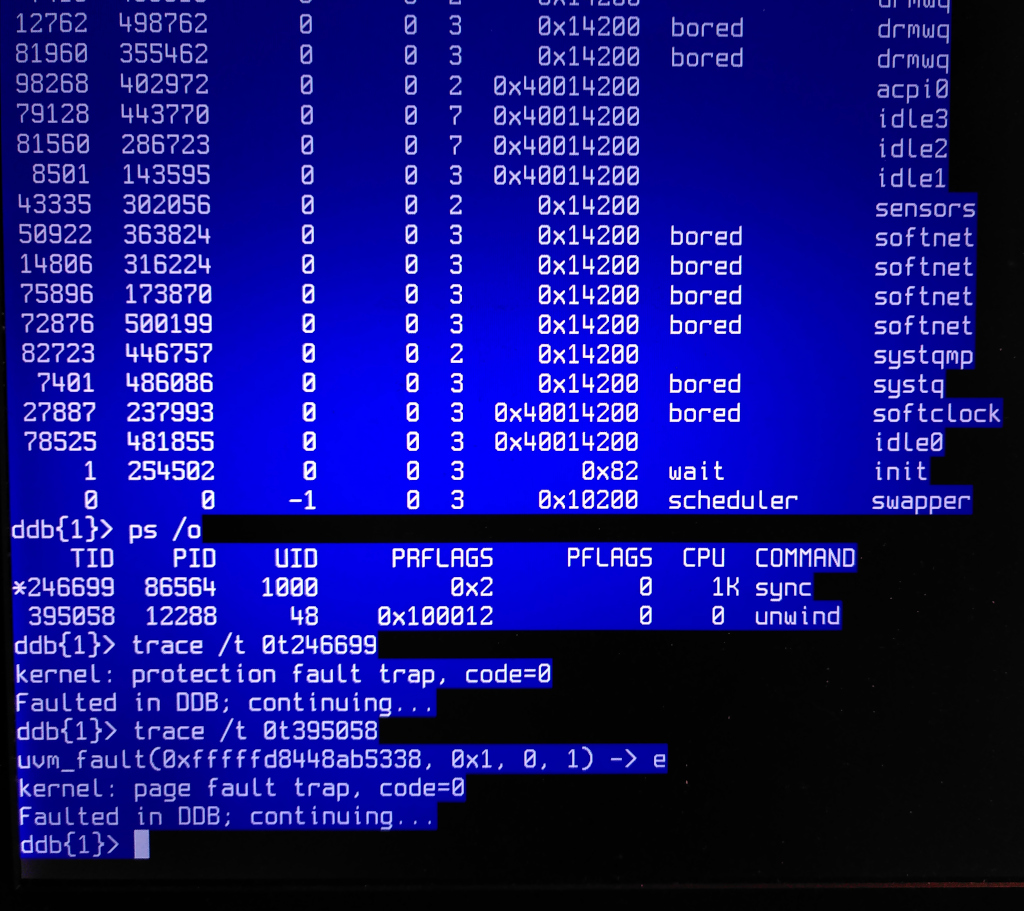
> > "ps" output (pictures only):
> > https://temp.schutijser.com/~caspar/2022-06-27-ddb/ps-1.jpg
> > https://temp.schutijser.com/~caspar/2022-06-27-ddb/ps-2.jpg
> > https://temp.schutijser.com/~caspar/2022-06-27-ddb/ps-3.jpg
> > https://temp.schutijser.com/~caspar/2022-06-27-ddb/ps-4.jpg
> >
> >
> > traces of active processes (I hope; if this is not correct I'm happy
> > to run different commands; pictures and transcription follow):
> > https://temp.schutijser.com/~caspar/2022-06-27-ddb/trace-1.jpg
> >
> > ddb{1}> ps /o
> >     TID    PID    UID    PRFLAGS    PFLAGS  CPU  COMMAND
> > *246699  86564   1000        0x2         0    1K sync
> >  395058  12288     48   0x100012         0    0  unwind
> > ddb{1}> trace /t 0t246699
> > kernel: protection fault trap, code=0
> > Faulted in DDB; continuing...
> > ddb{1}> trace /t 0t395058
> > uvm_fault(0xfffffd8448ab5338, 0x1, 0, 1) -> e
> > kernel: page fault trap, code=0
> > Faulted in DDB; continuing...
> > ddb{1}>
>
> Is it a hang or a panic/fault?  Here's a possible fix.  The idea is to
> make the list private to the sync function such that we could sleep on
> the lock without lock ordering reversal.
>
> That means multiple sync could be started in parallel, this should be
> fine as the objects are refcounted and only the first flush result in
> I/O.
I think there is one drawback: you can't sleep while iterating on
LIST_FOREACH(uvn_wlist): if the list is modified while sleeping, on wakeup
pointers might be changed.

see below.

> Index: uvm/uvm_vnode.c
> ===================================================================
> RCS file: /cvs/src/sys/uvm/uvm_vnode.c,v
> retrieving revision 1.124
> diff -u -p -r1.124 uvm_vnode.c
> --- uvm/uvm_vnode.c   3 May 2022 21:20:35 -0000       1.124
> +++ uvm/uvm_vnode.c   27 Jun 2022 16:21:28 -0000
> @@ -1444,39 +1437,22 @@ uvm_vnp_setsize(struct vnode *vp, off_t
>   * uvm_vnp_sync: flush all dirty VM pages back to their backing vnodes.
>   *
>   * => called from sys_sync with no VM structures locked
> - * => only one process can do a sync at a time (because the uvn
> - *    structure only has one queue for sync'ing).  we ensure this
> - *    by holding the uvn_sync_lock while the sync is in progress.
> - *    other processes attempting a sync will sleep on this lock
> - *    until we are done.
>   */
>  void
>  uvm_vnp_sync(struct mount *mp)
>  {
> +     SIMPLEQ_HEAD(, uvm_vnode) sync_q;
>       struct uvm_vnode *uvn;
>       struct vnode *vp;
>
> -     /*
> -      * step 1: ensure we are only ones using the uvn_sync_q by locking
> -      * our lock...
> -      */
> -     rw_enter_write(&uvn_sync_lock);
> +     SIMPLEQ_INIT(&sync_q);
>
> -     /*
> -      * step 2: build up a simpleq of uvns of interest based on the
> -      * write list.   we gain a reference to uvns of interest.
> -      */
> -     SIMPLEQ_INIT(&uvn_sync_q);
> +     KERNEL_ASSERT_LOCKED();
>       LIST_FOREACH(uvn, &uvn_wlist, u_wlist) {
>               vp = uvn->u_vnode;
>               if (mp && vp->v_mount != mp)
>                       continue;
>
> -             /* Spin to ensure `uvn_wlist' isn't modified concurrently. */
> -             while (rw_enter(uvn->u_obj.vmobjlock, RW_WRITE|RW_NOSLEEP)) {
> -                     CPU_BUSY_CYCLE();
> -             }
> -
>               /*
>                * If the vnode is "blocked" it means it must be dying, which
>                * in turn means its in the process of being flushed out so
> @@ -1485,6 +1461,7 @@ uvm_vnp_sync(struct mount *mp)
>                * note that uvn must already be valid because we found it on
>                * the wlist (this also means it can't be ALOCK'd).
>                */
> +             rw_enter(uvn->u_obj.vmobjlock, RW_WRITE);

using rw_enter(9) without RW_NOSLEEP might introduce a sleeping-point (if the
lock is already taken).

the previous construct was using a busy cycle to avoid the sleep (but I think
it
is also one reason of the deadlock: no progess was possible for others).

a possible construct could be:

        for (;;) {
                LIST_FOREACH(uvn, &uvn_wlist, u_wlist) {
                        vp = uvn->u_vnode;
                        if (mp && vp->v_mount != mp)
                                continue;

                        if (rw_enter(uvn->u_obj.vmobjlock, RW_WRITE|RW_NOSLEEP)
!= 0)
                                /* ignore locked uvn for now */
                                continue;

                        /* ... */
                }

                /* no more uvn in uvn_wlist */
                if (LIST_EMPTY(&uvn_wlist))
                        break;

                /* there are still uvn, let's others make progress */
                sched_yield();
        }


the loop will process all unlocked uvn, sleep only at end of the loop, and
restart the uvn_wlist processing.

>               if ((uvn->u_flags & UVM_VNODE_BLOCKED) != 0) {
>                       rw_exit(uvn->u_obj.vmobjlock);
>                       continue;
> @@ -1499,11 +1476,10 @@ uvm_vnp_sync(struct mount *mp)
>               uvn->u_obj.uo_refs++;
>               rw_exit(uvn->u_obj.vmobjlock);
>
> -             SIMPLEQ_INSERT_HEAD(&uvn_sync_q, uvn, u_syncq);
> +             SIMPLEQ_INSERT_HEAD(&sync_q, uvn, u_syncq);
>       }
>
> -     /* step 3: we now have a list of uvn's that may need cleaning. */
> -     SIMPLEQ_FOREACH(uvn, &uvn_sync_q, u_syncq) {
> +     SIMPLEQ_FOREACH(uvn, &sync_q, u_syncq) {
>               rw_enter(uvn->u_obj.vmobjlock, RW_WRITE);
>  #ifdef DEBUG
>               if (uvn->u_flags & UVM_VNODE_DYING) {
> @@ -1528,6 +1504,4 @@ uvm_vnp_sync(struct mount *mp)
>               /* now drop our reference to the uvn */
>               uvn_detach(&uvn->u_obj);
>       }
> -
> -     rw_exit_write(&uvn_sync_lock);
>  }
>

--
Sebastien Marie