Paris Peace Agreement: The Peace and Freedom in Context (Part
IV)Posted by: *Sophoan
Seng <http://www.sophanseng.info/author/cambodian/>* | Posted on: *October
21, 2014*
As three parts were sent out, I was called in for interview by CMN radio
<http://cmnkhmer.org/> and an honorable invitation to participate with
Paris Peace Agreement Commemoration organized by CICP
<http://www.cicp.org.kh/more/Activities/3/19/45> in Phnom Penh.

Regarding the interview that shall be broadcasted tomorrow or after
tomorrow,  I was asked to elaborate on the history of the Agreement, the
validation and invalidity of the Agreement, mechanism to enforce parties to
respect the Agreement in case of having violation, and the CNRP who joined
the Assembly at the present.

The clip conversation <https://www.youtube.com/watch?v=7dCMgMWuE9M> between
Sovanna and Phal allows us to figure out: the failed disarming policy, the
bad effect of free market, and the pains that all Cambodian people can
forgive but they cannot forget. This daily life politics illustration is
invaluable!

*Brief History*
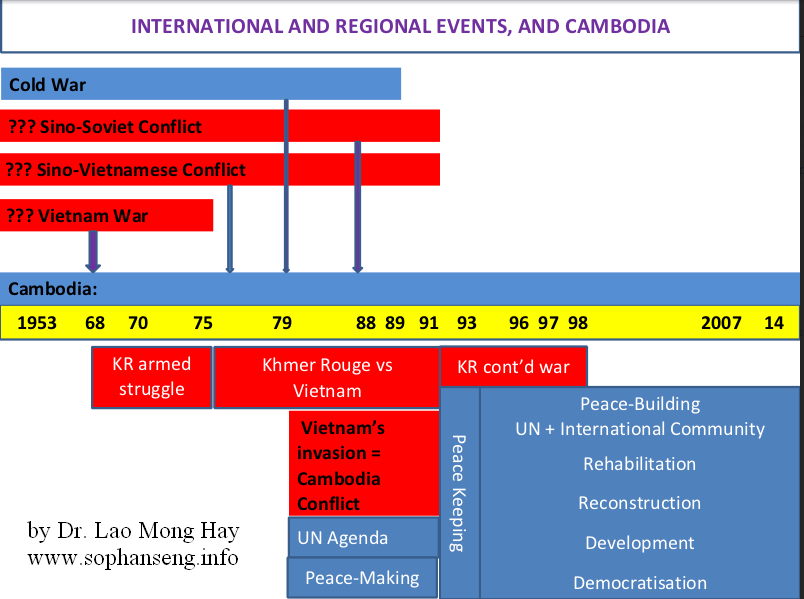
[image: Brief History of Paris Peace Agreement. Slide courtesy of Dr. Lao
Mong hay]
<http://www.sophanseng.info/wp-content/uploads/2014/10/Dr.-Lao-Mong-Hay-PPA-in-Brief.bmp>

Brief History of Paris Peace Agreement. Slide Courtesy of Dr. Lao Mong Hay

Briefing to what said during the interview, the Paris Peace Agreement was
crafted by two factors: four fighting fractions of Cambodia were exhausted
in killing each other, and powerful countries pressured on all parties
including Asean and Vietnam to sign the Agreement. Indonesia and France
were co-chair of the Agreement.


*Agreement Analysis*

The original agreement are filed in both Indonesia and France. There are 32
articles divided by 9 distinctive parts. Many pro-Government commentators
said that the Agreement is invalid since the creation of a legal government
after the election with the complete amendment of the Cambodia
constitution. Of course, their claim is right referring to the Part 1,
Article 1 which say:

For the purposes of this Agreement, the transitional
period shall commence with the entry into force of this
Agreement and terminate when the constituent assembly elected
through free and fair elections, organized and certified by the
United Nations, has approved the constitution and transformed
itself into a legislative assembly, and thereafter a new
government has been created.


Hence, the commentators might be missing to comprehend the term
“Transitional Period” in which 5 measures were taken into action: 1. This
transitional period, 2. United Nations Transitional Authority of Cambodia
(UNTAC), 3. Supreme National Council (SNC), 4. Withdrawal of foreign
military from Cambodia, and 5. Complete ceasefire.

In reality, the Agreement is still valid and it shall have no deadline to
be implemented by the signatory parties as stated clearly in Article 18 on
the “International Guarantee”.

Cambodia undertakes to maintain, preserve and defend,
and the other Signatories undertake to recognize and respect,
the sovereignty, independence, territorial integrity and
inviolability, neutrality and national unity of Cambodia, as
set forth in a separate Agreement.

A separate Agreement has 8 articles and the most important statement in
Article 5 that I mentioned within previous articles.

Beside this valid continuity, the Part III on “Human Rights” has maintained
the continuing task by sending Special Rapporteur to Cambodia by the United
Nations to report on progressive commitment of the Government on respecting
Human Rights of their own citizens. Latest UNs Special Human Rights
Rapporteur for Cambodia is Prof. Dr. Surya Subedi, and this Rapporteur has
no mandate until the Human Rights situation in Cambodia is being well off.

In Part VIII, Article 24, is ongoing to the fact that the foreign aids are
still flowing into Cambodia including many other development programs aided
in according to the Agreement as stated:

The Signatories urge the international community to
provide economic and financial support for the rehabilitation
and reconstruction of Cambodia, as provided in a separate
declaration.

*Impregnable Violations*

During these 23 years, Vietnam violated the Agreement through their
retaining power to force their former installed government led by Prime
Minister Hun Sen to sign the Supplemental Border Treaty (SBT) ratified by
the King of Cambodia on 30 November 2005. The SBT was in reverse to the
Agreement to discarding all past illegal treaties during the Vietnamese
occupation over Cambodia. The forced treaty was not only be able to grab
the remaining land border, Vietnam can establish more enmity environment
among Khmer political parties, activists and general citizens. Thailand
also claimed the ownership over Preah Vihear Temple in 2008 in revenge to
oppose Cambodia government to successfully listing it with the Unesco.
Cambodia government used the legal provision of the Paris Peace Agreement
through its instrumental organ of the ICC to claim back from Thailand.

For Cambodia government let by Prime Minister Hun Sen, who were also party
of the Agreement, at least, four violations are counted: The grenade attack
on peaceful demonstrators in 1997 led by Sam Rainsy, the bloody coup in
2007 to monopolize power from Funcipec, the acceptance of bilateral
supplemental border treaty with Vietnam is in gross violation to the Paris
Peace Agreement that is a multilateral instrument, and continual human
rights violations such as: emotion violence (impunity, extra judiciary
killing, and biased court system), financial violence (corruption and
forced eviction), physical violence (shooting to dead, battering and
jailing), and sexual violence (allowing the existence of sex workers and
brothels, and neglecting to punish those sex buyers as well as polygamy
men).

*CNRP*

CPP has been so nervous about accepting and recognizing Paris Peace
Agreement once they were the party of it.  Their uncertainty and naive
perspective towards Paris Peace Agreement is a setback to claim their past
communist regime rather than to move forward for in-dept reform. Hence,
CNRP has been vital to accept and recognize this day, and they have
celebrated it annually.  The entering into the Assembly of those 55
law-makers of the CNRP is a good sign to experiment their professionalism,
the work ethics, and democratic commitment. CNRP has laid down the policy
of nonviolence, cooperation, dialogue, and active leadership. The
partnership and engagement within the Assembly shall help Prime Minister
Hun Sen to speed up his in-dept reform in all fields he has frequently
promised with the Cambodian people. Although with the aids of CNRP to push
for reform is not successful, or Hun Sen administration is preparing to
backfire their promise, the Cambodian people will judge them in the next
2018 nationwide election.

--
--
You received this message because you are subscribed to the Google Groups
"Cambodia Discussion (CAMDISC) - www.cambodia.org" group.
This is an unmoderated forum. Please refrain from using foul language.
Thank you for your understanding. Peace among us and in Cambodia.

To post to this group, send email to [email protected]
To unsubscribe from this group, send email to
[email protected]
For more options, visit this group at http://groups.google.com/group/camdisc
Learn more - http://www.cambodia.org
---
You received this message because you are subscribed to the Google Groups
"Cambodia Discussion (CAMDISC) - www.cambodia.org" group.
To unsubscribe from this group and stop receiving emails from it, send an email
to [email protected].
For more options, visit https://groups.google.com/d/optout.